
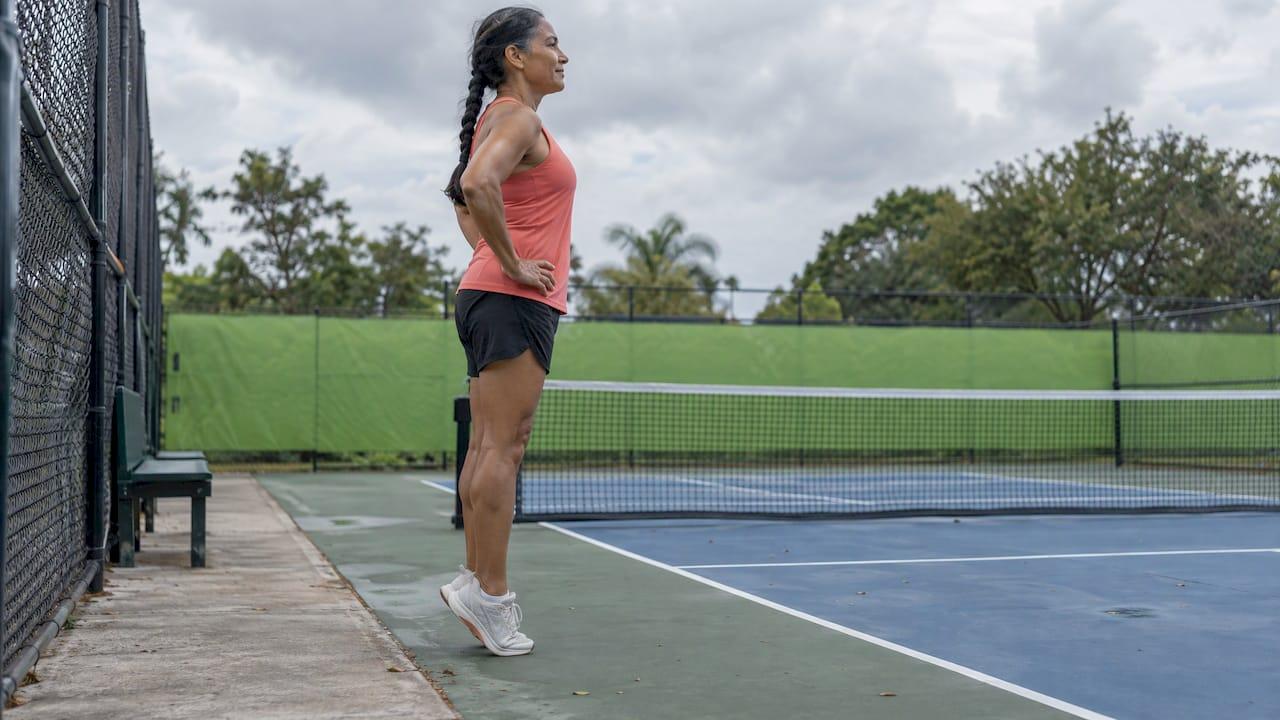
Healthy tendons in pickleball come down to four habits: warm up with dynamic movement, build strength in the tendons that work hardest, increase your playing time gradually, and stop when pain does not settle. The Achilles, the outer elbow and the rotator cuff take most of the strain, so that is where to focus. Below you will find what each tendon is up against, how to tell overuse from a tear, and a simple routine you can fit around your game.
TL;DR
- The tendons most often hurt in pickleball are the Achilles, the outer elbow (tennis elbow), the rotator cuff, the knee (patellar) tendon and the hip flexors.
- Gradual, dull, activity-related pain points to overuse. A sudden pop with immediate weakness points to a rupture and needs urgent care.
- Warm up for five to ten minutes with dynamic moves, add strength and balance work, and raise your game volume slowly.
- Wear court shoes, not running shoes, because pickleball is full of side-to-side movement.
- Pain that is not improving after a few days, or any sudden pop, is a reason to see a doctor.
Table of Contents
- Which tendons take the beating in pickleball
- Overuse or rupture: how to tell the difference
- Warm up the way your tendons need
- Strength work that reduces tendon stress
- Build up playing time and let tendons recover
- Shoes and court surface
- Players over 50 and competitive players
- Our perspective
- When to stop playing and see a doctor
- Check your own movement with Play On Pickle
- FAQ
- Sources
Which tendons take the beating in pickleball
Pickleball looks gentle, but it asks small tendons to do repeated, sharp work: split-step starts, lunges to the kitchen line, hundreds of swings and overhead reaches. A cross-sectional study of pickleball injuries at a tertiary academic center (2019 to 2023) found lateral epicondylitis in 75% of elbow cases, rotator cuff tears in 70% of shoulder cases, Achilles tears in 50% of foot and ankle cases, and iliopsoas tendinitis in 33% of hip and thigh cases.

A 2020 review in ACSM's Clinical Sports Medicine Reports lists the common overuse problems seen at Southern California tournaments: patellar tendinopathy at the knee, rotator cuff tendinopathy, lateral epicondylitis, Achilles tendonitis and plantar fasciitis.
Achilles tendon
The Achilles handles every push-off. Mass General Brigham notes that the ankle, Achilles, elbow and wrist carry the heaviest burden because they are smaller joints and muscles usually used for less demanding tasks. Sudden stops, starts and changes of direction are exactly what pickleball demands. If you are over 50, our guide on preventing Achilles pain from pickleball goes deeper.
Elbow tendons
UT Medicine describes tennis elbow as an overuse injury from repetitive wrist and elbow motion. It shows up as pain on the outer elbow when you grip the paddle or hit the ball, and it typically develops when players stretch out their sessions or play more often without enough conditioning. We cover recovery in our pickleball elbow pain guide and prevention in this low-equipment elbow plan. If the pain is on the inside of the elbow instead, see our golfer's elbow plan.
Shoulder, knee and hip
The same UT Medicine article names shoulder impingement, rotator cuff tendonitis and biceps tendonitis as common shoulder complaints, driven by repeated overhead motions such as serving or smashing. Hip and thigh tendinopathies tend to follow sudden lunges or runs, according to the authors of the academic center study above.
Casual play counts too
It is easy to assume only tournament players get tendon trouble. Dr. Matzkin at Mass General Brigham says risk is higher in competition, but many injuries happen in casual games, and repetitive motions like underhand serves, wrist flicks and side shuffles can overwork muscles and joints even in active players.
Overuse or rupture: how to tell the difference
Tendon problems sit on a spectrum, and knowing where your pain falls changes what you should do next.
Overuse (tendinopathy)
Cleveland Clinic describes tendinopathy as chronic tendon pain with reduced exercise tolerance and reduced tendon function. It can also bring swelling, heat, stiffness, reduced range of motion and a crackling or grating feel. Torrez Orthopedics says tendonitis develops gradually with a persistent dull ache, and typically responds to rest, ice and physical therapy.
For the Achilles specifically, Des Moines University Clinic explains that tendinosis is a gradual degeneration. It can present as a nodule above the back of the heel, with pain during activity, and ultrasound or MRI can help confirm the diagnosis.
Left alone, the problem can progress. Cleveland Clinic notes that chronic tendinitis can lead to scarring, micro-tearing and tendinosis, and that untreated tendinosis can lead to muscle atrophy and tendon rupture.
Rupture
A rupture is a different event. Torrez Orthopedics describes a sudden popping sensation with immediate weakness, and notes that ruptures often require surgical repair. Des Moines University Clinic adds a trap: after an Achilles rupture, pain can fade to a dull ache within a couple of minutes, which tempts players to keep going. A quiet ache does not mean the tendon is fine. The movement behind it, a quick shift of the foot from pointed down to pulled up, is a common one in pickleball.
| Sign | More like overuse | More like a rupture |
|---|---|---|
| Onset | Gradual, over days or weeks | Sudden, one moment |
| Feel | Dull ache, stiffness, worse with activity | Pop, then immediate weakness |
| Function | Reduced tolerance, still usable | Sharp loss of function |
| Next step | Reduce load, see a clinician if it lingers | Stop and get medical care promptly |
Warm up the way your tendons need
Cold tendons asked for explosive work are where many problems start. Yale Medicine recommends a five-to-ten-minute warm-up of dynamic movements such as lunges, arm circles and knee lifts, or an easy jog or 30 seconds of jumping jacks. After play, it suggests light static stretching and a slow walk.
The American Medical Association reports that Dr. Wu favors dynamic stretching, such as walking lunges, high knees or arm circles, over standing and holding a stretch for 30 seconds or a minute before play.
A simple order that covers the tendons above:
- Calves and Achilles: two minutes of easy marching or a light jog, then 10 slow heel raises.
- Hips and knees: 8 walking lunges per side and 10 high knees per side.
- Shoulders: 10 arm circles each direction, then a few easy shadow swings with a gradually larger range.
- Elbows and wrists: gentle wrist circles and a few light dinks before you hit with power.
The 2020 ACSM review notes that no pickleball-specific warm-up has been published, and suggests borrowing rotator cuff activation exercises used in other overhead sports, such as the Thrower's Ten program. If you coach, our two session templates and five to ten minute warm-up are ready to use.
Strength work that reduces tendon stress
Tendons adapt to load, so strength training is the most direct way to make them tougher. A 2025 Springer review by Massillon, Anders and Vitale says prehabilitation for pickleball players may include eccentric strengthening of the rotator cuff and lower extremities, balance and proprioceptive training to prevent falls, and core stabilization to support efficient movement through the body and protect the low back.
The same review lists building blocks for rebuilding after injury: squats, lunges, planks, bridges, rotator cuff work (empty can and external rotations) and scapular exercises (Y-T-W-L). Yale Medicine also recommends cross-training, strength exercises for the shoulder, arm and core, and balance and reflex work.
A practical weekly structure for recreational players:
- Two short strength sessions of 15 to 20 minutes on non-playing days.
- Lower body: slow squats, split squats and heel raises, taking about three seconds to lower.
- Upper body: external rotations with a light band, Y-T-W-L raises and a few sets of wrist and forearm work.
- Core and balance: planks, bridges and single-leg stands.
Pain should stay mild and settle quickly. If an exercise sharply aggravates a tendon, stop and have a clinician look at it. For a short starting routine, try our three-move pickleball prehab routine for recreational and senior players.
Build up playing time and let tendons recover
Most tendon trouble is a load problem, not a bad-luck problem. Yale Medicine advises starting with less and increasing games or playing time as fitness improves, taking breaks when fatigued, and warns that doing too much too soon causes overuse injury because the body has not adapted. The AMA piece adds that strains, shoulder or knee pain and pickleball elbow often result from ramping up intensity too quickly, and that people with heart or lung issues, or who are new to physical activity, should be medically cleared first.
A clinician in Lower Extremity Review Magazine calls the warning signs the "terrible 2s": too much, too aggressive, too often. Treat them as a cue to back off.
Some practical rules:
- Add no more than one extra session or a modest amount of court time in a given week, rather than doubling up after a break.
- Leave at least a day between hard sessions when you are getting back into the sport.
- Cut a session short when your footwork gets sloppy. Fatigue is when tendons take the hit.
- Alternate hard days with lighter ones, such as drilling dinks instead of playing long rallies.
Rest is part of training, not a pause in it. This piece on why rest builds strength makes the same case for another sport, and the logic carries over to the court. If you are coming back from time off, our four-stage return to pickleball lays out how to rebuild.
Shoes and court surface
Footwear changes how much sideways force your Achilles and calf absorb. The 2020 ACSM review says proper court shoes are essential, because running sneakers do not give adequate support for movement that is not straight ahead, and court shoes have tread that may lessen ankle sprain risk.
The Lower Extremity Review clinician recommends a basketball-type low or mid-top shoe with wood-surface traction for indoor play, and good tennis or basketball hard-surface shoes outdoors. Running shoes lack side-to-side stability. The Springer review also points to footwear with sole traction and lateral support as a key part of prevention.
Also replace shoes once the tread is smooth or the sides feel collapsed. A worn shoe can cost you grip right at the moment you plant and push.
Players over 50 and competitive players
Age changes tendons. A 2024 review in the aging athlete states that age-related changes in collagen composition reduce tissue compliance and raise injury susceptibility, and that a high number of reported pickleball injuries occur in patients aged 60 and older, while the average injury age in other racquet sports is under 50. The authors recommend that older athletes include muscle strengthening and assessments of balance, coordination and reaction time in multiphase training. Resistance training can increase strength, bone mass and bone mineral density in active aging individuals.
For older players, that means:
- A longer warm-up than you think you need.
- Strength work twice a week, treated as seriously as playing.
- More recovery days between long sessions.
- Extra attention to balance, since falls are a major injury route.
Competitive players face a different problem: volume. More tournaments and more drilling means more repeated load on the same elbow, shoulder and Achilles. The answer is still the same: planned strength work, deliberate rest weeks and honest monitoring of any pain that lingers.
Our perspective
Tendon injuries rarely arrive out of nowhere. They build up from small things: a stiff ankle on one side, a swing that leans on the forearm instead of the body, a calf that tires early. Most players cannot see these patterns while they play, and a generic exercise list cannot see them either.
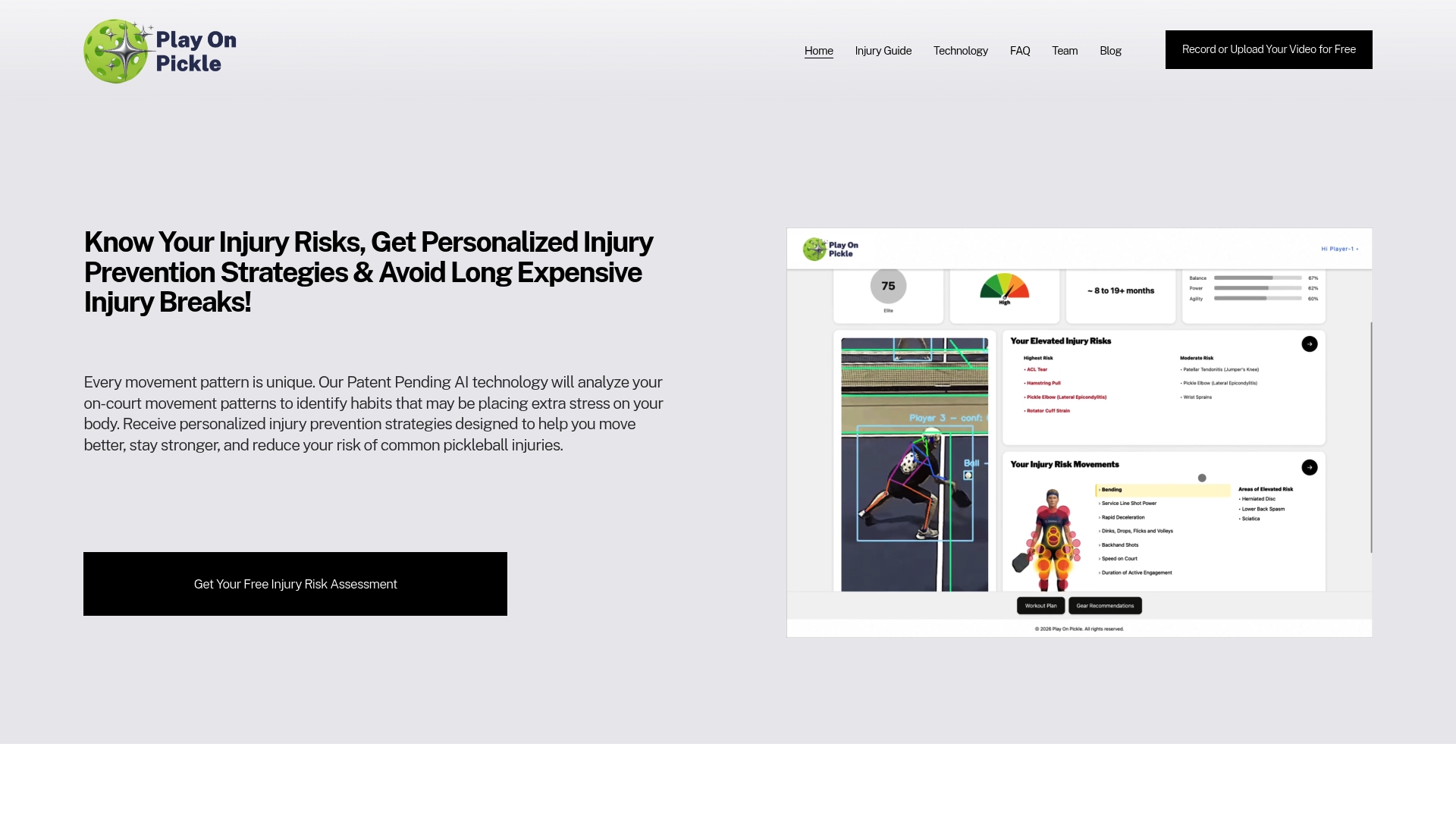
That is why we built Play On Pickle around movement analysis. You upload video of your play, our patent-pending computer vision identifies stress points in your body, and we turn that into a personalized injury risk assessment with simple exercises and equipment suggestions that fit your routine. Our approach is designed to be scientifically validated and practical: minimal equipment, minimal time, and recommendations tied to how you actually move.
For recreational players who rarely think about conditioning, that specificity matters. Knowing whether your Achilles, elbow or shoulder is the weak link lets you spend your 15 minutes of strength work where it counts, and lets you keep playing.
Drona
When to stop playing and see a doctor
Stop immediately and get medical care for a sudden pop, immediate weakness, or inability to push off or put weight on a leg. The Springer review notes that Achilles tendon rupture is often highly indicated for surgical intervention, so a delay does not help. Sports Health adds that acute ruptures are typically recognized and treated within two weeks, and that an untreated one can become chronic after four to six weeks.
For gradual pain, the guidance is consistent. Mass General Brigham says to seek care if an injury does not improve after a few days, and if you are leaning on gels or pain medication for more than a few days, make an appointment. UT Medicine says to consult a provider if symptoms worsen or do not improve within a few days, and notes that returning to the court without adequate rest raises the risk of tennis elbow or Achilles tendinitis. The AMA piece says a nagging injury that is not getting better with conservative management is a good sign to get evaluated, and an ankle injury with a lot of pain, swelling and inability to bear weight needs a doctor as soon as possible.
For short-term relief in the meantime, the Springer review describes the standard RICE approach (rest, ice, compression, elevation), followed by MEAT (movement, exercise, analgesics, treatment) for longer-term recovery. Persistent pain and reduced exercise tolerance are also covered in this active recovery plan, which shows how to structure lighter weeks around an injury.

Check your own movement with Play On Pickle
If you want to know which of your tendons is under the most stress, we can show you. Upload a video of your play and Play On Pickle analyzes your movement, flags the stress points and gives you a personalized plan of exercises and equipment suggestions. There is a free initial trial to start, and the plans are $9.99 per month or $99 per year. You can read how the patent-pending technology works, and our free tripod offer comes with the $9.99 monthly plan, which makes filming your games easier.
For more on staying on the court, read our injury prevention guide for recreational and older players.
FAQ
What is the most common tendon injury in pickleball?
It depends on the body part, but the Achilles and the outer elbow come up most. In the academic center study, lateral epicondylitis made up 75% of elbow cases and Achilles tears 50% of foot and ankle cases. Rotator cuff and knee tendon problems are also common.
Can I keep playing with mild tendon pain?
Mild, stable discomfort that settles quickly is different from pain that builds. Reduce your volume, keep warm-ups and strength work going, and watch the trend. If pain has not improved after a few days, or you are relying on pain relief to play, book a visit with your doctor.
How long should I warm up for pickleball?
Five to ten minutes of dynamic movement is the recommendation from Yale Medicine. Use lunges, knee lifts, arm circles or an easy jog, and save longer static stretches for after play.
Are running shoes okay for pickleball?
No. Running shoes are built for straight-ahead motion, and pickleball demands lateral stops and pushes. Court shoes with lateral support and appropriate traction are the better choice for protecting your ankles and Achilles.
Do older players need to do anything different?
Yes. Tendon tissue becomes less compliant with age, so older players benefit from regular strength work and balance training, a thorough warm-up and more recovery between sessions. If you have a heart or lung condition, or you are new to exercise, get medical clearance first.
Sources
- Pickleball-related injuries treated at a tertiary academic center
- Pickleball: Review and Clinical Recommendations (ACSM's Clinical Sports Medicine Reports)
- Pickleball Injuries, Mass General Brigham
- Common Pickleball Injuries and How to Prevent Them, UT Medicine
- Tendinopathy: What It Is, Symptoms, Causes & Treatment, Cleveland Clinic
- Tendon Rupture vs. Tendonitis, Torrez Orthopedics
- Pickleball: Could America's Fast-Growing Sport Be an Achilles Heel?, Des Moines University Clinic
- How to Prevent Pickleball Injuries, Yale Medicine
- What doctors want patients to know about preventing pickleball injuries, AMA
- Diagnosis and Management of Common Musculoskeletal Injuries (Springer, 2025)
- The Challenges with Pickleball: A Clinician's Perspective, Lower Extremity Review
- Pickleball Injuries in the Aging Athlete: A Critical Review
- Difference Between Tendonitis, Tendinosis and Tendinopathy, Sports Health