
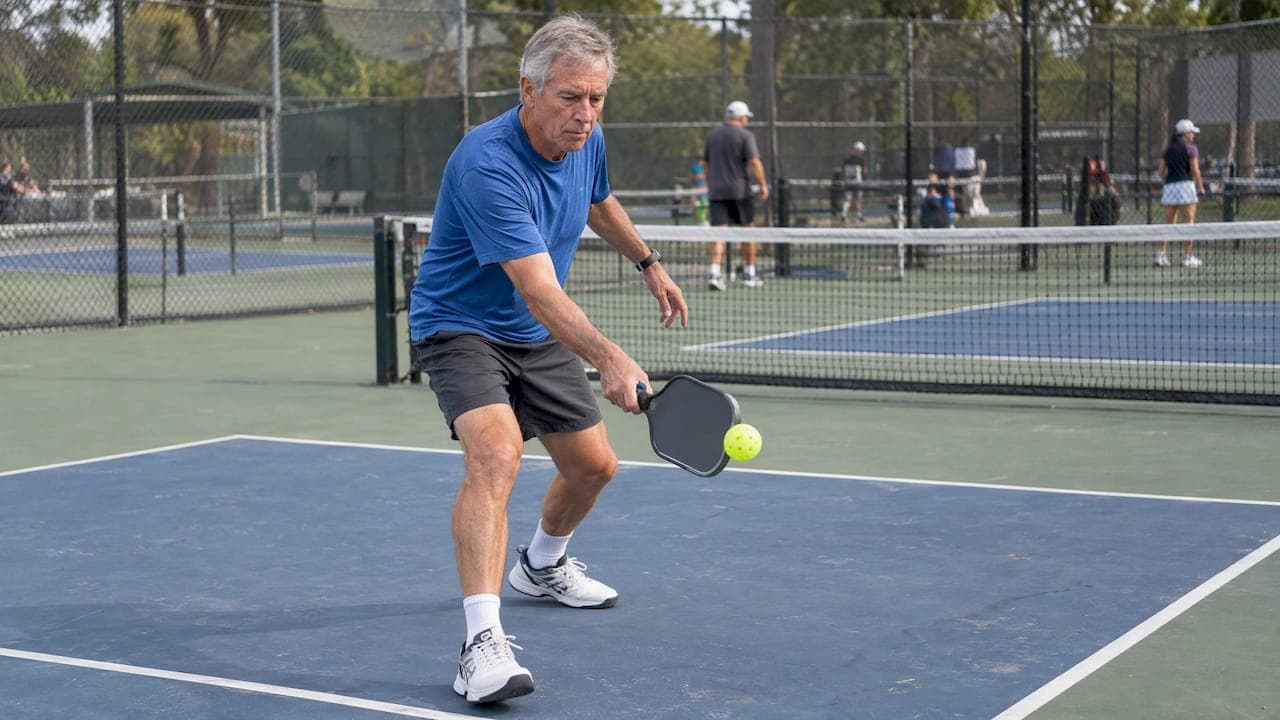
The backhand slice is a low, backspinning backhand that keeps the ball down, which makes it your go-to for low returns, resets, pace changes, and slice volleys. Pick it whenever you are stretched, jammed, or need to slow the rally. Set up low, take a compact swing, and tilt the paddle face slightly open so the ball skids instead of sitting up.
TL;DR:
- Use a relaxed handshake grip, keep the wrist neutral, and contact the ball low and in front while the legs and hips supply power.
- When a low, fast ball skids toward you, step in and meet it early; when it floats, settle and contact it in front.
- Progress from shadow swings to low feeds, then pressured returns and resets; advance only after at least 7 of 10 contacts meet the technique cues.
- Increase practice volume gradually, stop when your form slips, and allow recovery; rest and seek assessment for sharp or lingering wrist, elbow, or shoulder pain.
Table of Contents
- How do you set up the grip, paddle face, and contact point?
- What is the step-by-step sequence for returns and resets?
- How should your footwork and positioning support the slice?
- Which drills build a reliable backhand slice?
- What mistakes ruin the slice, and how do you fix them fast?
- What does research say about technique and injury risk?
- How should you practice the slice over time without overdoing it?
- How does technique protect your wrist, elbow, and shoulder?
- What injury risks does the backhand slice carry, and which exercises help?
- How can AI and computer vision improve your slice?
- Why I keep the slice in my game for the long haul
- Want movement feedback to go with your slice drills?
- FAQ
- Sources
How do you set up the grip, paddle face, and contact point?
Before you worry about footwork or drills, get the foundation right. The slice is a small, controlled motion, and most failures come from setup rather than from the swing itself. If your grip, face angle, and contact point are repeatable, the shot holds up under pressure. If any of them drift, you will feel it as popped-up balls and a tired forearm.
Start with the grip. A relaxed shake-hands (often called hammer) grip works well because it keeps your forearm and paddle in one line, which makes a clean, short path to the ball easier. A loose hold also lets the paddle do the work, which matters later when we talk about wrist stress.
Here is what to set up before every slice:
- Grip: shake-hands or hammer, held firmly enough to control the paddle face but never squeezed.
- Paddle face: slightly open, tilted a touch toward the sky, so the face brushes under the back of the ball and creates backspin.
- Contact point: low and slightly in front of your body, where you can see the ball meet the paddle.
- Wrist: neutral and quiet, with no flicking or snapping at contact.
- Power source: your legs and hip rotation, not your wrist.
Think of the contact as a catch-and-lift rather than a hit. The paddle meets the ball with a short downward-to-forward path, then guides it out low and over the net. You are shaping the ball, not slugging it.
Contact in front matters because it gives you time and keeps your arm from reaching back, where the shoulder works hardest and the face angle gets sloppy. Contact low matters because the slice is a low-ball shot. If you are catching the ball at chest height, a drive or a block is usually the better choice.
Pro Tip: Hold your paddle in front of you and rest your free hand lightly on the throat. This keeps the paddle in front of your body and ready, so you rotate your hips instead of arming the ball.
Coaching pieces that break down the backhand, like this pickleball tip of the week, land on the same cues: get low, keep the grip loose but the wrist stable, prepare the paddle early, and use a compact motion to lift the ball. Those habits are the backbone of the slice.
What is the step-by-step sequence for returns and resets?
Once your setup is solid, you need a routine you can run point after point. This sequence works for returning serve and for resetting from a tough spot. Learn it slowly, then let it speed up on its own.
- Split-step as the ball is struck. A small hop, landing on the balls of both feet, gets you ready to move in any direction.
- Read the ball early. Watch its height and direction off your opponent's paddle. A low, skidding ball asks for a slice. A high, soft one may not.
- Turn and prepare the paddle. Rotate your shoulders and bring the paddle back a short distance, paddle face slightly open, before the ball arrives.
- Step toward the ball. Plant your front foot toward the contact point so your weight moves forward with the swing. On a backhand, that is the non-dominant-side foot stepping in.
- Slice through the ball. Use a short, downward-to-forward brush under the back of the ball. Keep the wrist neutral.
- Finish compact and recover. Let the paddle continue a short way toward your target, then take small recovery steps back to a balanced ready position.
The same six steps change slightly depending on the job the shot has to do:
- Low return: aim for a lower trajectory so the ball crosses the net with little height, then drops into the kitchen or lands deep without bouncing high.
- Reset: make contact a touch deeper in your stance and add a bit more lift, so the ball floats softly into the non-volley zone and your opponent cannot attack.
- Slice volley: keep the swing even shorter and slightly forward, using the same open face to take pace off a ball you catch out of the air.
A quick note on the serve and return context: the official USA Pickleball rulebook sets the serve and service-motion requirements, and serves and returns can use forehand or backhand motions. That means a backhand slice return is perfectly legal, and you can practice it with full confidence on any court.
The most common reason this routine falls apart is rushing. You do not need a big swing to deal with a hard serve. You need good timing, a quiet wrist, and a short, controlled brush. The slower, calmer version of the shot is usually the better one.
How should your footwork and positioning support the slice?
You can have perfect mechanics and still miss if you arrive late or stand tall. The slice wants a low body and a stable base, because the contact point is low and your balance has to survive the stroke.
Keep these footwork habits in mind:
- Stay low with a wide base. Bend at the knees, not the waist, and keep your feet a bit wider than shoulder width. A wide base makes it easier to get under the ball and lift.
- Split-step every time. It times your movement to the ball and keeps you from planting flat-footed.
- Get under the ball. Lower your hips so the paddle can travel from slightly below the ball's center, which is where backspin comes from.
- Use small recovery steps. After the shot, shuffle back to balance instead of lunging forward or backing up in a big stride.
- Adjust for location. From the baseline, you often have a little more time, so let the ball come and make contact a touch deeper. Closer to the non-volley zone, take the ball earlier and keep the swing even shorter.
When should you take the ball earlier or later? A good rule is simple. If the ball is skidding low and fast, step in and meet it earlier so it does not die at your feet. If the ball is floating and giving you time, wait, settle, and make contact in front of your body with your weight moving forward.
Pair footwork with stroke work in your practice. Muscle memory does not form from one drill or the other alone. When you rehearse the split-step, the step toward the ball, and the compact brush together, the whole pattern starts to feel like one motion. Players who only practice swings tend to look good in a rally and fall apart on a fast return, because their feet never learned the timing.
If balance is something you want to work on beyond the court, balance training resources for seniors cover safe exercises that support the low stance and quick footwork this shot depends on. And for a short routine that wakes up the same movement patterns, our pickleball biomechanics basics guide has a warm-up and drills that fit before play.
Which drills build a reliable backhand slice?
Drills turn the checklist above into a habit. The key is progression: start with no ball and no pressure, then add feeds, then add game-like returns. Keep each session short and focused. Quality repetitions beat a long, tiring session.
- Beginner: shadow swings and contact rehearsal (5–10 minutes). Stand in your ready position and swing slowly with no ball. Practice the open face, the low-to-forward brush, and the compact finish. Pause at contact and check that the paddle is in front of you and the wrist is quiet. If you have a wall or a ball on a stick, even better, because you can see the contact point.
- Intermediate: controlled low-to-low feeds (3 sets of 10 repetitions). Have a partner feed soft, low balls to your backhand side. Your job is to slice each one back low, aiming over the net and into a target area. Rest briefly between sets so your arm stays loose.
- Advanced: serve-return and reset feeds under mild pressure. Have a partner serve or feed deeper, faster balls to your backhand. Slice returns into the kitchen or deep. Then add reset work: have your partner drive a ball at your feet and slice it softly back into the non-volley zone.
The progression rule keeps you honest: move to the next level only when you reach a consistency threshold, such as 7 of 10 balls with correct contact (low, in front, quiet wrist, open face). If you are at 4 or 5 out of 10, stay where you are. Rushing up means practicing bad contact faster, and that is exactly how overuse habits form.
Pro Tip: Use targets. Put a towel or cone about a paddle length over the net on your opponent's side. A slice that clears the net low and lands near the target is a good slice. A slice that lands deep but pops up is not.

Between drills, keep your breathing easy and your shoulders relaxed. Tension in the grip or the upper trapezius is a quiet sign that you are muscling the shot, and tension travels straight into the forearm.
What mistakes ruin the slice, and how do you fix them fast?
Almost every slice error traces back to a few repeatable habits. The good news is that each has a quick cue you can use between points.
- Wristy flicks. The paddle snaps at contact and the ball sails or floats. Fix it with a firm (not tight) grip and a "forearm and shoulder" cue: the paddle moves because your body rotates, not because your wrist whips.
- Standing up or stepping late. You arrive tall and reach for the ball, so your swing goes flat or you pop it up. Fix it with a low athletic stance and a well-timed split-step so your feet are set before the ball arrives.
- Hitting too flat or topping the ball. Without enough open face, the paddle meets the top half of the ball and drives it into the net. Open the face slightly and use catch-and-lift imagery: you are scooping the ball low and over, not pushing it forward.
- Contact too far back. A late contact point forces you to arm the ball and makes the face angle unpredictable. Move the contact in front of your body.
Here is a quick checklist you can run between points:
- Feet: low and wide, ready to split-step.
- Face: slightly open, wrist quiet.
- Contact: low and in front.
If the shot goes wrong, change only one thing at a time. Fixing three things at once usually means fixing none.
What does research say about technique and injury risk?
Technique is not only about winning points. It is also about keeping your shoulder, wrist, and elbow healthy over a long season. Clinical data from a tertiary academic center, summarized in a five-year cross-sectional study, found that shoulder and wrist problems are common in pickleball players. Rotator cuff tears were the most common shoulder injury, many injuries were on the paddle side, and conservative care was frequent while a portion of cases required surgery. The authors list proper technique and conditioning among preventive strategies.
A larger look at the sport comes from a nationwide study:
That finding is a reminder that the sport is not as gentle as it looks, and that how much you play and how aware you are of prevention both matter.
Practitioner guidance adds a mechanical piece to the picture. Excessive wrist extension at impact is widely seen as a high-risk pattern for upper-extremity overuse. A compact slice with a neutral wrist generally places less stress on the wrist and elbow than a wristy swing, which is why we keep coming back to the same cues.
Practical takeaways from the research and guidance:
- Keep the wrist neutral and the swing compact on every slice.
- Build forearm and shoulder strength so these tissues tolerate repeated reps.
- Control your drill volume instead of adding reps whenever you feel good.
- Warm up before play and allow real recovery between sessions.
- Treat nagging pain as information, not something to push through.
How should you practice the slice over time without overdoing it?
A slice that holds up in matches takes weeks, not days, and the plan should respect your body's ability to adapt. A simple four-week outline keeps the load manageable.
Week 1: contact and shape. Spend short sessions on shadow swings and slow feeds. A few short sessions are enough. The goal is clean contact, not speed.
Next, add feeds and footwork. Bring in controlled low-to-low feeds with your split-step and step-in. Keep the sets small and stop while your form is still crisp.
Then, add returns and resets. Add serve-return feeds and reset drills. Because these are faster and more demanding, cut back total reps rather than adding on top.
Finally, add live play with intent. Use the slice in games on purpose: slice a few returns, reset a few drives, and notice what works. Keep a light day between heavier practice days.
Some rules keep the progression safe:
- Increase total volume gradually, not suddenly.
- Stop a set when your technique starts to slip, because fatigue changes your wrist and shoulder position.
- Leave time to recover after a hard session.
- If you feel sharp or lingering pain in the wrist, elbow, or shoulder, rest and consider getting it checked before adding more load.
The nationwide data above ties higher weekly play to higher risk, which is a good reason to build slowly and track how your body responds. Progress that comes with soreness that lingers for days is progress that is too fast.
How does technique protect your wrist, elbow, and shoulder?
Good mechanics are the cheapest injury prevention you will ever buy, because they cost nothing but attention. Every cue in this article doubles as a protection cue.
- Neutral wrist. Keeping the wrist in line with the forearm avoids the extension-at-impact pattern that overloads the tendons on the back of the forearm and the elbow. Our guide to pickleball wrist pain explains how those problems develop and how to return safely.
- Compact swing. A shorter backswing means less time and distance for the shoulder to work under load, and fewer chances for the face angle to go wrong.
- Legs and hips first. When your lower body supplies the power, your arm stays relaxed instead of compensating. That keeps stress off the small joints.
- Contact in front. Reaching behind your body strains the shoulder. Contact in front keeps the joint in a stronger, safer position.
- Loose, not tight, grip. A death grip sends tension up through the forearm and into the elbow. If you are dealing with that kind of pain, our pickleball elbow prevention plan shows a low-equipment way to build forearm resilience.
Add a simple warm-up before every session: a few minutes of light movement, arm circles, gentle wrist and forearm mobility, and some slow shadow slices. For a short strength routine that supports all of this, try our three-move pickleball prehab routine, which is designed for recreational and senior players.
Technique and conditioning work best together. Clean mechanics reduce the load on your tissues, and stronger tissues tolerate the load that is left. Neither one replaces the other.
What injury risks does the backhand slice carry, and which exercises help?
The slice is lower stress than a wristy swing when done well, but it still has weak points. Knowing them lets you train for them instead of waiting for pain.
Common risk areas:
- Wrist and forearm extensors. If the wrist flicks or extends at contact, the tendons on the back of the forearm take the load. Over many reps, that can become irritation near the wrist or outer elbow.
- Shoulder (rotator cuff). Reaching behind your body or arming a late slice loads the shoulder. The tertiary-center series we cited earlier found rotator cuff tears to be the most common shoulder injury in its pickleball patients.
- Lower back and knees. The low, wide stance puts demand on your hips, knees, and lower back, especially if you bend at the waist instead of the knees. The nationwide study named the knee and lower extremity among the commonly injured areas.
Preventive exercises matched to those risks:
- Wrist extensor strengthening: with a light weight or a resistance band, slowly lift and lower the back of the hand, a few controlled repetitions on each side.
- Grip and forearm work: gentle squeezes of a soft ball, followed by slow wrist rotations, to build endurance without tension.
- External rotation with a band: elbow tucked at your side, rotate the forearm outward and return slowly, which supports the rotator cuff.
- Bodyweight squats and split squats: these build the leg and hip strength that lets you stay low and power the stroke from the ground up.
- Glute bridges and a gentle core hold: these support your lower back during the low stance.
Keep the load light and the movement slow. If an exercise causes sharp pain, stop. For persistent shoulder pain that does not settle with rest, a clinician can help, and some players explore non-surgical options such as PRP, with a plain-language explainer on how PRP works for shoulder injuries available as background reading.
How can AI and computer vision improve your slice?
Your eyes and a coach's eyes are limited. Neither can easily see a wrist angle at contact or a small tilt in the shoulder across repeated swings. Computer vision can.
Here is the idea. You record a short video of yourself hitting backhand slices, and software tracks key points on your body, such as the wrist, elbow, shoulder, hips, and knees, frame by frame. From that, it can show things that are hard to feel and hard to spot:
- Whether your wrist extends at impact or stays neutral.
- How far back your contact point drifts when you are rushed.
- Whether your hips actually rotate or your arm does all the work.
- How your knee and hip angles change as you get tired.
That kind of feedback helps in two ways. First, it makes your technique work more targeted. Instead of guessing that your slice floats because of a flick, you can see it and fix that exact thing. Second, it points toward stress. A pattern that repeats across many swings is the one most likely to cause overuse trouble later, and spotting it early gives you time to change it.
None of this replaces drills, strength work, or a good coach. It makes them sharper by showing you what the drill is or is not changing. A player who records short clips regularly can compare form over time and see whether the cues in this article are actually showing up in the swing.
Why I keep the slice in my game for the long haul
I value the backhand slice because it gives you options without costing your joints. It slows a fast rally, neutralizes a hard drive, and keeps the ball low enough that opponents cannot easily attack. Done with a neutral wrist and a compact motion, it is also one of the shots that asks the least of your arm. That combination of tactical range and lower stress is what makes it worth building.
The habit I would suggest is small: add a short period of slice work to regular practice, alternating between shadow-and-feed work and return-and-reset work. Stop each set while your form is still crisp. Over time, that steady rhythm does more than one marathon practice ever could.
If you want the movement side checked too, Play On Pickle is a tool built for movement-aware players who want to see how their body handles the game.
— Drona
Want movement feedback to go with your slice drills?
Technique drills tell you what to practice. Seeing how your body actually moves tells you what to fix. We built our service to do exactly that: you upload a video of your play, and our AI movement analysis finds your biomechanical stress points and turns them into personalized exercise recommendations.

Here is how that fits with the work above:
- It spots stress points. We flag patterns like wrist extension at contact or a drifting contact point that you may not feel.
- It tailors the fixes. You get exercises matched to your own movement, not a generic routine.
- It supports steady practice. The recommendations are simple and fit around your normal sessions.
You can start with a free trial, and our pricing page lists the plans: $9.99 per month or $99 per year. Upload a few backhand slices this week and see what your swing shows you.
FAQ
What grip do you use for slices?
Most players use a relaxed shake-hands, or hammer, grip for the backhand slice. It keeps the forearm and paddle in line and makes a short, clean path to the ball easier. Hold it firmly enough to control the paddle face, but not so tight that tension travels into your forearm.
Can you serve backhand in pickleball?
Yes. The official USA Pickleball rulebook covers serve and service-motion requirements, and serves can use a forehand or backhand motion. What matters is following the release and contact rules, not which side of your body you serve from.
How do you hit a single-handed backhand slice in pickleball?
Use a neutral wrist, a slightly open paddle face, and a compact swing. Contact the ball low and slightly in front of your body, brush under the back of it, and let your legs and hips supply the power rather than your wrist.
Is the backhand slice bad for your arm?
Not when it is done well. A compact slice with a neutral wrist generally puts less stress on the wrist and elbow than a wristy swing. Keep your grip relaxed, build forearm and shoulder strength, and increase practice volume gradually.
Sources
- Pickleball-related injuries treated at a tertiary academic center over five years: a cross-sectional study - PMC
- Understanding Injury Patterns and Predictors in Pickleball Players: A Nationwide Study of 1,758 Participants | Sports Medicine - Open | Springer Nature Link
- OFFICIAL RULEBOOK