
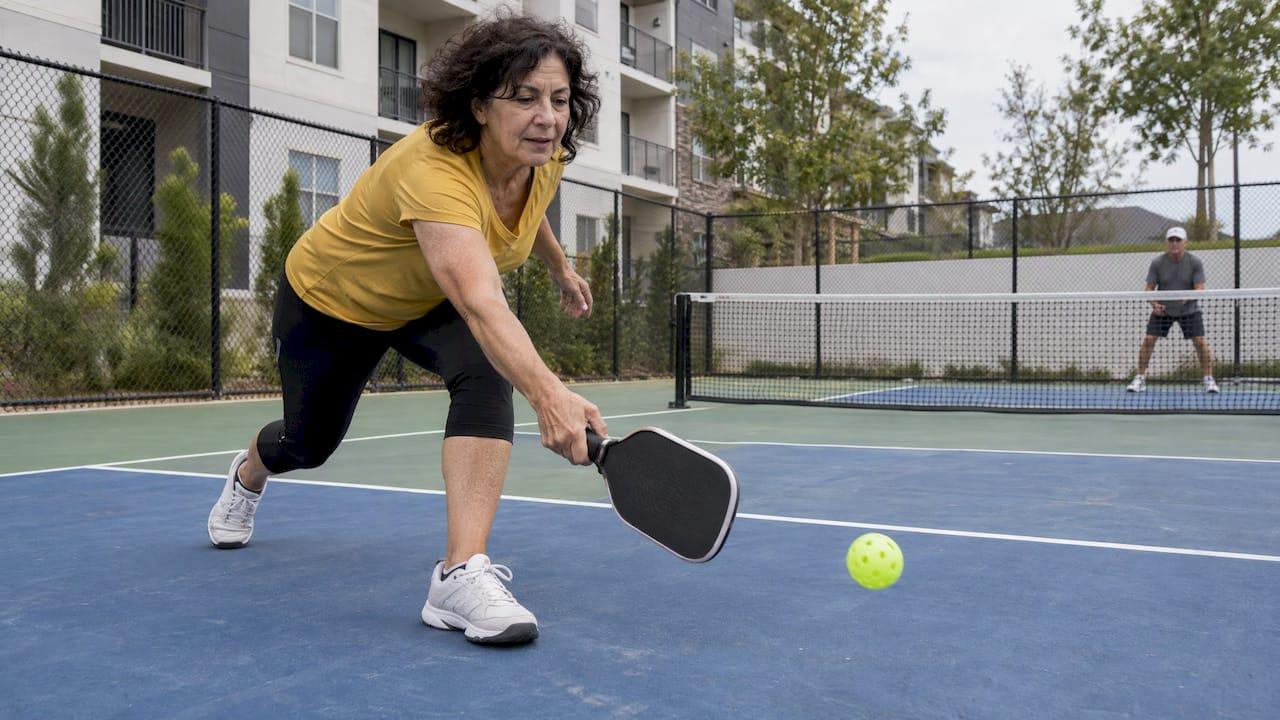
A safe pickleball lunge has three parts: a controlled step with the knee tracking over the middle of the foot, a tall torso with the contact point in front of you, and a quick pull back to a ready position. The reach gets the ball. The recovery keeps you healthy and in the point. Most lunge injuries come from a short stride, a knee that caves inward, or a hunched torso, and all three are visible on video before they turn into pain.
This guide covers the forward and lateral lunge on the court, step by step, the errors that raise injury risk, drills that build the movement, and how older players and players with past injuries can adapt it.
TL;DR
- Lunge by leading with the foot, not the paddle: step, plant, hit, then pull the lunging foot back to the anchor foot.
- Keep the front knee tracking over the second toe, the chest tall and the shin close to vertical.
- A short stride, a knee that collapses inward and a forward-leaning torso are the errors that stress the knees most.
- Build the pattern with unweighted lunges, a cone drill and recovery reps before adding speed or load.
- Filming yourself from the front and side shows what your knee and torso actually do mid-lunge.
Table of Contents
- Where lunges happen in pickleball
- The forward lunge, step by step
- The lateral lunge for wide balls
- Lunge or load? Choosing the right step
- Recovery is the skill that wins points
- Common lunge errors and how to fix them
- Drills that build a safer lunge
- Older players and past injuries
- Try it on your own lunge
- FAQ
- Sources
Where lunges happen in pickleball
A lunge is a long, deliberate step that stretches you toward a ball you cannot reach by walking. In pickleball it shows up in two main places. The forward lunge reaches a ball that drops into the kitchen, and the side lunge handles a wide dink or an around-the-post shot, according to The Dink's breakdown of lunge shots. The same piece notes that lunge strength stabilizes the lower body during the shot and helps you launch back to ready position.
The lunge is also where many falls start. A 2025 peer-reviewed study in Healthcare identifies lunging and moving backward as the leading reported reasons for pickleball-related falls. It also notes that the hip abductors and extensors control the pelvis during a lunge, while the quadriceps decelerate you and reverse direction.
So the goal is not a deeper lunge. It is a lunge you can leave quickly. Coaches at one pickleball school put it plainly: the deeper the lunge at the non-volley zone, the harder it is to step out of it, according to High Five Pickleball. Reach only as far as you can recover from.
The forward lunge, step by step
Use this version for balls dropping short in front of you.
- Start balanced. Feet about shoulder-width or slightly wider, knees soft, weight on the balls of the feet. A 2020 clinical review in Current Sports Medicine Reports recommends a split step into a ready position with stable feet and balanced weight, which lowers the risk of wrong-footing, ankle sprains and falls.
- Lead with the foot. Lift the nearest foot and take a large step toward the ball while the trailing foot stays planted as an anchor. Silver Ridge's lunge-step method uses this cue because chasing the ball with the paddle pulls your shoulders ahead of your feet.
- Stack the body. Keep the chest up so the shoulders sit over the hips. SilverSneakers cues keeping weight in the front foot as the knees bend.
- Set the angles. Cleveland Clinic describes the front knee near 90 degrees, the back knee near 45 degrees, the front shin vertical and the front knee in line with the fourth and fifth toes.
- Contact in front. The same Current Sports Medicine Reports review notes that keeping the contact point in front of the body reduces undue biomechanical stress.
- Hit, then settle. Stroke the dink, drive or reset from a quiet base. Silver Ridge reports accuracy improves when the head and body stay as still as possible during the stroke.
- Recover. Pull the lunging foot back to the anchor foot and return to ready position.
The order to remember is lunge and plant, stroke, recover to the anchor foot.
Where does this go wrong? Usually at step 2, when the stride is too short, and at step 5, when the contact point drifts beside or behind the hip. Both are hard to feel in the moment, which is why a side-view video helps. When you upload clips to Play On Pickle, the movement analysis looks for biomechanical stress points in how you move, so you see what the lunge does to your body rather than guessing.
The lateral lunge for wide balls
The side lunge covers wide dinks and the shot that skirts the post. Mechanically it differs from the forward version.
- Step out to the side with the lunging foot pointing forward, keeping the other leg straight. The Output by Peloton describes a big step with both feet pointing forward.
- Hinge at the hips and push them back as the working knee bends, keeping the chest up. IntoPickleball compares it to sitting back into a chair, with the working knee aligned over the ankle.
- Keep your head and upper body facing forward, as Cleveland Clinic describes, with the lunging knee reaching about 90 degrees, the shin vertical and the thigh parallel to the floor in a full exercise version. On court you will use a smaller range, so size the lunge to the ball.
- Press through the working heel to return, and keep shoulders square to the net.
One cue from Evolute Pickleball: use lateral shuffles with shoulders square and a low center of gravity instead of crossover steps, which increase balance loss and slow recovery.
Lunge or load? Choosing the right step
Not every low ball needs a lunge. Pickleball Union's footwork guide separates two moves. The lunge is a short stability step for a ball within one controlled step of the kitchen line, with about 70% of your weight loaded into the outside leg. The load is a deeper, power-oriented braking step when you are pulled off the line, with 80% or more on the planted foot. If you are reaching beyond one controlled step, a load or a quick step-and-recover is usually the safer choice than stretching further.

The 2020 clinical review adds a warning on the other end: forceful eccentric stops when sprinting to the nonvolley zone can cause lower-extremity musculotendinous tears and ankle sprains. Smooth deceleration, with the hips lowered and the feet under you, spreads that braking load across more muscle.
Recovery is the skill that wins points
Reaching the ball is half of the movement. The Dink's media team makes the case that recovery is the trained skill: reaching the ball does not help if you are out of position for the next shot. A good lunge, they say, extends your reach by 18 inches or more, and the hit-recover-reset sequence should follow every shot.
A practical recovery checklist:
- Push off the lunging foot rather than the heel of the back foot.
- Keep weight on the balls of the feet. Weight on the heels gets you caught flat-footed.
- Let the lunging foot return to the anchor foot, then split step as the opponent hits.
- Avoid backpedaling on the heels to answer lobs. The clinical review advises against it, especially for older players with reduced agility, and suggests turning and running for the ball instead. The American Council on Exercise gives the same advice.
For more on the landing that starts the recovery, see our guide to split step drills for pickleball.
Common lunge errors and how to fix them
The National Strength and Conditioning Association's guide to the lunge says errors can go unrecognized even by experienced personal trainers, and that poor lunge performance can aggravate earlier lower-body injuries. Its list, along with Cleveland Clinic's, maps neatly onto pickleball.
| Error | Why it matters | Fix |
|---|---|---|
| Stride too short | Increases patellar-tendon stress, per the NSCA | Make the front-to-back distance longer than a walking stride, back heel lifted |
| Knee caves inward | Raises knee torque; Cleveland Clinic lists it among the most common lunge mistakes | Push the knee out so knee, shin and ankle line up; slow down and reduce range before adding speed |
| Back foot rotates outward | Increases knee torque, per the NSCA | Keep toes and knees of each leg pointing the same direction |
| Torso leans forward, knee drifts ahead | Increases knee shear force | Move the hips in a straight line with an erect torso and braced abdominals |
| Added weight too soon | Loads a pattern you have not mastered | Add weight only after a full unweighted set |
If the knee caving pattern sounds familiar, our piece on knee valgus in pickleball shows how to spot it and work on it. If joint, knee or lower-back pain persists after lunging, stop and see a sports medicine physician or athletic trainer, as Cleveland Clinic advises.
Drills that build a safer lunge
Start with form, then add the court.
Warm-up lunges
Take a big forward lunge step, pause with your hands in ready position, then rotate the shoulders toward the front leg and back. PaddleTek's warm-up guide uses this rotation to ready the core and spine for swings. Follow with side lunges. Five to ten minutes of dynamic warming up with squatting and lunging before play is also part of the program in the 2025 Healthcare study.

Strength work
Cleveland Clinic suggests holding each rep one to three seconds for two to three sets of eight to 12 reps. ACE's pickleball workout includes side lunges within a conditioning segment of one to four sets of eight to 15 reps, two to three days a week on nonconsecutive days.
For kitchen-line dinking, a Selkirk Sport training article describes lateral lunges with a five-second hold, then four, three, two and one seconds across five reps before switching legs.
Court drills
- Clockwork cones. Place cones equally around a circle and lunge to each one. The goal is equal extension left and right. The Dink notes most players find forehand-side lunges easier and need to develop the backhand side.
- Lunge and recover. Step aggressively to one side, reach the paddle to a wide ball, then drive off that foot back to center. Alternate sides for 10 reps each.
- Twelve-position drill. The right foot lunges to positions one through six and the left to seven through twelve, in the sequence lunge and plant, stroke, recover. It works without a court.
If you want a full routine, our pickleball prehab moves and plyometrics for pickleball pages go further.
Older players and past injuries
Falls are the central concern. The Healthcare study found no existing evidence-based fall-prevention program for senior pickleball players, then designed a 10-week multi-faceted one. It included a lunge matrix, bridging, side stepping with a resistance band, dual-task single-leg balance and change-of-direction drills. If you are building a similar base, balance training for seniors covers safe exercises for fall prevention, and our 8 week balance plan is written for pickleball.
Some adjustments that keep the pattern without the strain:
- Shorten the range and add a light hand support for unweighted practice lunges.
- Choose cross-training or court shoes over running shoes for lateral stability. A review of pickleball injuries also mentions lace-and-strap ankle braces for chronic ankle instability and lightweight compressive knee braces for chronic knee pain or instability.
- Practice falling and rolling with momentum instead of bracing with an outstretched hand, which the clinical review links to fewer upper-extremity injuries.
- If you have significant cardiovascular or pulmonary conditions, discuss playing with your physician. With severe osteoarthritis, the same review advises caution when beginning pickleball, so talk with your doctor first.
For agility work at a gentle pace, see our agility drills for older players.
Our view: your lunge is personal
Lunge advice usually comes as one set of angles for everyone. Real bodies differ: hip mobility, ankle range, which side is stronger, how the knee tracks when you are tired. A forward lunge that looks fine in a mirror can still hide a knee drifting inward on the backhand side.
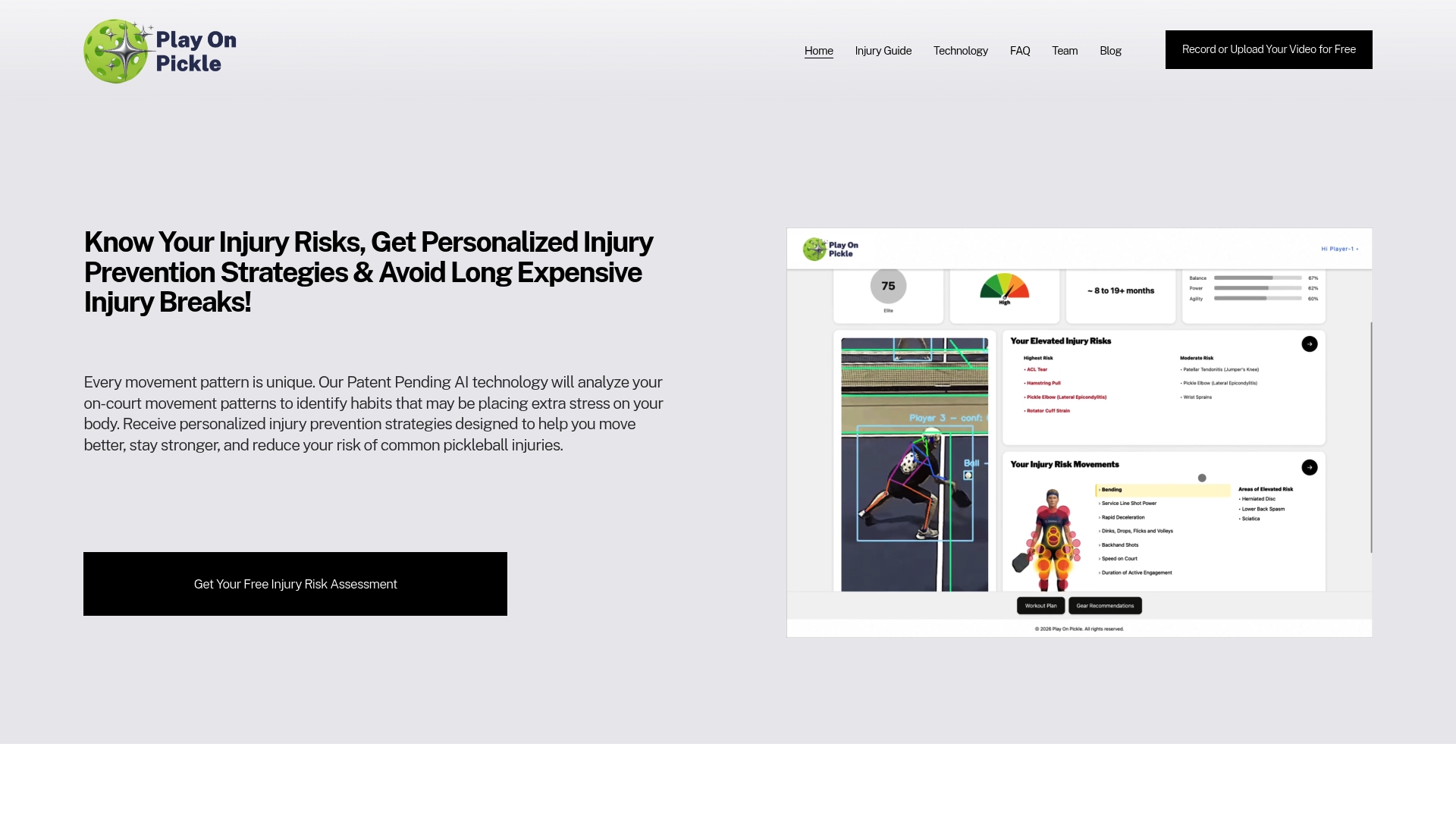
That is why we built Play On Pickle around movement analysis. Our patent-pending computer vision is designed to read how you move on court from a video you upload, identify the stress points in your body, and turn them into a personalized injury risk assessment with simple exercises that fit into your routine. We think recreational players, who rarely get a physical-training plan at all, benefit most from small, targeted changes they can repeat.
For coaches, facilities and physiotherapists, the same idea means seeing a player's pattern before it becomes a complaint, and choosing the exercise that fits that player.
Drona
Try it on your own lunge
Play On Pickle is a subscription for AI-powered movement analysis from video, with personalized exercise and equipment recommendations. It starts with a free trial, then costs $9.99 per month or $99 per year. A free tripod offer comes with the monthly plan, so you can film your lunge from the front and the side. You can also read how our technology works.
FAQ
How far should I lunge in pickleball?
Only as far as you can recover from in one controlled move. Pickleball Union describes the lunge as a move for balls within one controlled step of the kitchen line. If you have to stretch beyond that, step and load rather than overreach.
Should my front knee go past my toes?
Cleveland Clinic's guidance is to keep the lunging knee from passing the toes with a vertical ankle in the exercise version. On court, the more important check is direction: the knee should track over the second toe, not cave inward. Slow down and reduce range if it does.
How do I stop falling when I lunge?
Lead with the foot rather than the paddle, keep your chest tall, avoid backpedaling and build hip and thigh strength. The 2025 Healthcare study ties hip abductors, extensors and quadriceps to lunge control. If you have fallen before or have balance concerns, check with your physician before starting a new program.
How often should I practice lunges?
The ACE pickleball workout prescribes conditioning two to three days per week on nonconsecutive days, for one to four sets of eight to 15 reps. Start unweighted and add load only after a full set looks clean.
Sources
- A Clockwork Lunge, The Dink
- Pickleball: Review and Clinical Recommendations, Current Sports Medicine Reports
- Effect of a Multi-Faceted Training Program on Falls, Healthcare (MDPI)
- High Five Pickleball footwork guide
- Part 2 The Lunge-step, Silver Ridge
- 3 Best Exercises to Improve Your Pickleball Game, SilverSneakers
- How To Do Lunges and Muscles Worked, Cleveland Clinic
- 10 Essential Strength Exercises for Pickleball Players, The Output by Peloton
- Get A Leg Up, IntoPickleball
- Pickleball Footwork Fundamentals, Evolute Pickleball
- Pickleball Footwork 101: When to Lunge and When to Load, Pickleball Union
- How to Improve Pickleball Footwork: 5 Pro Drills, The Dink
- Pickleball Workout to Improve Your Game, ACE
- The Undervalued Lunge, NSCA Personal Trainer Quarterly
- Best Pickleball Warmup Exercises, PaddleTek
- Strengthening exercises to support lateral movements, Selkirk
- Pickleball: Injury Considerations in an Increasingly Popular Sport