
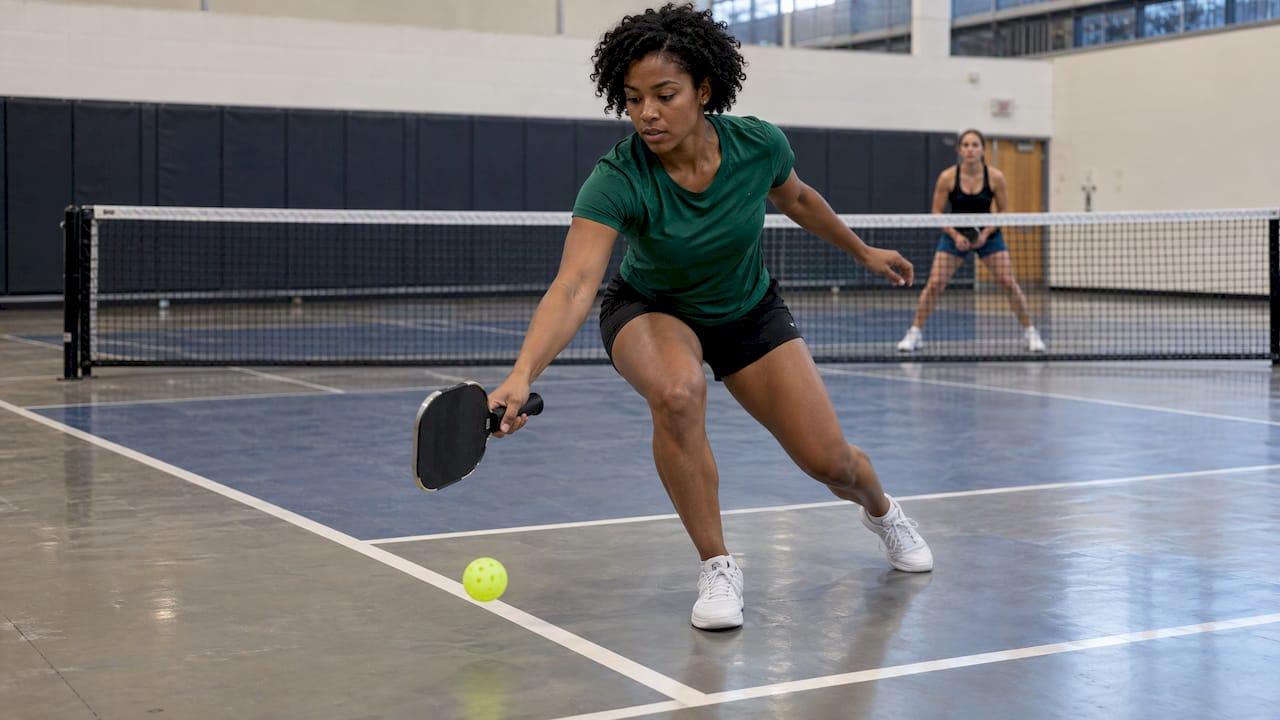
Knee valgus in pickleball is the knee drifting inward, toward the midline, while your foot is planted. It tends to show up when you lunge for a dink, split-step at the kitchen line or pivot after a quick reset. It is a movement pattern, not a diagnosis, and it is one of the more trainable habits in your game. Below you will find what it looks like on court, what usually causes it, what the research does and does not show, and the drills that build better knee control.
TL;DR
- Knee valgus means your knee collapses inward relative to your hip and foot during a lunge, landing, stop or pivot. It is a movement pattern, not an injury by itself.
- Common contributors include weak hip and glute muscles, stiff ankles, fatigue and habits carried over from other sports.
- Research links valgus during landing with higher knee injury risk, mostly in studies of athletes in other sports. The evidence is not strong enough to call it a sure cause.
- Strength, balance and landing drills can reduce it. Two to ten weeks of training changed valgus in most studies in one review.
- Stop playing and get checked if you have swelling, locking, catching or pain that wakes you at night.
Table of Contents
- What knee valgus looks like on the pickleball court
- Why your knee moves inward
- What the research does and does not say
- How to check your own knees, and the limits of a mirror
- Drills that build knee control for pickleball
- Older players and existing knee problems
- Our perspective on knee control
- Put a movement check behind your training
- FAQ
- Sources
What knee valgus looks like on the pickleball court
Picture a wide lunge to your forehand side at the kitchen. As you decelerate, your front knee slides inward past your big toe instead of tracking over your second and third toes. That inward cave is what a physical therapy lunging checklist describes as knee valgus during deceleration. Its fix is simple to state: the knee points the same way as the toes, with your whole foot in contact with the ground.
The pattern appears in a few predictable spots:
- Split-step landings. You land from the small hop as your opponent hits, and one or both knees dip inward.
- Hard pivots. You plant one foot and turn to chase a cross-court dink, and the knee falls inside the line of the foot.
- Wide lunges. You reach for a passing shot on the ad side and the front knee collapses as you push back.
- Put-away landings. You come down after a jump overhead or after crashing the kitchen.
One clinic article calls out planting to change direction on a sharp cross-court dink, lunging wide, and landing from a put-away as typical moments. Another describes valgus knee collapse during split-step landings or hard pivots as a fault that adds acute stress on the ACL and meniscus and chronic wear over time.
Researchers describe the full pattern as happening in three planes: the thigh bone rotates inward and moves toward the midline, and the pelvis drops on the opposite side, according to a 2019 paper in the Journal of Orthopaedic & Sports Physical Therapy. So valgus is not only about the knee. It is a whole-leg and pelvis story, which is why the fixes start above and below the joint.
Why your knee moves inward
Pickleball asks for a lot of short, sharp, multi-direction movement. Several things can nudge the knee inward during it.
Weak hip muscles. A 2022 scoping review explains that weak gluteal muscles lead to inward rotation and adduction of the thigh bone, which produces valgus at the knee. The same review notes that excessive hip adduction and knee valgus is proposed as a common risk factor for a range of acute and overuse lower-body injuries, including the ACL. In pickleball terms, weak hip abductors, especially the gluteus medius, let the knee fold inward on quick direction changes at the kitchen line.
Stiff ankles and tight hips. If your ankle cannot bend enough for the knee to travel forward over the toes, the knee often finds another path: inward.
Quad dominance and underused glutes. Players who push mostly with the front of the thigh and rarely load the back of the hip tend to lose control as they tire.
Fatigue. Form slips late in a long session or the third game of a tournament day. The knee that tracked well at 9 a.m. may cave at noon.
Habits from other sports. Players who come from running, tennis or basketball bring movement habits that may not fit a game of constant lateral shuffles and short stops. These contributors are listed in one clinical guide to dynamic knee valgus in pickleball.
If you are wondering which moves put the most stress on the inner knee, one pickleball injury explainer lists lateral shuffles to cover dinks, wide lunges at the kitchen, quick direction changes after a speed-up, split-step-and-push movements, backpedaling or twisting for lobs, and sudden stops after chasing a short ball. The same page notes that the medial collateral ligament (MCL) sits on the inside of the knee and helps keep it from collapsing inward, so it takes the load when the knee is pushed into valgus.
What the research does and does not say
The honest picture has two halves. Knee problems are common in pickleball, and valgus is a plausible contributor. But the strongest valgus research comes from other sports and from landing tasks, not from pickleball courts.
Knees are a frequent trouble spot. In a nationwide US study of 1,758 pickleball players, the knee had the highest injury prevalence at 29.1%. In a single medical center's records from 2017 to 2022, 487 pickleball patients accounted for 618 injuries, and knee sprains, meniscus tears and ACL or MCL tears all ranked among the more common orthopaedic diagnoses.
Valgus and ACL risk. A 2026 systematic review of 16 studies found that a greater dynamic knee valgus angle or moment during landing is commonly linked with higher non-contact ACL injury risk. The link was clearest in single-leg landings, in female athletes, and within 40 to 100 milliseconds after the foot touches down. The authors conclude that valgus is an observable and trainable factor, but differences in study design and measurement thresholds prevent strong causal claims.
Women and girls face higher ACL risk. A 2022 clinical review in American Family Physician states that females sustain up to eight times more ACL tears than males. It lists different hip and knee alignment, smaller ACL size and greater ligament laxity among the contributors, and names dynamic knee valgus as a risk factor for both ACL tears and patellofemoral pain. A 2021 systematic review also reports that ACL-injured female athletes landed with significantly greater knee abduction than injured male athletes.
Screening tests are imperfect. The 2019 JOSPT paper notes that many consider valgus one of the most important predictors of serious knee injury, yet the predictive validity of common screening tests such as the vertical drop jump has been questioned.
What that means for you: you do not need to panic about a knee that dips in on one lunge. You should treat repeated, visible inward collapse as a signal worth training, especially if you are tired, returning from a layoff or have a history of knee trouble.

How to check your own knees, and the limits of a mirror
You can learn a lot with a phone and ten minutes.
- Film from the front. Set your phone at knee height about eight feet away. Record yourself doing a split-step landing, a side lunge and a single-leg squat.
- Watch the line. Draw an imaginary line from hip to knee to second toe. Does the knee stay on it, or does it drift toward the other leg?
- Check both sides. Many players have a stable "good" leg and a wobbly one.
- Repeat when tired. Film a second set after a hard hitting session to see how form changes with fatigue.
- Look at the pelvis. A hip that drops on the side of the lifted leg is part of the same pattern.
A coach can use the same clips to spot faulty patterns during live play too. A sports physical therapist writing about pickleball knee health notes that a movement screen can identify knee valgus on split-step landings and correct it before it turns into an injury.
Keep the limits in mind. A 2022 study of the two-dimensional frontal plane projection angle, which is the angle you see on a front-facing video, found it predicted knee valgus forces during landing and change-of-direction tasks, but with weak to moderate strength, and not at all during stepping. A single video clip is a useful clue, not a measurement of the load inside your joint. That is why repeated clips across different movements, and a professional's eye when something hurts, give a better picture than one frame.
Drills that build knee control for pickleball
The encouraging news: this pattern responds to training. A 2021 systematic review of 10 studies with 423 participants found that seven studies showed significant reductions in dynamic knee valgus after exercise programs lasting two to ten weeks, using hip- and ankle-focused work.
Build a routine from four buckets.
Open up ankles and hips
The lunging checklist from a physical therapy clinic recommends ankle dorsiflexion stretches, hip flexor mobility drills and thoracic spine rotations to improve lunging mechanics. Spend two minutes per drill before you play.
Strengthen the hips and legs
An orthopedic practice suggests side-lying leg lifts and clamshells for 2 to 3 sets of 12 to 15 reps per side, plus multi-angle lateral lunges for 2 sets of 8 to 10 reps per leg. The lunging checklist adds split squats, reverse lunges, step-downs and single-leg Romanian deadlifts. Lateral band walks and step-ups are also standard hip-and-leg choices in a fitness guide for senior players, which suggests starting with two sets of 10 to 12 reps, two days per week, and building gradually.

Practice landings that look like pickleball
The dynamic knee valgus guide suggests three drills that resemble real play:
- Split-step landing drill: hop and land in a split step 10 to 20 times, keeping soft knees over your toes with no inward collapse.
- Lateral bounds (skaters): 2 to 3 sets of 6 to 8 bounds per side, holding each landing for 2 to 3 seconds.
- Diagonal lunges at 45 degrees: 2 to 3 sets of 6 to 8 per side.
In every rep, the cue is the same: knee over the second toe, whole foot on the ground, hips back and level.
Add balance and fatigue resistance
Single-leg balance work, starting at 30 seconds and progressing to a softer surface, is part of the orthopedic routine above. The 2026 systematic review also points to trunk and ankle stabilization and fatigue-resistance training as part of prevention. In practice that means finishing your last set of lunges with the same clean knee line as your first.
Want ready-made versions? Our guides on a three-move pickleball prehab routine, exercises mapped to court moves and a quick pre-game warm-up turn these ideas into schedules you can follow.
Older players and existing knee problems
Players in their 50s, 60s and beyond often arrive with a history: a past meniscus tear, arthritis or a stiff hip. Emory Healthcare's sports medicine team notes that older adults have a higher injury risk because of pre-existing wear-and-tear, and that players with balance issues are more likely to fall. Its advice includes a dynamic warm-up, starting with up to three sessions a week and reassessing after a few weeks, and returning gradually after an injury.
Balance is the piece most players skip. One senior fitness guide says a 30-second single-leg stand is harder than it sounds for most people over 60, and that poor balance shows up as slow footwork, missed split steps and late recovery at the kitchen line. If you want a structured way in, this overview of balance training for seniors is a good place to start, and our own eight-week balance plan for pickleball players ties the work to the court. For a wider set of habits, see our senior pickleball safety checklist and injury prevention guide for recreational and older players.
When to stop and get checked
Putting the court down for a day is cheaper than a long layoff. According to a pickleball knee pain guide, stop and rest if:
- pain starts during play and gets worse as the session goes on
- swelling appears around the knee after play
- the knee locks, clicks or catches, which can point to meniscus involvement
- going downstairs hurts 24 hours or more after your last session
- pain wakes you at night
If you have any of these, see a sports medicine physician or a physical therapist rather than trying to push through. The clinic checklist adds sharp knee pain or instability, repeated ankle rolling, loss of balance, and pain that gets worse after playing as reasons to stop and reassess. After an acute injury, get a clinical evaluation before you return to the court, then build back gradually.
Our perspective on knee control
Most recreational players treat knee health as something to think about after it hurts. We see it the other way around. The inward knee collapse that worries clinicians is visible in movement long before it becomes pain, and that is exactly why we built our service around watching movement.
Our approach is designed to use patent-pending computer vision to analyze video of how you actually move on a pickleball court, identify stress points in the body, and turn them into simple exercises tailored to your biomechanics. We believe the best prevention plan is the one you will actually do, so we keep it short, specific and fitted to your routine.
A mirror and a hunch can tell you something is off. A repeatable analysis that you can run again after six weeks of training tells you whether the work is paying off. That is how we think recreational players, older adults, coaches and facilities should approach knee control: look, train, and look again.
Drona
Put a movement check behind your training
If you would rather not guess whether your knee tracks well when you are tired, Play On Pickle analyzes video you upload and returns a personalized injury risk assessment with tailored exercise and equipment recommendations. Our subscription is $9.99 per month or $99 per year, and we offer a free initial trial. See plans and pricing.
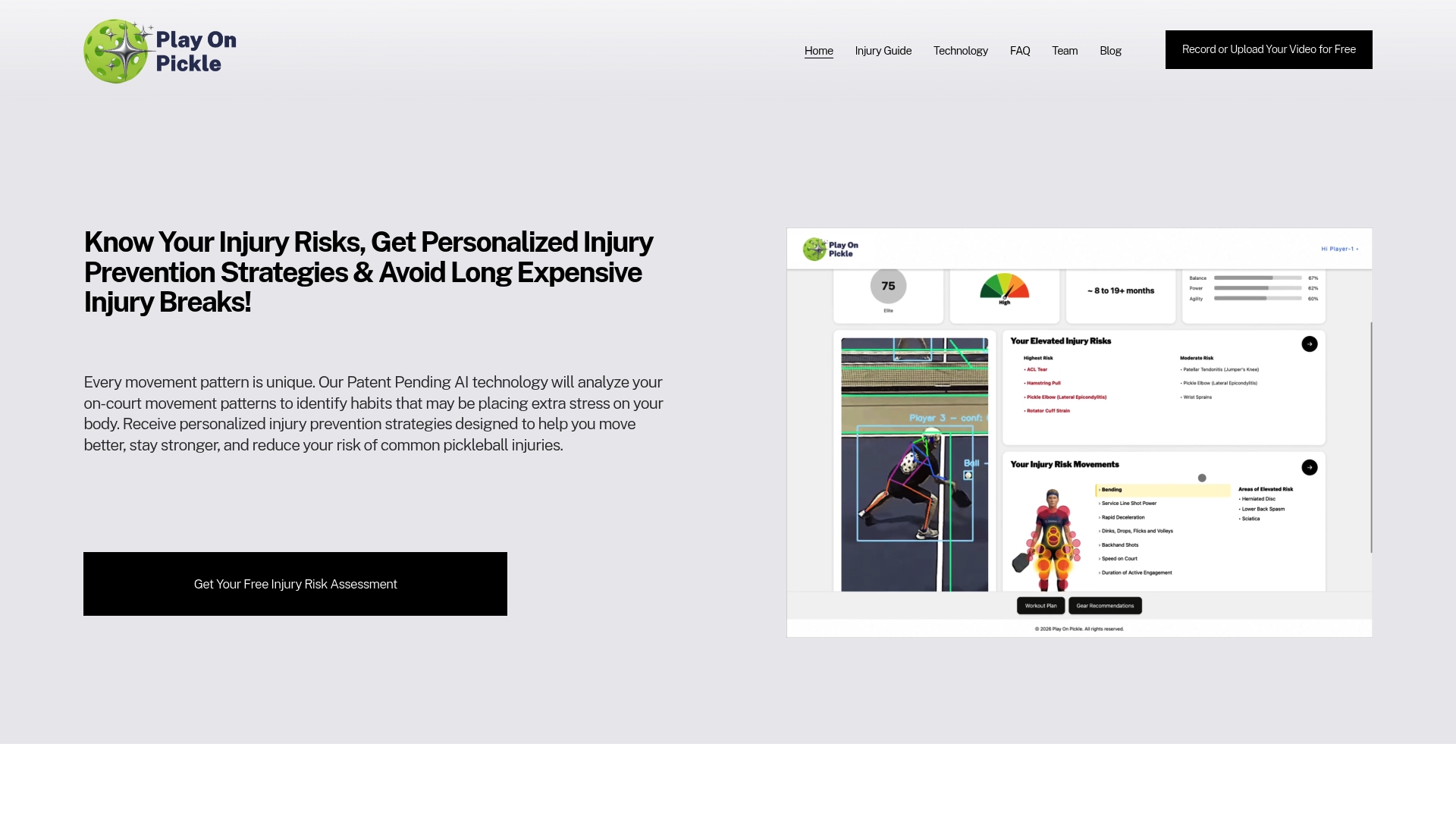
You can read how the system works on our technology page. The free tripod offer pairs a tripod with the monthly plan, which makes the front-on filming described above easy to repeat.
FAQ
Is knee valgus the same as being knock-kneed?
Not quite. Being knock-kneed describes standing alignment, while dynamic knee valgus describes how the knee moves during an action such as a lunge or landing. You can stand with straight legs and still see your knee cave inward when you land from a split step. That is why movement video tells you more than a standing photo.
Does knee valgus mean I will tear my ACL?
No. Research links greater valgus during landing with higher non-contact ACL injury risk, but the authors of the 2026 systematic review say study differences prevent strong causal conclusions. Treat valgus as a trainable risk factor, not a prediction. Women and girls are at higher ACL risk overall, so building hip and landing control is especially worthwhile.
How long does it take to improve knee control?
In a 2021 review, seven of ten studies found significant reductions in dynamic knee valgus after programs lasting two to ten weeks. Your timeline depends on your starting strength, how often you train and how well you keep your form late in sessions. Plan on at least a few weeks of consistent work, two or three days per week.
Should I wear a knee brace to fix valgus?
The research cited in this article focuses on strengthening, mobility, balance and landing practice, not on braces. If you already have a diagnosed injury, ask your physician or physical therapist what support is appropriate for you.
Can I train knee valgus away if I already have knee arthritis or a past meniscus tear?
Often you can work on hip strength and landing control, but the plan should fit your history. Check with a sports medicine physician or physical therapist first, and stop if you notice swelling, locking, catching or pain that persists. Start light and progress gradually.
Sources
- The Physical Therapy Pickleball Lunging Checklist
- Pickleball Knee Pain: Causes, Prevention and Recovery
- Dynamic knee valgus: proven fixes to stop pain and injury
- Rethinking Dynamic Knee Valgus and Its Relation to Knee Injury (JOSPT, 2019)
- The influence of gluteal muscle strength deficits on dynamic knee valgus (scoping review, 2022)
- 5 Pickleball Exercises for Seniors to Protect Every Joint
- Why Your Knee Hurts on the Inside After Pickleball
- Understanding Injury Patterns and Predictors in Pickleball (Sports Medicine - Open, 2025)
- Evaluation of Pickleball-Related Injuries at a Single Medical Center
- Dynamic knee valgus systematic review (Archives of Rehabilitation, 2026)
- Care of the Active Female (American Family Physician, 2022)
- Stiff Landings, Core Stability, and Dynamic Knee Valgus (2021)
- The Pickleball Player's Guide to Knee Health
- Does the 2D Frontal Plane Projection Angle Predict Frontal Plane Knee Moments? (2022)
- The effects of hip- and ankle-focused exercise intervention on dynamic knee valgus (2021)
- Pickleball Injury Prevention: An Orthopedic Surgeon's Guide
- Pickleball Fitness for Seniors: Train Safe, Play Better
- Pickleball Wellness and Injury Prevention (Emory Healthcare)
- Balance Training for Seniors: Safe Exercises to Prevent Falls