
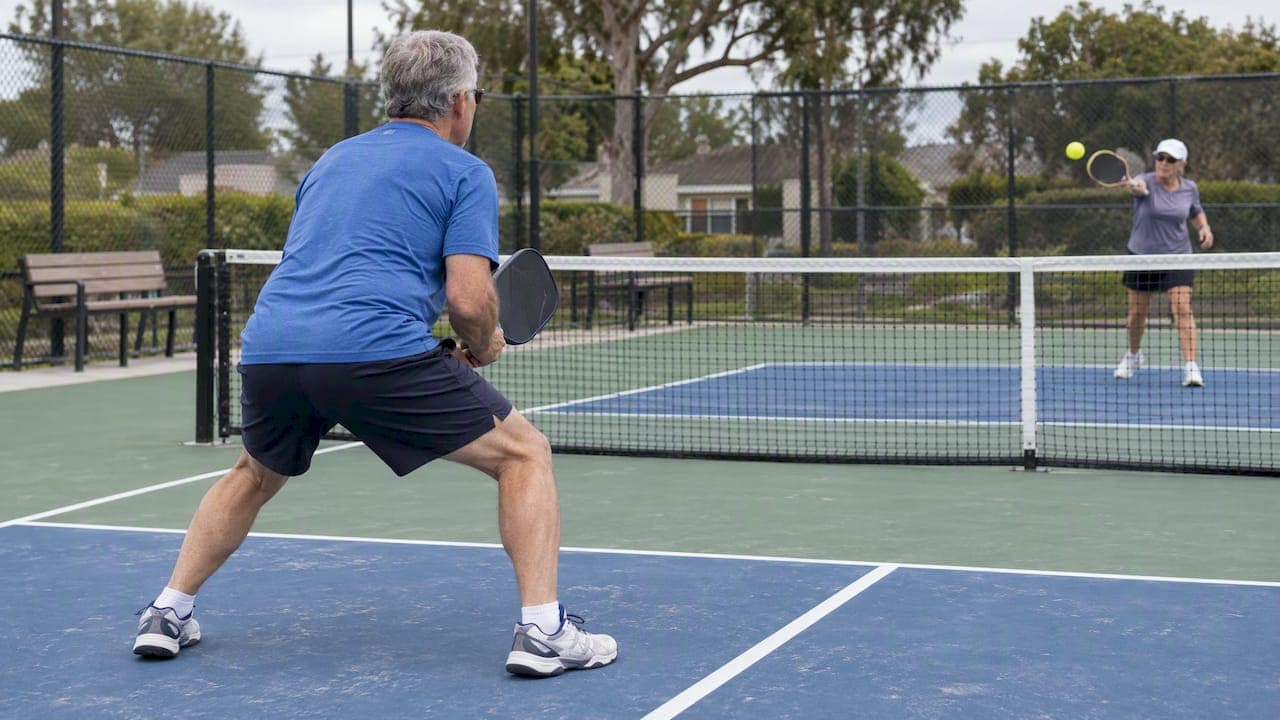
A split step is a small, light hop you perform right before your opponent hits the ball, so you land balanced on your toes at the exact moment of contact. That timing is the single most important detail: land too early or too late and you lose the reactive edge it's meant to give you. Done right, it improves your reaction speed and lets you change direction faster.
TL;DR:
- Time the hop so you are airborne as your opponent swings and land at paddle contact; watch paddle acceleration, with impact sound as a backup cue.
- Build timing through shadowing, predictable feeds, random feeds, then rallies; the prescribed partner drill uses 3 sets of 10 feeds before adding unpredictable direction.
- Keep the hop low, land shoulder width apart on the balls of your feet with bent knees, and push laterally from your outside leg.
- After knee or ankle problems, use a weight shift; after a lower body injury, add movement only when stationary landings feel stable and pain free.
- USA Pickleball reports split stepping can improve reaction speed by up to 13.1% and produce 43.6% faster force onset than standing with feet flat.
Table of Contents
- What the split step is and why it helps your movement
- Timing: how to read opponent cues and time your split step
- Technique and footwork: how to land and push off correctly
- Common mistakes and quick corrections
- Drills and progressions to practice the split step on-court
- Biomechanics and injury-prevention notes from AI movement analysis
- The biomechanical benefits of the split step in reducing injury risk
- How improper split-step technique can lead to stress injuries
- How to modify the split step for players with different physical limitations or injury history
- Integration of split-step technique into overall injury prevention strategies
- Role of muscle conditioning and warm-up exercises to support effective split steps
- How AI and movement analysis can optimize individual split-step mechanics
- Fitting the split step into match play
- How Play On Pickle helps players practice split-step mechanics safely
- FAQ
- Sources
What the split step is and why it helps your movement
The split step itself is simple: a short, low hop that ends with your feet about shoulder-width apart, weight on the balls of your feet, knees slightly bent. You're not jumping for height. You're resetting your base so both legs are loaded and ready to fire in any direction the instant you read where the ball is going.
We see this movement used in three main spots on a pickleball court. At the baseline, it prepares you for a return of serve or a deep groundstroke. In transition, moving from baseline to kitchen, it keeps you stable while you're still covering ground. And right at the kitchen line, it's what lets you react to a fast dink or a surprise attack without getting caught flat-footed.
The payoff shows up in measurable ways. According to USA Pickleball, performing a split step can make players up to 13.1% faster in reaction speed and produce a 43.6% faster onset of force production, the time between seeing the ball and actually moving toward it, compared to standing flat-footed.
That's the difference between getting a paddle on a hard-driven ball and watching it go by. A few reasons this matters so much:
- It shortens the gap between seeing the shot and reacting to it.
- It keeps your weight centered instead of leaning or drifting, which makes any direction equally available.
- It becomes a repeatable habit that works the same way on every shot, so you stop guessing and start reacting.
Timing: how to read opponent cues and time your split step
Timing is where most players lose the benefit of the split step entirely. The hop itself is easy. Landing it at the right instant is the skill that takes practice.
The core rule, confirmed by USA Pickleball's research, is this: you want to be airborne as your opponent swings and land right as their paddle makes contact with the ball. Land too early and you're flat-footed again by the time the ball arrives. Land too late and you're still in the air when you need to be moving.
To time it well, you need to read a few signals before contact happens:
- Paddle acceleration. Watch for the moment your opponent's paddle starts speeding up into the ball, not when they first start their backswing.
- Shoulder and hip rotation. A rotating torso usually means a bigger swing is coming, which often signals a drive rather than a soft dink.
- The sound of impact. In live play, the crack or pop of paddle on ball is a reliable backup cue if your eyes are slow to pick up the visual signs.
Training this in isolation first makes a real difference before you try it in a rally. Start with shadowing: no ball, just watching a partner's paddle swing and practicing your hop timing against their motion. Once that feels automatic, move to a controlled partner feed, where someone feeds you predictable shots and you split-step before each one. From there, progress to random feeds where you don't know direction or pace ahead of time. Finally, bring it into live rally play, where you're applying the timing under real match pressure.
Pro Tip: Count out loud during shadow drills, "hop, land" timed to your partner's swing, until the rhythm feels automatic without thinking about it.
Most players rush this progression and jump straight to live play, which means they're reinforcing bad timing instead of correcting it. Give each stage a few focused sessions before moving on.
Technique and footwork: how to land and push off correctly
Good timing means nothing if your landing mechanics are off. The way you land determines how fast you can actually push off in the direction you need to go.
Your feet should land roughly shoulder-width apart, toes pointed slightly outward rather than straight ahead or pigeon-toed. This width gives you a stable base without restricting your ability to push laterally. Your knees should be bent enough that your weight sits low, with your center of mass between your feet rather than leaning forward onto your toes or back onto your heels.
A short, low hop that lands you on the balls of your feet, not flat-footed, cuts how hard your joints absorb impact while still giving you the reactive benefit of the movement, as supported by balance training for seniors promoting safer joint loading. This lighter landing is also part of why USA Pickleball's data shows faster reaction times: a balanced toe landing lets your legs fire immediately instead of first having to recover from an awkward plant.
Push-off direction depends on where the ball is headed:
- For lateral movement, push off the outside leg first, driving your hips toward the ball's path.
- For forward movement toward the kitchen, push off both legs evenly with a slight forward lean from the ankles, not the waist.
- For a quick retreat, push off your front foot and open your hips to run backward without crossing your feet.
A simple way to test each of these: have a partner call out a direction right as you land your split step, and check whether your first step goes exactly where it should without hesitation or a false step in another direction.
Common mistakes and quick corrections
Most split-step problems come down to a handful of repeatable errors, and each one has a straightforward fix you can work on between points.
- Jumping too early. This happens when players react to the backswing instead of the moment of contact. Fix it by watching the paddle face specifically, not the opponent's whole body, and delaying your hop until the paddle is accelerating forward.
- Jumping too high. A tall hop takes longer to complete and leaves you airborne past the moment you need to react. Keep the movement low and quick, more of a weight shift than a jump.
- Landing flat-footed or too far forward. This usually means the hop was rushed or the player anticipated a specific shot rather than staying neutral. Reset by focusing on a toe-first landing with weight centered, not leaning toward where you expect the ball to go.
- Freezing after landing. Some players land the split step correctly but then hesitate instead of moving. This is often a decision-making lag rather than a timing problem, and it responds well to reactive drills where a partner or coach calls a direction immediately after your landing, forcing a faster decision.
Each of these corrections works best as a short, repeated micro-drill rather than something you try to fix mid-match. Spend five minutes before a session isolating just one error at a time.
Drills and progressions to practice the split step on-court
Building reliable split-step timing takes structured repetition, starting isolated and gradually adding the chaos of live play.
- Wall toss drill. Stand a few feet from a wall, toss a ball against it, and split-step as it leaves your hand, landing just before it rebounds back to you. Aim for 20 to 30 reps per set.
- Self-toss timing drill. Toss a ball into the air yourself and split-step to land right as it reaches its peak, training the hop-and-land rhythm without relying on a partner.
- Partner feed drill. Have a partner feed you shots at a steady, predictable pace from across the net, focusing purely on landing your split step as their paddle contacts the ball. Run 3 sets of 10 feeds.
- Reactive multi-direction drill. A partner feeds balls to random spots (forehand, backhand, short, deep) and you split-step before reacting to each one, training both timing and quick decision-making together.
- Live rally integration. Apply the same timing during actual points, starting at a slower pace and gradually increasing intensity as the habit holds up under pressure.
Pro Tip: Track your progress by counting how many times out of ten you land the split step before contact rather than after, since consistency matters more than speed at first.
Progress shows up as fewer missed first steps, quicker recoveries after your opponent's shot, and a noticeable drop in how often you're caught flat-footed on a hard-hit ball. Our tailored pickleball exercises mapped to common court movements can help you connect this drill work to the specific patterns you use most during matches, and the pickleball conditioning routines we've outlined give you rep targets that build the leg strength these drills depend on.
Biomechanics and injury-prevention notes from AI movement analysis
Split-step mechanics aren't just about speed. How you land affects how much stress your joints absorb on every single point, and that adds up over a season of play.
A balanced, toe-first landing spreads impact across your ankles, knees, and hips more evenly than a flat-footed or heel-first landing does, which tends to concentrate force in the knees. Movement analysis built on computer vision can flag patterns that are hard to catch with the naked eye, like one leg consistently absorbing more load than the other, or a delayed push-off that signals compensation somewhere else in the kinetic chain.
Those flagged patterns point to specific, simple corrective work:
- Single-leg balance holds to address asymmetric loading between your dominant and non-dominant leg.
- Soft-landing cue drills, like stepping off a low box and focusing on a quiet, toe-first landing, to correct a heavy or flat-footed habit.
- Short mobility resets for the ankles and hips to support a lower, more controlled hop instead of a high, stiff one.
Our balance training plan walks through an eight-week progression built around exactly these kinds of corrections, which pairs well with any split-step work you're already doing on-court.
The biomechanical benefits of the split step in reducing injury risk
Beyond reaction time, the split step plays a real role in how your body absorbs the repeated stop-start demands of pickleball. Every time you stand flat-footed and then have to suddenly accelerate, your joints take a sharper, less controlled hit than when you're already loaded and ready to move.
Landing the split step on the balls of your feet with bent knees pre-loads your calf, quad, and glute muscles, letting them act as shock absorbers before you even need to move. This is different from a flat-footed reaction, where your tendons and joints have to absorb the initial shock of sudden deceleration before your muscles can engage.
Over the course of a match, with dozens or even hundreds of direction changes, this difference compounds. A pre-loaded, balanced landing reduces how often your knees and ankles take an unguarded, awkward hit, which is one of the more common ways recreational players pick up overuse strain in the lower body. It also keeps your hips more square and stable, reducing the kind of twisting load that can aggravate the lower back during fast lateral movement.
The split step, in this sense, functions as both a reaction tool and a low-level protective habit, one you're already building into every point once the timing becomes automatic.
How improper split-step technique can lead to stress injuries
A mistimed or poorly executed split step doesn't just cost you a reaction. It can quietly build up joint stress over time, especially for players who log a lot of court hours.
Jumping too high turns a quick, light movement into a harder landing, since more height means more force to absorb when you come down. Repeated high landings, especially flat-footed ones, put extra strain on the knees and ankles with every single point, and that kind of repetitive stress is a common contributor to overuse injuries like patellar tendinitis or ankle instability.
Landing with your weight too far forward, on your toes but leaning into them rather than centered, shifts extra load onto the balls of the feet and the front of the ankle joint, which can aggravate issues like plantar fasciitis with enough repetition. Landing too far back, on the heels, sends more force up through the knees and lower back instead of letting the leg muscles absorb it.
None of these patterns cause an injury in a single instance. The risk builds from doing the same flawed mechanic dozens of times a match, multiple times a week, without correction. That's why catching and fixing a mistimed or poorly landed split step early matters more than it might seem to in the moment, since it's a pattern that gets repeated constantly throughout a normal playing session.
How to modify the split step for players with different physical limitations or injury history
The split step doesn't have to look identical for every player, and it shouldn't, especially if you're managing a previous injury or a physical limitation.
Players recovering from knee or ankle issues can lower the intensity of the hop significantly, turning it into more of a weight shift than a true jump. The goal, being balanced and ready at the moment of opponent contact, stays the same even if the movement itself is smaller and closer to the ground.
For players with limited ankle mobility, focusing on a wider stance with slightly more weight on the heels, while still staying off a completely flat foot, can provide more stability without demanding the same range of motion a deeper toe-loaded position requires.
Older or recreational players managing joint sensitivity often benefit from practicing the timing component separately from the physical hop at first, training the "when" with shadow drills before adding the "how" of a full jump. This isolates the reaction training from the physical demand, letting the movement itself be scaled back without losing the timing benefit.
Anyone returning from a lower-body injury should treat the split step as a skill to rebuild gradually, starting with stationary timing reps and adding movement only once the landing itself feels stable and pain-free. Our prehab routine for recreational and senior players offers a short set of moves designed to support exactly this kind of gradual return.

Integration of split-step technique into overall injury prevention strategies
The split step works best as one piece of a broader approach to staying healthy on the court, not as an isolated drill you practice once and forget.
Pairing split-step training with regular lower-body conditioning means your legs can actually execute the mechanic correctly under fatigue, late in a long match, when form naturally starts to break down. A player with strong glutes and calves holds a balanced landing position far more consistently in the third game of a session than one who hasn't built that base strength.
It also connects directly to kitchen-line play, where quick, controlled footwork matters as much as the split step itself. Our guide on volley mechanics at the kitchen line covers how reset footwork and split-step timing work together during fast net exchanges, where there's little time to think and even less time to recover from a bad landing.
Treating the split step as part of a season-long injury-prevention habit, rather than a one-off technique fix, means revisiting your mechanics periodically, especially after any break from play or any change in how your body feels during movement. Small mechanical drift, like a slightly higher hop or a slightly more forward landing, tends to creep back in over time without regular review.
Role of muscle conditioning and warm-up exercises to support effective split steps
A split step is only as good as the muscles executing it, which means conditioning and warm-up work directly determine how well you can perform the mechanic late into a match.
Calf and ankle strength support the toe-first landing position without collapsing into a flat foot, while glute and hip strength control the lateral push-off that follows. Without adequate strength in these areas, players tend to default to flatter, less controlled landings as fatigue sets in, even if their timing and intent are correct.
A proper warm-up matters just as much as conditioning itself. Jumping straight into split-step drills on cold muscles increases the chance of an awkward first few reps, which is exactly when poor habits tend to form. A short warm-up that includes ankle mobility work, light hopping, and a few dynamic lunges prepares the joints and muscles for the repeated loading a split-step session demands.
Our 5- and 10-minute warm-up routines are built around exactly this kind of preparation, giving you a quick way to get ready before drill work or a match. For players who want a deeper foundation in the mechanics themselves, our biomechanics primer with a short warmup and three drills breaks down how these pieces connect.
How AI and movement analysis can optimize individual split-step mechanics
Every player's split step looks slightly different, shaped by their own strength, mobility, and movement habits, which makes generic coaching advice only go so far.
Computer-vision based movement analysis can review your actual landing mechanics from simple video, flagging specifics like uneven weight distribution between your legs, a landing that's consistently too high, or a push-off that favors one direction over another. These are details that are genuinely hard to self-assess in real time, since the whole point of the split step is that it happens fast and under reactive pressure.
Once a pattern is flagged, like a dominant leg absorbing more load or a delayed push-off on one side, the corrective work can be targeted rather than generic: specific balance exercises, mobility drills, or landing cues aimed at that exact issue instead of a one-size-fits-all program. Pairing that kind of individualized feedback with repetition counts and simple video review turns split-step practice into a more precise process, closing the gap between knowing the technique in theory and actually executing it consistently on-court. Our technology page explains more about how this patent-pending computer vision approach works.
Fitting the split step into match play
The split step shouldn't run on autopilot for every single shot. We'd rather you learn when to lean on pure reaction timing (fast exchanges at the net, a surprise drive) and when pre-positioning and anticipation matter more, like setting up early for a predictable return.
Consistent practice is what makes the difference between forcing the movement and trusting it. Once the timing is automatic, it becomes part of how you reset after every shot, not something you're thinking about mid-point.
Start slow, with shadow drills and controlled feeds. Add speed only once the landing feels effortless.
— Drona
How Play On Pickle helps players practice split-step mechanics safely
We built our AI movement analysis to catch exactly the kind of mechanical details that are hardest to see in your own split step: uneven loading, a landing that's a little too flat, a push-off that favors one side. Upload a video, and our patent-pending computer vision flags those stress points and maps them to exercises built for your own movement pattern, not a generic routine.

For split-step training specifically, that means:
- A clear picture of whether your landing mechanics match the timing you're working on.
- Personalized corrective exercises tied to whatever your movement pattern actually needs.
- A way to track whether your mechanics are improving over multiple sessions, not just guessing.
Our monthly subscription runs $9.99 per month, or you can choose the annual subscription at $99 per year, and new sign-ups can currently get a free tripod with the monthly plan to make recording your mechanics easier from day one.
FAQ
What is the hardest shot to hit in pickleball?
Opinions vary among players and coaches, but shots requiring split-second reaction and precise touch, like a fast reset volley at the kitchen line or a well-placed third-shot drop, are commonly cited as the most difficult to execute consistently. Good split-step timing makes these shots more manageable by giving you a balanced, ready position the instant you need to react.
What is a split step?
A split step is a small, light hop performed just before your opponent makes contact with the ball, designed to land you in a balanced, ready position on the balls of your feet. According to USA Pickleball, this technique can improve reaction speed by up to 13.1% compared to standing flat-footed.
What is the golden rule pickleball?
There's no single universally agreed "golden rule" of pickleball, but one widely taught principle is to let the ball bounce when in doubt during the two-bounce rule sequence, avoiding unnecessary volleys that can lead to unforced errors. Pairing solid shot selection with consistent split-step timing supports better decision-making throughout a point.
How good is a 2.5 pickleball player?
A player who is still developing basic stroke mechanics and court positioning consistency, especially under pressure or against faster pace, can benefit greatly from building reliable split-step timing as an effective way to improve reaction speed and move closer toward more advanced play.