
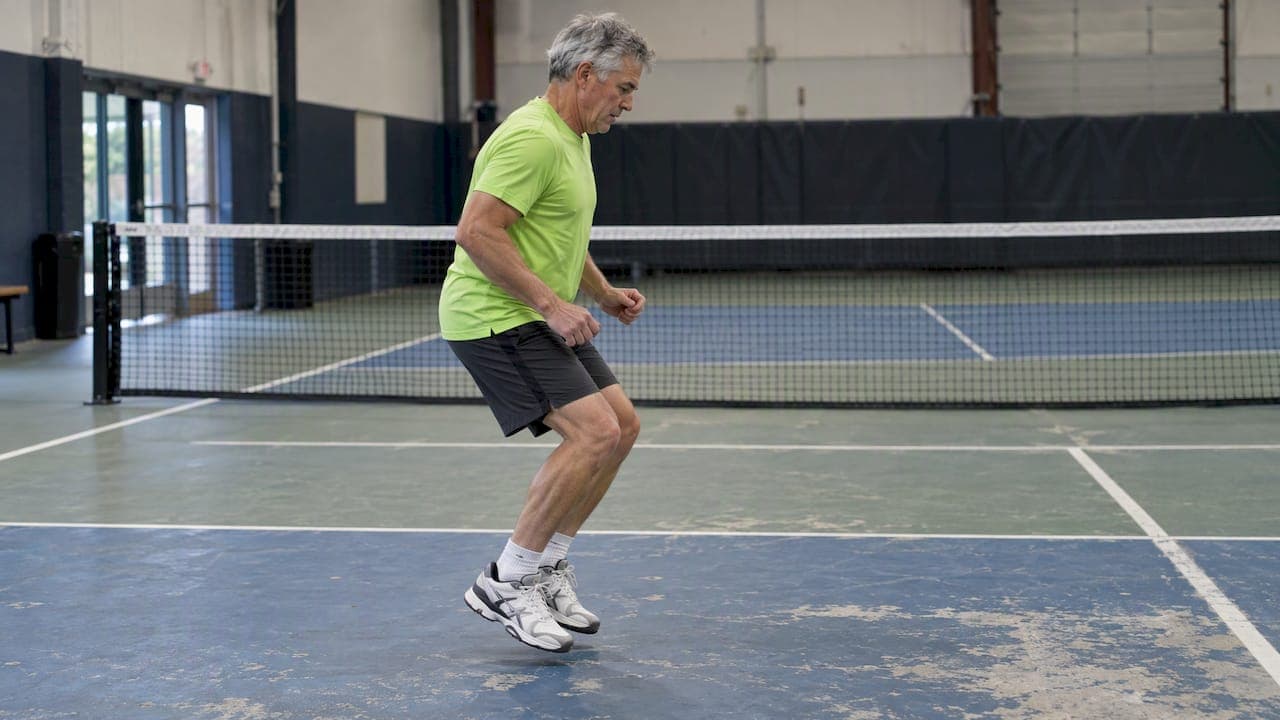
Plyometrics for pickleball means short, controlled jumping and hopping drills that train your legs to push off, stop and change direction faster. Done well, they sharpen your first step and your split step. Done badly, they load your Achilles, knees and ankles with more impact than they are ready for. The fix is not more intensity. It is learning to land first, then adding speed.
This guide covers what plyometrics should look like for a recreational player, how to use an agility ladder without rushing it, a simple weekly plan, and how to scale everything down if you are over 50 or returning from an injury.
TL;DR
- Start with landing, not jumping. NASM practitioners say to build deceleration capacity before high-velocity speed work.
- Two or three short sessions a week, with 48 to 72 hours between them, is enough. Expect changes in reactive movement within 4 to 6 weeks.
- Agility ladders reward precision. Slow the pattern down until every foot strike is quiet and controlled.
- Older players should think small hops, split-step timing and soft landings, not box jumps.
- Your own movement flaws, such as knees caving in on landing, decide which drills help you most.
Table of Contents
- Why pickleball players need plyometrics at all
- What plyometrics should mean on a pickleball court
- Agility ladder drills, done the right way
- A four-week plyometric plan for recreational players
- If you are over 50 or coming back from an injury
- Why generic drills are not enough
- Our perspective
- See your own landing mechanics
- Common mistakes to avoid
- FAQ
- Sources
Why pickleball players need plyometrics at all
Pickleball looks gentle, but the movement is stop and start: a quick lunge to a dink, a split step, a backpedal off a lob, a sharp lateral push to cover the kitchen line. Those are the same actions that show up in the injury data.
A short report on foot and ankle injuries in pickleball players describes rising injuries in older players, with running, lunging forward and sudden changes of direction as primary mechanisms. In one clinical cohort it counted Achilles tendon ruptures as 39.4% of foot and ankle injuries. A 10-year analysis of US emergency department visits also tracks the climb in pickleball injuries nationally.
Plyometric work trains the thing that protects you in those moments: the ability to absorb force and redirect it. That is the injury-prevention case. The performance case is real too. A systematic review of plyometric training in healthy people aged 9 to 63 found small-to-moderate positive effects on jump height and sprint performance (effect size 0.45) and a 0.46 effect size improvement in balance.
What plyometrics should mean on a pickleball court
Forget the picture of athletes leaping onto 30-inch boxes. For pickleball, the useful version is smaller and more specific:
- Small hops with a quiet landing, to teach the foot and ankle to absorb force.
- Split-step timing drills, to land balanced just as your opponent makes contact.
- Lateral bounds and skaters over short distances, to mimic side-to-side coverage.
- Eccentric-focused stops, where you move, then freeze for a second on the landing leg.
A pickleball-focused plyometrics guide makes the same point for older players: plyometrics does not have to mean explosive, high-impact jumping. Controlled neuromuscular drills build tendon and joint resilience without the risks of hard, high-velocity landings.
The landing comes first
Eccentric strength is your muscles' ability to lengthen under tension, which is what happens every time you land or stop. NASM practitioners treat it as the most effective way to reduce the risk of problems like Achilles ruptures and ACL stress. So the order is simple: learn to stick the landing, then add height or speed.
A landing check you can do in a mirror or on a phone video:
- Land on the ball of the foot, then let the heel lower softly.
- Knees track over the middle toes, not caving inward.
- Hips push back and chest stays tall. No stiff, straight-leg thud.
- Hold the landing for two seconds without wobbling.
If you cannot hold a two-second landing, you are not ready for the next drill on the list.
Agility ladder drills, done the right way
The agility ladder is the most common off-court tool pickleball players own, and the most common place to waste it. The usual mistake is rushing. Sloppy, fast feet increase injury risk, while the real gains come from stable, controlled foot strikes, according to The Dink's off-court footwork guide.
A standard ladder lays flat on the ground with rungs roughly 12 to 18 inches apart. Here are four patterns that suit pickleball, in order of difficulty.
| Pattern | What it trains | Starting pace |
|---|---|---|
| One foot in each square | Foot placement, rhythm | Walk-through, then jog |
| In-in-out-out | Lateral control, stopping outside the ladder | Slow, pause at the end |
| Lateral shuffle through | Side-to-side coverage at the kitchen | Controlled, eyes up |
| Ickey Shuffle | Direction changes, coordination | Very slow until clean |
The rule for every pattern: if your foot clips a rung, you are going too fast. Drop the speed until you can finish three clean passes in a row, then speed up slightly.
Keep your eyes up
On court you never look at your feet. Once a pattern is clean, have a partner hold up fingers or point left and right while you move, or bounce a ball against a wall. That turns a footwork exercise into a reaction drill.
A four-week plyometric plan for recreational players
Training just three times a week can produce measurable improvements in reactive speed and movement patterns within 4 to 6 weeks, as long as you allow 48 to 72 hours of recovery between sessions, according to the same off-court footwork guide. Here is a conservative version. Warm up for five to ten minutes first, with a routine like our pickleball warm-up.
Weeks 1 and 2: land and control
- Two-foot small hops in place: 2 sets of 8
- Single-leg balance with a soft knee bend: 2 sets of 20 seconds per side
- Ladder, one foot per square, walking: 3 passes
- Split-step, stop, hold: 2 sets of 6
Weeks 3 and 4: add direction
- Lateral hops over a line: 3 sets of 8 total
- Skater steps with a two-second hold on each landing: 3 sets of 6 per side
- Ladder in-in-out-out: 4 passes, clean before fast
- Split-step into a short lateral push: 3 sets of 6 per side
Keep the total under about 20 minutes. Low volume with high quality beats long sessions with tired, sloppy landings. Stop a set the moment your form breaks.
Pair it with strength
Plyometrics sit on top of basic strength. Squats, step-ups, calf raises and hip work make the tissues tough enough to take the landings. Our guides to pickleball conditioning and a 90-day pickleball training plan show how to fit both into a week.
If you are over 50 or coming back from an injury
Older players are where the injury numbers are heaviest. One 10-year analysis found that the 65 to 80 age bracket accounted for 61.1% of cases in its data, as described in the foot and ankle injury report. That is a reason to train carefully, not a reason to avoid training.
For this group:
- Replace jumps with heel raises, small hops and step-and-stick drills done near a wall or rail.
- Treat balance as part of the plan. The CDC's older adult guidelines call for at least 150 minutes of moderate aerobic activity a week, muscle strengthening on at least 2 days and balance work such as standing on one leg.
- Be patient. Evidence on older adults suggests that consistency and total program length matter more than intensity. A minimum of around 12 sessions is often needed before functional gains stick, according to ACSM.
- Build your balance base first. This guide to balance training for seniors is a useful place to start, and our 8-week balance plan for pickleball players is built around court movements.
If you have had an Achilles, knee or ankle injury, or you have osteoporosis, joint replacements or heart conditions, check with your physician or a physical therapist before starting any jumping drills. Calf or heel-cord pain that lingers for days after play is a reason to get examined first. Our article on Achilles pain in players over 50 explains what to watch for.
Why generic drills are not enough
Two players can do the same hop drill and need very different things. One lets the knees collapse inward on landing. Another twists the trunk or rotates the shoulder awkwardly when reaching. Researchers on neuromuscular training for court-sport athletes argue that programs should be personalized to individual stressors such as knee valgus on landing rather than relying on generic exercises.

If your knees dive inward when you land, tailoring your program to that is what makes the difference. Content on matching exercises to your individual landing mechanics and movement weaknesses reinforces the idea that recovery and prevention work best when they are specific to the person.
The problem is that you can rarely see your own landing. A friend with a phone helps. A coach helps more. Our guide to tailored pickleball exercises mapped to court moves shows how to match drills to the shots and movements where you struggle.
Our perspective
We built Play On Pickle around one belief: most recreational players are not hurt by playing too much, they are hurt by moving without preparation. Pickleball asks for sudden decelerations, and most players never train for them.

Plyometrics are a good example. Done right, they are one of the best tools for protecting the Achilles, knees and ankles. Done in a rush, from a YouTube video that assumes you already move well, they are a quick way to find your weak link the hard way.
So our advice is this: film your movement before you add intensity. Look at how you land, how you load the leg when you lunge, where the knee goes. Then pick two or three drills that fix what you see, and do them consistently. Small, boring, repeated work beats an ambitious routine you drop after a week. That is why our analysis is built on video of your own movement, and why we focus on simple exercises that fit into the time you have.
— Drona
See your own landing mechanics
Play On Pickle analyzes video of you moving and identifies stress points in your body, then gives you a personalized injury risk assessment with tailored exercise and equipment recommendations. You upload video and get a plan matched to your biomechanics, rather than a generic drill list. There is a free initial trial, and plans are $9.99 per month or $99 per year. You can also see how the technology works, or check the free tripod offer that comes with the monthly plan so you can film your sessions.
Common mistakes to avoid
- Jumping before you can land. Master the two-second hold first.
- Doing plyometrics on tired legs. Do them after the warm-up, before a hard session, never at the end of a long match.
- Daily sessions. The adaptation happens in the recovery gap. Keep 48 to 72 hours between sessions.
- Skipping the warm-up. Cold tendons and fast landings are a poor mix. Try the 5- and 10-minute routines.
- Hard surfaces and worn shoes. Use court shoes with good lateral support and a forgiving surface where you can.
- Ignoring pain. Sharp pain in the heel, calf or knee ends the set. Persistent pain means seeing a clinician.
For more general prevention habits, read our guide to pickleball injury prevention and the three-move pickleball prehab routine.
FAQ
Are plyometrics safe for pickleball players over 60?
Often yes, if you scale them down. Choose small, controlled hops, split-step timing and slow landings rather than explosive jumps, and build balance and strength first. If you have joint, tendon or heart conditions, ask your doctor or a physical therapist before starting. Our senior pickleball exercises are a gentler starting point.
How often should I do plyometrics for pickleball?
Two or three short sessions a week is enough for most recreational players. Leave 48 to 72 hours between sessions so your nervous system and tendons can adapt. Reactive movement tends to improve over 4 to 6 weeks of consistent work.
Is an agility ladder worth using for pickleball?
Yes, if you treat it as a precision tool. Slow patterns such as in-in-out-out train clean foot placement and stopping control. If you rush through the ladder and clip the rungs, you are practicing sloppy mechanics.
Do I need a gym or box for pickleball plyometrics?
No. Small hops, skater steps, lateral hops over a line and ladder work need only floor space and a ladder or tape. Boxes are optional and rarely needed for recreational players.
Sources
- Emerging Patterns of Foot and Ankle Injuries in Pickleball Players (PubMed)
- Increasing Incidence of Pickleball Injuries Presenting to US Emergency Departments (PubMed)
- Plyometric training systematic review (PubMed)
- Neuromuscular training for court-sport athletes (PubMed)
- CDC: Physical activity guidelines for older adults
- ACSM: Strength and power exercise for osteoarthritis
- NASM: Pickleball fitness training
- The Dink: How to improve footwork off court for pickleball
- Pickleball plyometrics: explosive footwork drills
- Pickleball footwork ladder drills