
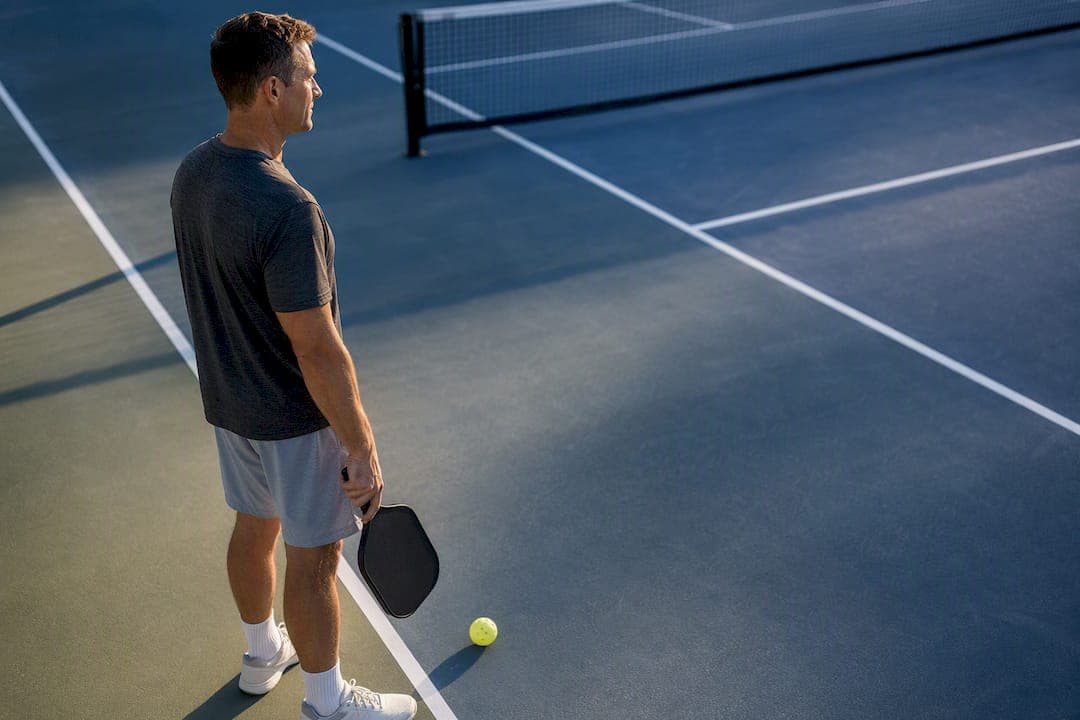
Pickleball load management comes down to three rules: increase weekly court time by no more than 10 to 20 percent, warm up dynamically for 5 to 10 minutes before every session, and run 2 to 3 targeted strength sessions a week for your hips, glutes, core, and shoulders. Follow those three, and you address the biggest driver of pickleball injuries: volume that outpaces what your tendons and ligaments can absorb. The sections below cover the warning signs, the weekly plans, and how an AI tool can personalize all of it to your own movement.
TL;DR:
- Playing three or more times weekly increases injury risk by 45 percent, especially if injury prevention measures like warm-ups and strength training are not prioritized.
- Exceeding your body's tissue capacity often shows up as joint pain or stiffness lasting more than 24 hours, requiring reduced activity and possible medical assessment.
- Increasing weekly court time should stay within 10 to 20 percent increments to avoid volume spikes that elevate overuse injury chances.
- A proper warm-up takes less than 10 minutes and includes light cardio, mobility work, and dynamic footwork, significantly reducing injury risk during play.
- Targeted strength sessions focusing on hips, glutes, core, and shoulders, scheduled on non-consecutive days, help maintain joint stability and prevent injuries in pickleball.
Table of Contents
- What Load Management Means for Pickleball Players
- Why Load Management Matters: What the Injury Data Shows
- Signs You've Exceeded Your Load (And What to Do About It)
- A Practical Weekly Ramp-Up Plan (Sample 4-Week Progression)
- Your 5-Minute Dynamic Warm-Up (And How to Pace a Session)
- Strength Training That Actually Protects Your Game
- Match-Day Adjustments When Your Body Needs a Break
- Recovery Habits That Multiply Your Training Gains
- What to Do When Pain Shows Up
- How AI Movement Analysis Fits Into Your Load Plan
- Balancing More Court Time With Staying Healthy
- Getting Started With Play On Pickle
- Sources
- FAQ
What Load Management Means for Pickleball Players
Load isn't just how many hours you play. It's the combination of time on court, the intensity of that time, how many days in a row you play, and how many explosive, direction-changing movements you rack up during a session. A two-hour double match with your regular Tuesday group is a different load than two hours of tournament singles with constant sprinting and lunging, even though the clock reads the same.
The trap most players fall into is confusing cardiovascular fitness with tissue readiness. Your heart and lungs adapt to new activity in days. Your tendons, ligaments, and cartilage adapt over weeks to months. You can feel great, breathe easy, and still be loading a rotator cuff or an Achilles tendon faster than it can rebuild.
Two patterns show up constantly among new injuries:
- The "weekend warrior" who plays twice a week for a month, then jumps to daily play during a vacation or a work break.
- The player who enters a tournament after months of casual play, suddenly stacking three matches in a single day.
Both cases share the same problem: cardio says go, tissue says not yet.
Why Load Management Matters: What the Injury Data Shows
The injury numbers behind pickleball's growth are not subtle. A nationwide study of 1,758 pickleball players found that players who competed three or more times per week had a 45 percent higher likelihood of getting injured than less frequent players. That single data point should reshape how you think about a "light" week of daily pickleball.
The same research turned up something even more useful for prevention: players who rated injury prevention as low or moderate priority were twice as likely to get hurt as players who took it seriously. That's not about talent or fitness level. It's about whether you warm up, whether you strength train, and whether you respect ramp-up limits.
Players who reported playing three or more times per week had 45 percent higher injury odds. Those who didn't prioritize prevention were twice as likely to get injured.
Beyond frequency, the injury types themselves cluster predictably. Reviews of pickleball injury patterns consistently point to two categories: sudden traumatic injuries (a rolled ankle, a fall lunging for a dink) and slow-building overuse injuries like rotator cuff tendinopathy, Achilles issues, and meniscal irritation, most of which trace back to volume spikes and skipped conditioning, according to a review of pickleball injury types.
Age and experience compound the risk. Newer players tend to have less developed movement patterns for lateral shuffles and split steps, so they load joints inefficiently. Older players start with less tendon elasticity and slower repair rates, so the same volume spike that a 30-year-old shrugs off can sideline a 60-year-old for weeks. Neither group is doomed. Both just need to respect the same ramp-up math, adjusted for their starting point.
Signs You've Exceeded Your Load (And What to Do About It)
The most useful tool you own for load management costs nothing and takes ten seconds: the next-day test. How your body feels roughly 24 hours after playing tells you almost everything about whether yesterday's session was appropriate or excessive.
General muscle soreness that eases with movement and is gone or fading by the next day is normal training response. Pain that is localized to a joint, gets worse with use rather than better, or comes with stiffness lasting more than 24 to 48 hours is a different animal. That pattern usually signals structural irritation, not routine fatigue.
Here's how to read the signals and respond:
- Mild, diffuse soreness that fades within a day — Normal. Play your next scheduled session as planned.
- Localized joint pain that lingers past 24 hours — Reduce your next session's volume by half and skip drives or overhead smashes.
- Pain that worsens with the same movement repeated — Stop that movement pattern entirely for the week and substitute lower-impact drills.
- Morning stiffness lasting more than 48 hours, or swelling — Take a minimum of 3 to 5 days off court and consider a clinician visit.
- You catch yourself altering your swing or footwork to avoid pain — Stop playing. Physicians flag altered mechanics as a sign of tissue actively failing under load, and playing through it usually turns a minor issue into a long layoff.
Pro Tip: Keep a one-line note in your phone after every session: hours played, intensity (1 to 10), and how you felt the next morning. Three weeks of that log will show you your personal load ceiling faster than any generic rule can.
If you hit red flag number four or five more than once in a month, that's not bad luck. That's your body telling you the current schedule doesn't fit your current tissue capacity.
A Practical Weekly Ramp-Up Plan (Sample 4-Week Progression)
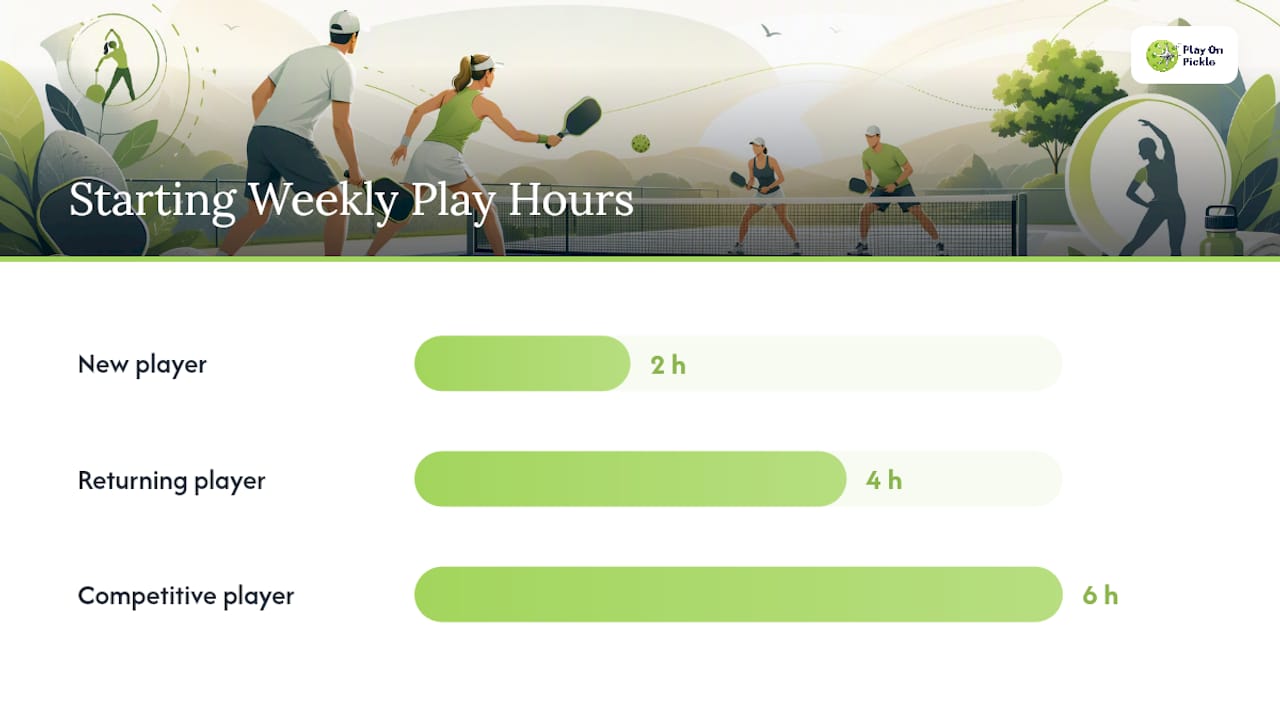
The 10 to 20 percent rule is simple in theory and easy to blow past in practice. If you played 3 hours last week, this week tops out around 10 to 20 percent more, not nearly double to 5 hours. That gap between "feels fine" and "is fine" is exactly where overuse injuries incubate.
Here's how that math plays out for three different starting points:
- New player starting at 2 hours/week — Week 1: 2 hours. Week 2 increases slightly. Each week, increase total play time by no more than 10 to 20 percent, so totals grow gradually rather than jumping in large leaps.
- Returning player starting at 4 hours/week — Week 1: 4 hours. Week 2 increases slightly. Each week, increase total play time by no more than 10 to 20 percent, so totals grow gradually rather than jumping in large leaps.
- Competitive player starting at 6 hours/week — Week 1: 6 hours. Week 2 increases slightly. Each week, increase total play time by no more than 10 to 20 percent, so totals grow gradually rather than jumping in large leaps. This is approaching a reasonable ceiling for most recreational schedules.
Notice the ranges widen as the baseline grows. That's intentional. A jump from 6 to 7.2 hours is a bigger absolute demand on tissue than 2 to 2.4 hours, even though both represent a 20 percent increase.
A few scheduling rules make this progression actually work instead of just looking good on paper:
- Avoid stacking three or more high-intensity sessions on consecutive days, even within your weekly cap. Tissue needs at least one lower-load day between hard sessions.
- Build a deload week into every fourth or fifth week, where you drop volume back to roughly 70 percent of your peak, even if you feel capable of more.
- Before a tournament, taper court time in the final week rather than adding extra practice. Arrive slightly undertrained, never overreached.
- Treat back-to-back tournament days as a single load event. Plan for reduced intensity or a rest window between matches, not just between weekends.
- If you missed more than two weeks of play for any reason, restart the ramp-up from roughly half your prior volume, not where you left off.
This isn't about being conservative for its own sake. It's about giving connective tissue the weeks it needs, since tendons and ligaments adapt slower than the cardiovascular system does, which is exactly why a player can feel ready for more volume while their joints are not.
Your 5-Minute Dynamic Warm-Up (And How to Pace a Session)
A proper warm-up before pickleball takes less time than finding a parking spot near a busy court complex, and it does more for injury prevention than almost anything else on this list.
Run through this sequence before you pick up a paddle:
- Minutes 1 to 2, light cardio: Brisk walking or light jogging in place to raise core temperature.
- Minutes 2 to 4, mobility work: Arm circles, walking lunges, high knees, and torso rotations to open up the shoulders, hips, and spine.
- Minutes 4 to 6, footwork prep: Lateral shuffles and split-step drills that mimic actual court movement.
- Minutes 6 to 10, progressive kitchen rallies: Start with soft, controlled dinks and gradually add pace and movement as your body signals it's ready.
That last phase matters more than players give it credit for. Jumping straight into full-speed drives after arm circles skips the exact rehearsal your nervous system needs for the specific demands of the game.
Pacing during the session itself is its own skill. If you feel your legs getting heavy or your reaction time slipping mid session, that's your cue to ease off, not push through. Switching to doubles for a set, favoring dinks and controlled rallies over drives, or simply taking a longer changeover break all lower acute load without ending your day early.
Close every session with a short cool-down: 3 to 5 minutes of walking to bring your heart rate down gradually, followed by light static stretching for the calves, hamstrings, and shoulders. Hydrate immediately rather than waiting until you're home.
Pro Tip: If your warm-up routine feels like a chore, cut it to the bare 5-minute version rather than skipping it entirely. A short warm-up beats no warm-up by a wide margin, and consistency matters more than duration.
Strength Training That Actually Protects Your Game
Pickleball asks your body to decelerate hard, change direction instantly, and rotate through the trunk on nearly every point. The joints that absorb most of that demand are the hips, glutes, core, shoulders, and calves, which is exactly why clinicians recommend building targeted strength around those specific areas rather than a generic full-body routine borrowed from the gym.
The rotator cuff deserves particular attention. Overhead smashes and quick, short-lever shots at the net load the shoulder in ways most recreational players never trained for before picking up a paddle. Weak stabilizers there are a common thread in shoulder tendinopathy cases among mid-level players.
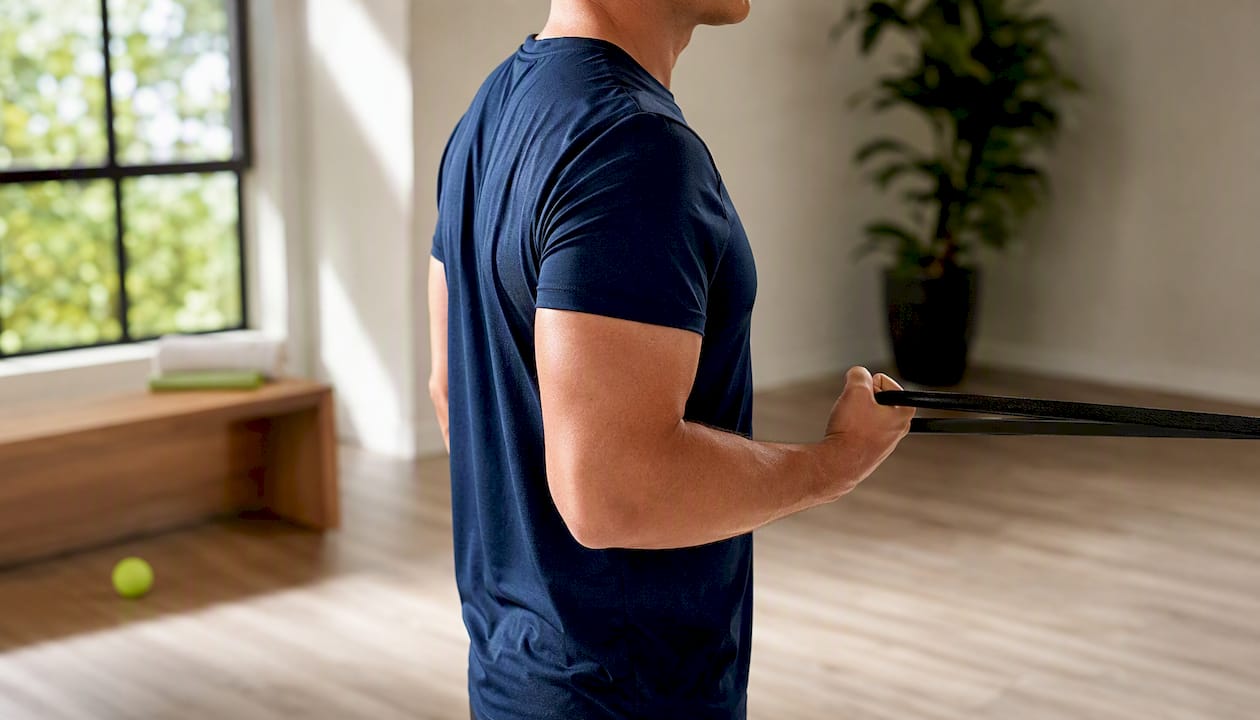
Two sessions a week, 20 to 30 minutes each, cover the bases without adding meaningful fatigue to your court time.
Session A: Lower body and stability
- Lateral band walks, 3 sets of 12 steps each direction, to activate the glutes that control side-to-side movement.
- Single-leg glute bridges, 3 sets of 10 per side, progressing to a slower 3-second lowering phase after two weeks.
- Slow-lowering calf raises, 3 sets of 12, emphasizing a 3 to 4 second eccentric phase to build Achilles tolerance.
- Standing hip abduction with a resistance band, 2 sets of 15 per side.
Session B: Core, shoulder, and rotational control
- Dead bug, 3 sets of 10 per side, for anti-rotation core control.
- Cable or band rotational chops, 3 sets of 10 per side, mimicking the trunk rotation of a groundstroke.
- External rotation with a light resistance band, 3 sets of 15, targeting the rotator cuff directly.
- Bird dog, 3 sets of 8 per side, holding each rep for 2 seconds.
Keep the weight light and the control high. Movement quality and stability transfer to pickleball better than heavy lifting, so resistance bands and body weight are appropriate tools for most recreational players, not a compromise.
Schedule these sessions on non-consecutive days, ideally the day after a hard match rather than the morning before one. If you're mid ramp-up week and feeling unusually fatigued, it's fine to swap a strength session for a lighter mobility routine rather than skip recovery entirely.
Match-Day Adjustments When Your Body Needs a Break
Not every load decision happens in the gym or on a rest day. Some of the smartest load management happens mid-match, through tactical choices that keep you playing while asking less of your body.
- Choose doubles over singles when you're managing fatigue or returning from a minor issue. Doubles cuts your court coverage roughly in half.
- Favor dinks, drops, and controlled rallies over hard drives when your shoulder or elbow feels off. Drives generate far more joint stress per shot.
- Shorten your playing block. Two focused hours beats four hours where the back half is played on compromised mechanics.
- Rotate out for a game or two during open play sessions rather than playing every single game back to back.
Tournament days call for their own plan. Build in a rest window between matches whenever the bracket allows it, even if that means arriving earlier or leaving later than you'd prefer. If you're managing a nagging issue, tell your partner or team ahead of time so substitutions or rotation plans are already agreed upon rather than negotiated mid-event under pressure. Controlled re-entry, meaning you ease back into full intensity after a break rather than sprinting into the first point at full speed, protects against the exact spike-in-volume pattern that causes overuse injuries in the first place.
Recovery Habits That Multiply Your Training Gains
Everything covered so far builds capacity. Recovery is what lets your body actually use it.
Sleep is the biggest lever most players ignore. Aim for 7 to 9 hours a night, since clinical guidance consistently ties adequate sleep to tissue repair and resilience against repeated sport loads. Cutting sleep short on a night after a heavy match session is one of the fastest ways to blunt the adaptation you just worked for.
- Hydrate steadily throughout the day, not just during play. Dehydration going into a session reduces tissue elasticity and raises strain risk.
- Use active recovery, like a 20 minute walk or gentle mobility work, on days off rather than complete inactivity, which tends to leave joints stiffer.
- Prioritize protein intake to support muscle repair, and don't neglect basic collagen-supporting nutrients like vitamin C-rich foods that assist connective tissue healing.
- Consider non-invasive recovery modalities, such as those covered in this guide to sports recovery therapy, when soreness lingers longer than expected.
- Schedule at least one full rest day weekly, even during a good stretch where you feel capable of more.
None of these habits are complicated. They're just easy to skip when the schedule gets busy, which is exactly when they matter most.
What to Do When Pain Shows Up
New or worsening pain during or after play calls for a specific, unglamorous response: stop the aggravating movement, scale back total volume, and protect the area rather than testing it repeatedly to see if it's "really" hurt.
A staged return works better than an all-or-nothing approach:
- Days 1 to 3: Complete rest from the aggravating movement. Light walking is fine.
- Days 4 to 7: Reintroduce pain-free range of motion and light mobility work, no paddle.
- Week 2: Light, controlled dinking only, well below match intensity, monitoring the next-day response closely.
- Week 3: Gradual return to rallying at 50 to 70 percent intensity, avoiding the specific shot that originally caused pain.
- Week 4 and beyond: Full return only if the prior stage produced zero pain, both during and 24 hours after.
Certain signs mean this whole staged approach should pause in favor of a clinician visit: swelling that doesn't reduce within a few days, pain that wakes you at night, numbness or tingling, or any joint that feels unstable or gives way. A physician's evaluation at that point is faster and cheaper than months of guessing. For specific joints, resources on wrist pain, elbow pain, and Achilles issues walk through joint-specific red flags in more depth.
How AI Movement Analysis Fits Into Your Load Plan
Every rule in this article works better when it's calibrated to your actual movement, not a generic recommendation. That's the gap Playonpickle's computer vision technology is built to close: it analyzes a short video of your play and identifies where your specific mechanics are creating stress, whether that's an overloaded shoulder on your overhead swing or excessive strain on one knee during lateral movement.
The AI video analysis works alongside the manual tracking described above, not instead of it. Practical outputs include:
- Flagging biomechanical stress points specific to your swing and footwork patterns.
- Generating personalized exercise recommendations that target the joints your own movement puts most at risk.
- Tracking trends across sessions, so you can see whether your mechanics are improving or drifting back toward risky patterns.
None of this replaces a clinician when you're already dealing with pain or a suspected injury. Think of it as the layer that catches the small mechanical habits that eventually become the injuries this article is written to help you avoid.
Balancing More Court Time With Staying Healthy
The players who last longest in this sport aren't the ones with the best forehand. They're the ones who treat load like a budget instead of a reward for enthusiasm. Progress that feels almost boringly gradual, a 10 percent bump here, an extra strength session there, beats the boom-and-bust cycle of playing hard for three weeks and then sitting out six.
Track your sessions and your next-day responses the same way you'd track a training log for any other sport. The data doesn't lie the way memory does. A week you remember as "fine" often looks very different once you write down what your knee actually felt like the morning after.
Playing more and getting hurt less isn't a contradiction. It's a scheduling problem with a known solution.
— Drona
Getting Started With Play On Pickle
Most load management advice asks you to guess how your own mechanics stack up against the general rules. Playonpickle removes the guesswork on that one piece: it uses patent-pending computer vision to analyze your actual on-court video and map your specific movement patterns to the stress points most likely to cause injury.
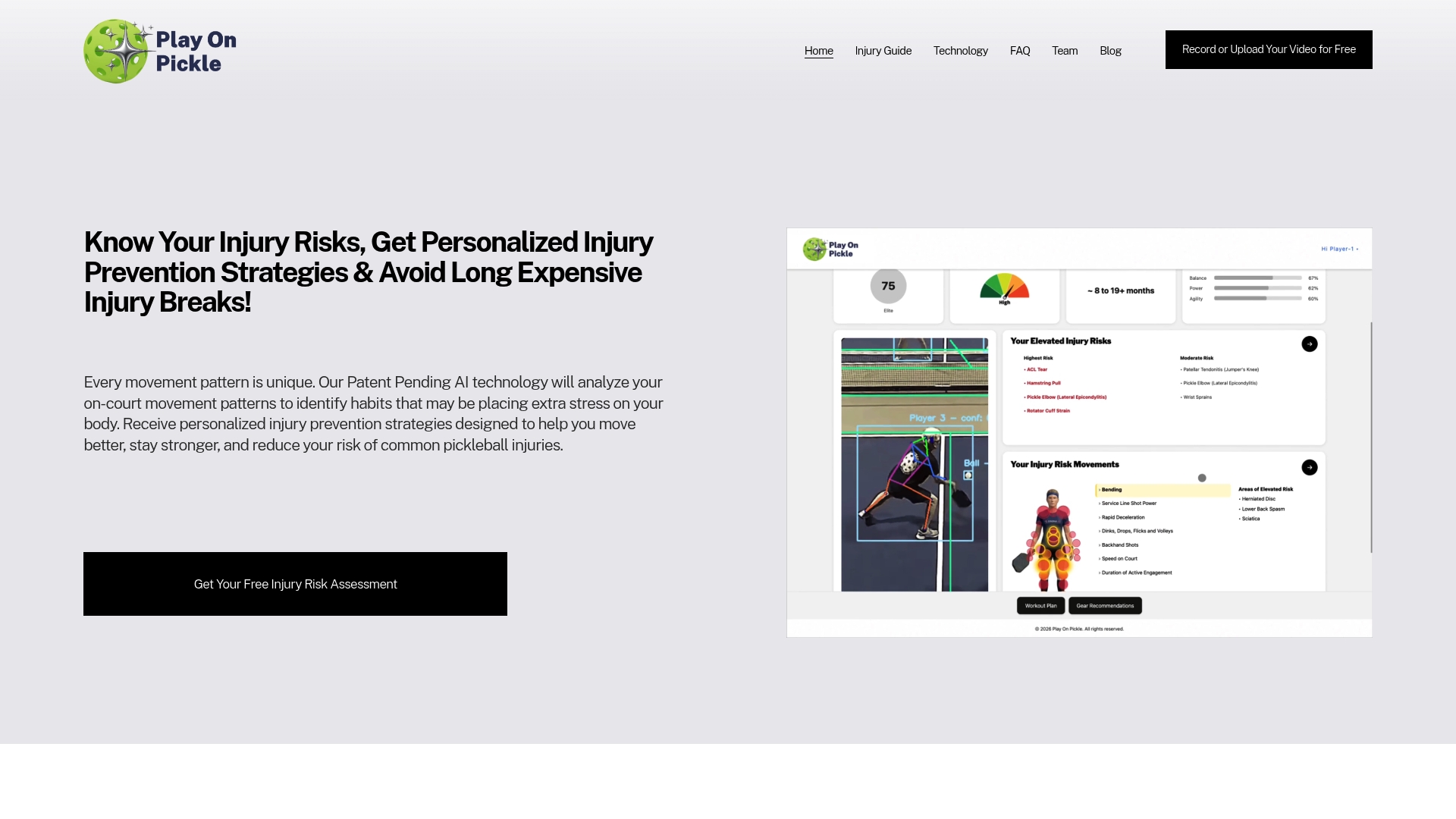
Once you upload a short clip of yourself playing, the system flags where your mechanics are putting excess strain on a joint and builds a personalized set of exercises around it, the kind of targeted work this article recommends for hips, shoulders, and core, but tuned to your own swing instead of a generic list. Progress tracking then lets you see whether those stress points are improving week over week, which turns the next-day test and the weekly ramp rules into something measurable instead of something you're eyeballing.
Playonpickle's monthly subscription runs $9.99 per month, with an annual subscription available at $99 per year for players who want to commit for the season. New subscribers can also claim a free tripod with signup to make filming your own sessions easier. Start by uploading a short video of your next match and see what your own movement is telling you.
Sources
This guide draws on a nationwide study of 1,758 pickleball players covering injury predictors, alongside injury-prevention guidance from UC Davis Health and an orthopedic surgeon's prevention guide. Additional context on injury types comes from a peer-reviewed review of pickleball injuries and physician commentary published by the American Medical Association.
- Understanding Injury Patterns and Predictors in Pickleball Players: A Nationwide Study of 1,758 Participants — PMC
- Pickleball injuries are on the rise. Here are 10 tips to avoid them while playing. — UC Davis Health
FAQ
What Is Load Management in Pickleball?
Load management means controlling how much court time, intensity, and repeated explosive movement you accumulate week to week, so your tendons and ligaments have time to adapt rather than break down. The core rule is a 10 to 20 percent weekly increase in court time, paired with dynamic warm-ups and targeted strength work.
What Are the Five P's of Pickleball?
The "five P's" typically refer to positioning, patience, placement, power, and preparation, the core tactical and mental skills coaches use to teach shot selection and court strategy. They describe playing strategy rather than injury prevention, though preparation overlaps with warming up properly before matches.
How Fast Do Pros Serve in Pickleball?
Professional pickleball serves generally travel at speeds well below tennis serves, since the paddle and court dimensions limit how much pace a serve can generate. Recreational serves are typically slower still, which is one reason serving carries lower injury risk than groundstrokes or overhead smashes.
What Kind of Weight Training Is Best for Pickleball Players?
Low-weight, high-control strength training focused on the hips, glutes, core, and shoulders, using resistance bands, bodyweight movements, and slow eccentric exercises like calf raises, transfers best to pickleball's demands. Heavy bodybuilding-style lifting isn't necessary and can add fatigue that interferes with movement quality on court.
How Can I Tell if I've Exceeded My Load for the Week?
Use the next-day test: general soreness that fades within 24 hours is normal, while localized joint pain, swelling, or stiffness lasting more than 24 to 48 hours signals you've exceeded your tissue's capacity. When that happens, cut your next session's volume and consider an AI movement analysis through a tool like Playonpickle to identify which specific movement is driving the strain.