
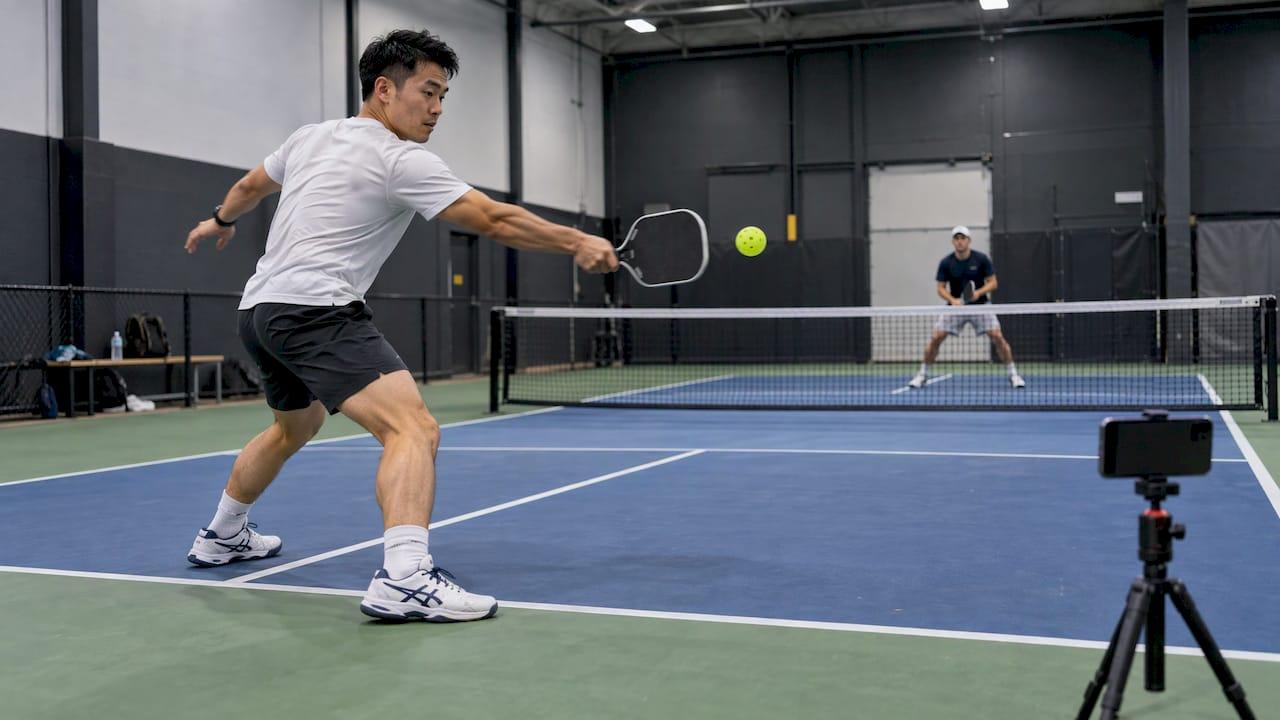
Your injury risk in pickleball is not the same as the next player's. It depends on your age, how often you play, how long you have played, your injury history, how strong and stable your hips, shoulders and core are, and how you actually move on court. Some of these you can't change. Many you can, and AI movement analysis from a phone video now helps you see which ones matter most for you.
This guide covers what the research says about who gets hurt and why, how movement patterns feed into risk, how AI assessment works, and how to turn all of it into a simple plan.
TL;DR
- Risk is personal: age, weekly play frequency, experience level, past injuries and movement quality all shift your odds.
- In a 2025 nationwide study, players who played three or more times a week had 45% higher odds of injury than those who played up to twice a week.
- Falls drive many of the serious injuries, and hip strength and change-of-direction ability are linked to falling.
- AI video analysis looks at how you move, flags stress points, and turns them into targeted exercises you can fit into a normal week.
- Pain you can't explain, swelling that worsens, or trouble putting weight on a limb needs a clinician, not a workaround.
Table of Contents
- Why "average risk" tells you little about your own
- The factors that shape your personal risk
- How your movement pattern adds to the picture
- What AI movement analysis looks at
- How Play On Pickle turns a video into a plan
- Building your own prevention plan
- Where each type of player should focus
- Our perspective
- Try a personalized assessment
- When to see a medical professional
- FAQ
- Sources
Why "average risk" tells you little about your own
Pickleball injury numbers are large. A 10-year analysis found an estimated 66,350 pickleball-related injuries in US emergency departments between 2013 and 2022, with fractures the most common diagnosis (32.7%) and strains and sprains close behind (30.8%). The wrist was the most injured body part. The mean age of injured patients was 64.6 years, and 61.1% were between 65 and 80.

Those figures describe a population. They tell you pickleball injuries are common and that older players show up often in emergency rooms. They don't tell you whether your shoulder, knee or elbow is the one to protect. That is the gap personalized risk assessment fills.
The data also shows that the pattern of injury differs by person. A 2025 epidemiology study using the national injury surveillance database found that women had higher odds of hand and wrist injuries and fractures, while men had higher odds of lower extremity injuries and strains or sprains. Two players on the same court can face quite different problems.
The factors that shape your personal risk
The most useful single source here is a 2025 study of 1,758 US pickleball players. Twelve-month injury prevalence was 68.5%, and the knee was the most commonly affected area (29.1%), followed by the shoulder (22.2%), back (19.9%) and elbow (18.4%). The same study identified predictors of injury. Here they are in plain terms.
| Factor | What the study found |
|---|---|
| Playing frequency | Three or more sessions a week: odds of injury 1.45 times higher than up to two |
| Experience | Fewer than five years of play: odds 1.50 times higher |
| Age | Odds rose for age groups from 33 to 77 years (odds ratios from 1.83 to 3.11) |
| Sex | Male sex associated with 1.33 times higher odds |
| Attitude to prevention | Players who rated injury prevention as low or moderate importance had 2.02 times higher odds |
| Session length | Average session duration was not a significant predictor |
Two things stand out. First, newer players are at higher risk, which makes sense: their bodies and movement habits haven't adapted to the sport's stop-start demands. Second, how much you value prevention is itself linked to injury. That is the factor most within your control.
Frequency, long sessions and back-to-back days
A 2025 study of 253 recreational players looked at the upper body. It found that 41% reported at least one upper extremity injury, and that the risk was 1.51 to 1.53 times higher among those who played longer or more frequent sessions or on consecutive days. For acute injuries, relative risk was 2.38 for playing more than two hours at a time and 4.97 for playing on consecutive days. A tight baseline grip was also linked to acute injury.
A systematic review of six articles reached a similar conclusion. It listed age, gender, technique, equipment, lack of warm-up and stretching, past injuries, overuse and court surface as risk factors, and said overuse and skipped warm-ups deserve the most attention.
Age and the tissue you have
Age is the most consistent factor. A 2026 systematic review of 15 studies found that age 50 or older was a consistent risk factor across nearly all studies, with falls the leading mechanism of lower extremity injury. One critical analysis review notes that in other racquet sports the average injury age is under 50, while in pickleball many cases are in patients 60 and older. The authors point to age-related changes in the collagen of tendons and ligaments, which reduce tissue compliance.
In fracture data the pattern is stark: a 2024 analysis found that 87% of fracture patients were over 60, 69% were female, and 92% of fractures were due to falls.
None of this means older players should stay off the court. It means the work that makes the biggest difference for them is strength, balance and fall control.

Falls, hips and how fast you change direction
A 2024 study of 92 recreational players found that 42% had fallen while playing, and 30% had fallen more than once. Players who fell were older and slower on a pickleball-specific change-of-direction test, and stronger hip abductors were associated with faster times. Hip strength and agility are trainable. If you are in the group that worries about falls, a balance training guide for seniors is a sensible companion to your court work.
Injury history and what you do away from the court
Past injuries appear in the risk factor reviews, and so does conditioning. The research on prehabilitation, covered below, is built on the idea that the body you bring to the court matters as much as the court time itself.
How your movement pattern adds to the picture
The factors above are about you as a statistic. Movement analysis is about you as a mover. Two players of the same age and weekly frequency can load their elbows very differently depending on grip, contact point and swing path.
Some examples from the clinical literature:
- Grip. The review on aging athletes notes that the Eastern grip is related to radial-sided injuries, while the Western grip is associated with ulnar-sided injury.
- Paddle weight. The same review notes that new players tend to use heavier paddles (8.5 oz) than lighter versions (7.2 oz), which may raise the risk of lateral epicondylitis in beginners.
- Footwork. A clinical review in ACSM's Clinical Sports Medicine Reports recommends learning the split step to stay in a ready position, being careful with sudden stops near the non-volley zone line, keeping the contact point in front of the body, and avoiding backpedaling on your heels to chase a lob.
Each of these is something you can see on video and correct. Most players never see them, because nobody watches their forehand from the side with a trained eye.
What AI movement analysis looks at
AI movement analysis uses pose estimation: software finds your joints in each frame of a video and tracks how they move. A 2025 research preprint is a good example of the approach. It used markerless pose estimation from a smartphone camera, extracted elbow-angle time series during the forehand drive, and used clustering to sort novice players into three distinct upper-limb movement patterns. The authors argue that this kind of objective, data-driven method gives a biomechanical explanation for the high rate of tennis-elbow type problems in novices, where assessment has typically relied on subjective visual observation.
Broader sports science points in the same direction. A 2025 review reports that machine learning and wearable technology show promise by capturing dynamic, personalized, high-dimensional data, and that models combining modifiable and non-modifiable risk factors, such as workload, injury history and fitness, predict better than a single test.
That is the logic behind a personalized assessment: combine who you are (age, history, how often you play) with how you move (joint angles, asymmetries, stress points), and turn it into a short list of priorities rather than a generic routine.
How Play On Pickle turns a video into a plan
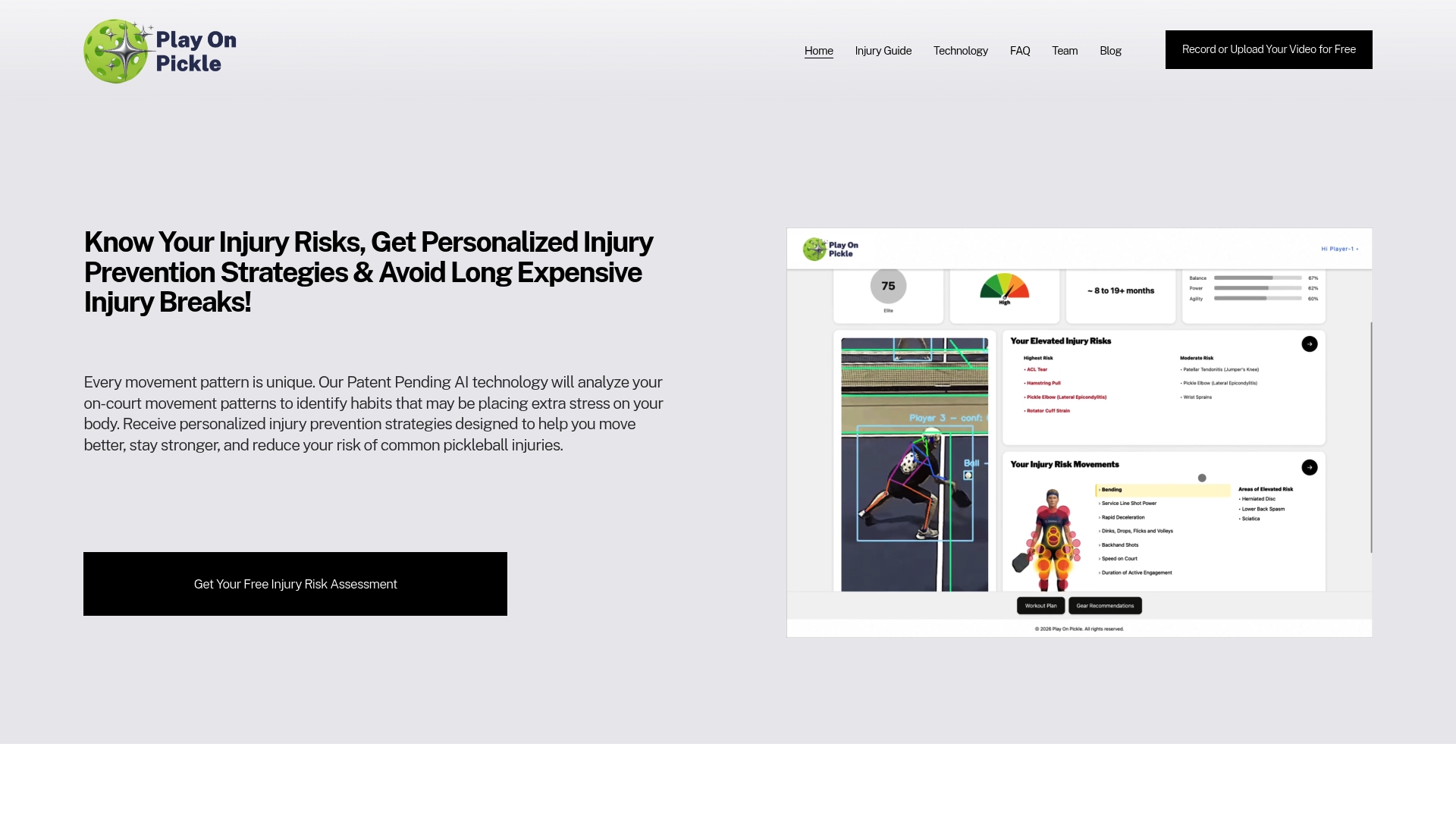
We built Play On Pickle around this idea. You upload a video of yourself playing, and our patented computer vision technology analyzes your movement patterns, identifies biomechanical stress points in your body, and produces a personalized injury risk assessment. From there you get tailored exercise and equipment recommendations designed to fit into your existing routine. Our approach is designed for convenience: minimal equipment, and little time.
We describe it as clinically validated, patent-pending analysis built for pickleball-specific biomechanics, as opposed to a generic workout app. If you want the detail on how video review works, our guide to pickleball video analysis walks through it, and how computer vision and a short warm-up cut risk covers the research behind it.
Building your own prevention plan
Whether you use an app or not, the research points to a few priorities. Adapt the order to your own risk profile.
- Check your load first. If you play three or more times a week, or on back-to-back days, build in rest days and avoid stacking long sessions. This is the cheapest change and the one the data supports most clearly.
- Add prehabilitation. A 2025 clinical article recommends eccentric strengthening of the rotator cuff and lower extremities, balance and proprioceptive training, and core stabilization. The authors describe prehab as exercise programming designed to optimize functional capacity, correct asymmetries and enhance joint stability. Our prehab routine for recreational and senior players shows three moves to start with.
- Train your hips and your first step. Given the link between hip abduction strength, change-of-direction speed and falls, single-leg and lateral strength work earns a place in your week. Our six-week single leg plan is built for this.
- Fix the technique cues. Use the split step, keep contact in front of your body, and avoid backpedaling on your heels.
- Match your equipment to your body. If you are new and your elbow aches, a lighter paddle and a more neutral grip are worth discussing with a coach.
- Warm up. The authors of the ACSM review suggest a sport-specific warm-up such as a quick game of skinny singles, while noting that no studies yet show it reduces injury. A short routine takes little time, and our 5 to 10 minute warm-up guide for coaches and players lays one out.
For older players, fall risk deserves its own attention. A clinician-written checklist on moves that cut fall risk at home is a useful complement to court-specific work. Our senior pickleball safety checklist puts the evidence together for players over 60.
Where each type of player should focus
| If you are... | Start here |
|---|---|
| A newer recreational player | Pace your weekly sessions, use a lighter paddle, learn the split step |
| A 3 to 5 times a week regular | Schedule rest days, vary session length, add shoulder and hip strengthening |
| Over 60 | Balance, single-leg strength, fall-safe footwork, a gradual build-up |
| A coach or facility | Standardize a short warm-up and use video to spot movement flaws early |
| A competitive player | Track asymmetries and workload; use video to find overload patterns |
For a wider look at the numbers behind these groups, see our pickleball injury statistics page, and for a plan by player type, our injury prevention guide.
Our perspective
Most pickleball injury advice is written for an average player who doesn't exist. Warm up, stretch, wear good shoes: all fine, and none of it tells you whether your right shoulder or your left knee is the weak link.
We think the next step in prevention is personal. When a player can see how their own body moves, with their own grip, their own footwork and their own habits, the advice stops being abstract. A recreational player who plays three mornings a week doesn't need a gym program built for an elite athlete. They need two or three simple exercises aimed at the places their movement loads hardest, and a plan that fits into a busy week.
That is what we designed Play On Pickle to deliver: video in, stress points identified, a short targeted plan out. The research on prehabilitation says that the body you bring to the court shapes your longevity in the sport. We want every player, whatever their age or level, to have the tools to build that body.
Drona
Try a personalized assessment
If you want to know where your own risk sits, Play On Pickle gives you an assessment based on your own video, with exercise and equipment recommendations built around what the analysis finds. There is a free initial trial, so you can see your first results before committing.
After the trial, the monthly subscription is $9.99 per month and the annual subscription is $99 per year. You can also start from our home page and see how it works.
When to see a medical professional
Personalized tools help you prevent problems. They don't replace a diagnosis. One health system's guidance says to see a doctor if you can't put weight on the injured area, if pain or swelling gets worse, or if you can't use your hand, arm or leg normally. A sudden sharp pain in the back of the ankle or calf during a push-off, a fall followed by wrist pain, or an ankle that keeps swelling are all reasons to book a visit with your primary care doctor, an orthopedic specialist or a sports medicine physician. If you have a heart condition, joint replacement, osteoporosis or you've been inactive for a long time, check with your doctor before ramping up play or starting a new exercise program.
FAQ
What affects my personal injury risk in pickleball the most?
Age, how often you play, how long you've played and your attitude toward prevention all show up in the research. In a nationwide study of 1,758 players, playing three or more times a week, having under five years of experience and rating prevention as low or moderate in importance each raised the odds of injury. Your movement pattern adds a further layer that video can reveal.
Can AI really assess injury risk in pickleball?
AI pose estimation can track joint angles from smartphone video and sort movement patterns, as a 2025 research preprint showed for the forehand drive in novice players. Play On Pickle uses patented computer vision to find stress points in your movement and turn them into a personalized plan. It is a way to see your own mechanics and prioritize exercises.
Does playing more often always mean more injuries?
Frequency matters, but so does the way you play. Players with three or more sessions a week had higher odds of injury in the 1,758-player study, and playing on consecutive days raised acute upper-body injury risk in a separate study. Average session length alone was not a significant predictor in the larger study, so spacing and recovery are worth planning.
Are older players at higher risk?
Yes, age 50 or older is a consistent risk factor in the research, and most fractures happen in players over 60, mostly through falls. Balance, hip and leg strength, and a gradual build-up are the priorities. Starting a strength routine earlier tends to make that easier.
What equipment should I use to lower my risk?
Paddle weight and grip both appear in the clinical literature. Beginners tend to use heavier paddles, which may raise the risk of tennis elbow, and different grips load different sides of the forearm. Our assessment includes equipment recommendations based on your movement, and a coach can check your grip in person.
Sources
- Increasing Incidence of Pickleball Injuries Presenting to US Emergency Departments (PMC)
- The Epidemiology of Pickleball Injuries Presenting to US Emergency Departments (PMC)
- Understanding Injury Patterns and Predictors in Pickleball (Sports Medicine - Open)
- Risk of Upper Extremity Injury in Recreational Pickleball Players (MDPI)
- Risk factor of pickleball injury: systematic review and meta-analysis
- Lower Extremity Injuries in Adult Pickleball Players: A Systematic Review (PMC)
- Pickleball Injuries in the Aging Athlete: A Critical Analysis (PMC)
- Pickleball-Related Fractures in the United States From 2002 (PMC)
- Hip Strength, Change of Direction, and Falls in Recreational Pickleball Players
- Pickleball: Review and Clinical Recommendations (ACSM's Clinical Sports Medicine Reports)
- Automated Diagnosis of Upper-Limb Kinetic Chain Patterns (SportRxiv)
- Predictive Utility of the Functional Movement Screen and Y-Balance Test (PMC)
- Diagnosis and Management of Common Musculoskeletal Injuries in Pickleball (Springer)
- The Top 5 Pickleball Injuries: Symptoms, Prevention and When to See a Doctor (MetroHealth)