
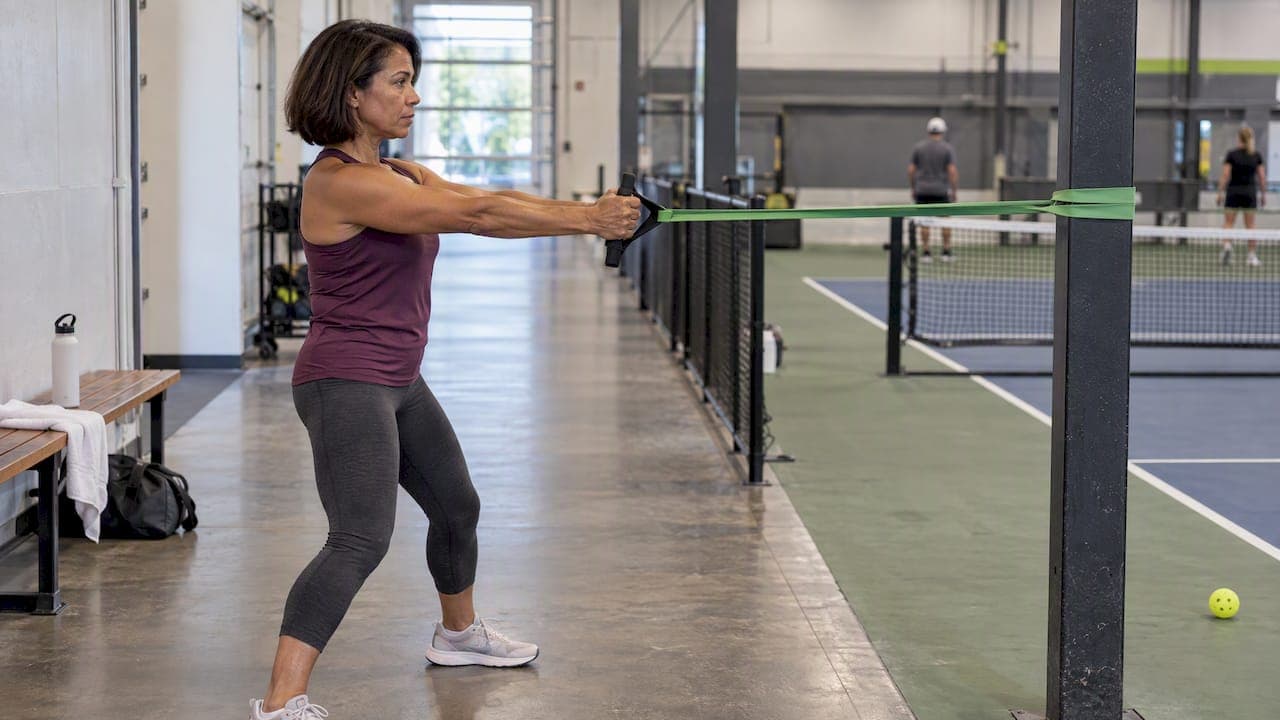
Good pickleball core training is mostly about control, not crunches. Your core has to hold your trunk steady while your legs and hips drive the movement, so the best exercises resist rotation, resist arching, and teach you to stop and change direction without wobbling. Do that two or three times a week for about 20 minutes and you will move better, hit more stable shots, and give your lower back and knees some protection.
Below you will find the exercises worth your time, how to put them into a weekly plan, how to adjust them if you are older or new to the game, and where most players go wrong.
TL;DR
- Your core transfers force from your legs and hips to your paddle arm. Train it to stay stable (anti-rotation, anti-extension), not just to bend.
- Start with three moves: Pallof press, dead bug and side plank. Add a rotational chop once those feel easy.
- Twenty minutes, two or three days a week, is enough for most recreational players.
- Pair core work with lateral and backward movement practice, because lunging and moving backward are where many falls happen.
- If you have back pain that lingers, see a physician or physical therapist before adding load.
Table of Contents
- Why your core matters on a pickleball court
- Anti-rotation and anti-extension: the two ideas to build around
- The core exercises to start with
- A 20-minute weekly plan
- Core training is not only planks: add deceleration and hips
- If you are 60 or older
- If you are newer to the game
- When your back is the problem
- Our perspective
- Get a core plan matched to your own movement
- Common mistakes to avoid
- FAQ
- Sources
Why your core matters on a pickleball court
Pickleball looks gentle, but it is an intermittent sport. NASM describes short bursts of high-intensity movement separated by brief recovery, with demands in several directions: forward and backward acceleration, lateral shuffles, rotation and quick stops.
Every one of those actions runs through your trunk. When you swing a forehand, power starts in the ground, travels up through your hips, and exits through your shoulder and arm. If your midsection is soft, energy leaks and something else absorbs the load. Often that is your lower back or shoulder.
The injury numbers are a good reminder. A nationwide survey of 1,758 players with a mean age of 62.7 found a 12-month prevalence of 68.5% for all-complaint injuries. Knee injuries were the most common at 29.1%, followed by other lower extremity problems and shoulder and back pain. The same study found that players with fewer than five years of experience had 1.5 times higher odds of injury. Newer players are the ones who most need a base of trunk stability.

One caution so you train the right thing. A 2026 study of recreational doubles players found they felt more tired after an 11-game session, yet showed no sign of acute neuromuscular fatigue. In plain terms, you probably do not need marathon-style endurance core work. Quality and control beat long burn-out sets.
Anti-rotation and anti-extension: the two ideas to build around
Most people picture core training as crunches and sit-ups. NASM's guidance for pickleball points toward anti-rotational and anti-extension work instead, such as Pallof presses and planks, because crunches repeatedly flex the spine and do little to teach it to stay still under load.
Here is what those terms mean in court language:
- Anti-rotation: resisting a twist. When you reach wide for a forehand dink or block a hard drive, your trunk should not get yanked around. You rotate on purpose, not by accident.
- Anti-extension: resisting your lower back arching as your arms go overhead or your legs push off. Think of reaching for a lob without cranking your lumbar spine.
- Anti-lateral flexion: resisting a sideways collapse when you lunge or shift weight to one leg.
A coach quoted on a pickleball podcast frames the core as a rigid bridge that moves energy, which is why beginners often get more from stability work than from explosive drills early on. That matches how we think about it too.
The core exercises to start with
Keep reps slow and breathing steady. If your form breaks, stop the set. Quality is the whole point.
Pallof press (anti-rotation)
Anchor a resistance band at chest height beside you. Stand sideways to it, hold the band at your sternum, and press your hands straight out. The band tries to rotate you toward the anchor. Do not let it. Hold for two seconds, bring the hands back, repeat.
- Dose: 2 to 3 sets of 8 to 10 reps per side.
- Common mistake: letting the hips twist or the ribs flare.
- Court link: blocking and holding your shape through a punched volley.
Dead bug (anti-extension)
Lie on your back with arms toward the ceiling and knees bent at 90 degrees. Press your lower back lightly into the floor. Slowly extend one arm overhead and the opposite leg out, then return. Alternate sides.
- Dose: 2 to 3 sets of 6 to 8 reps per side.
- Common mistake: your back arches off the floor as the leg lowers. Shorten the range until it stays down.
- Court link: reaching overhead for a lob while keeping your trunk quiet.
Side plank (anti-lateral flexion)
Lie on one side with your elbow under your shoulder. Lift your hips so your body forms a straight line. Hold, breathing steadily. Drop your bottom knee to the floor if the full version is too hard.
- Dose: 2 to 3 holds of 20 to 30 seconds per side.
- Court link: lateral lunges at the kitchen line.
Bird dog
On hands and knees, extend one arm and the opposite leg while keeping your back flat and hips level. Pause, return, switch. It is a gentle option when planks bother your wrists or shoulders.
- Dose: 2 sets of 8 reps per side.
Front plank with a shoulder tap
From a forearm or high plank, lift one hand at a time to tap the opposite shoulder without letting your hips rock. This adds an anti-rotation challenge to a standard plank. Some players like holding a paddle and tapping it side to side, which makes the move feel closer to the game.
- Dose: 3 rounds of 8 to 12 taps total, or 20 to 40 seconds.
Half-kneeling chop (controlled rotation)
Once you can resist rotation, train it on purpose. Kneel on one knee with a band or cable anchored high. Pull the handle diagonally down across your body, rotating through your upper back while your hips stay square. Control the return.
- Dose: 2 sets of 8 reps per side.
- Court link: the coiling and uncoiling of a groundstroke.
A 20-minute weekly plan
You do not need a gym. A band, a mat and a sturdy anchor point cover everything above.
| Day | Focus | What to do | Time |
|---|---|---|---|
| Day 1 | Stability | Dead bug, side plank, Pallof press (2 sets each) | 15 to 20 min |
| Day 2 | Rest or play | Normal pickleball, easy walking | n/a |
| Day 3 | Stability plus movement | Bird dog, plank shoulder tap, Pallof press, 2 sets of lateral lunges | 20 min |
| Day 4 | Rest or play | Normal pickleball | n/a |
| Day 5 | Add rotation | Half-kneeling chop, side plank, dead bug | 20 min |
After three to four weeks, add a third set or a slightly heavier band. Progress one variable at a time: more reps, a longer hold, or more resistance. If you want a short routine you can do right before you play, our pickleball prehab routine covers three moves for recreational and senior players.
Core training is not only planks: add deceleration and hips
A strong plank does not automatically make you safe when you lunge backward for a lob. Stopping and changing direction put your trunk, hips and knees to work together.

A study of 92 recreational pickleball players found that 42% reported a fall while playing and 30% had fallen more than once. Lunging and moving backward were leading reasons for falls, and players who fell were notably different on hip strength and change-of-direction measures. That points to a simple takeaway: train the hips and the core as one system.
To cover that, add these to your plan:
- Lateral lunges and split squats: 2 sets of 6 to 8 per side, slow lowering.
- Backward lunges or reverse steps: practice a controlled "step back and stop" rather than backpedaling fast.
- Side-lying hip abduction or banded side steps: 2 sets of 10 to 12 per side.
- Single-leg balance with a light reach: build up to 30 seconds per leg.
If you want these matched to specific court situations, see our guide to tailored pickleball exercises mapped to court moves. For the speed and power side of the picture, our pickleball conditioning guide goes further.
If you are 60 or older
According to the analysis of US emergency department visits, most pickleball injury cases involved players aged 60 to 79. Age is no reason to stay off the court, but it does change what your core work should emphasize.
- Balance is as important as strength. ACSM's guidance on being active as we get older stresses balance training alongside strength work. Challenge your balance by narrowing your stance or shifting your weight, near a counter or wall for support. A deeper walk-through of balance training for seniors can help you choose safe progressions.
- Start with the regressions. Side plank on the knees, dead bug with arms only, Pallof press with a light band.
- Go slow. A controlled four-second lowering phase beats extra reps.
- Keep one hand near support for single-leg work until you feel steady.
Our 8-week balance plan for pickleball players and the senior pickleball safety checklist go step by step.
If you have osteoporosis, a recent fall, heart conditions, or dizziness, ask your physician or a physical therapist which exercises are right for you before you start.
If you are newer to the game
The Owoeye-led survey found that players with under five years of experience had higher odds of injury. Many new players put in lots of court time and almost no off-court preparation. A sensible approach:
- Spend your first month on the three stability moves (Pallof press, dead bug, side plank) and the hip work above.
- Hold off on twisting, explosive moves such as medicine ball slams until you can do the basics with clean form.
- Treat your warm-up as part of training, not as optional. Five minutes of leg swings, hip circles and a few controlled bodyweight lunges before you play is a good start.
When your back is the problem
If your lower back tightens after a long session, it is easy to blame weak back muscles. The hip study above points to something else: back pain often shows up when the hips and trunk fail to stabilize during multidirectional lunging. Strengthening the muscles around the back is useful, but so is practicing stops and changes of direction.
For general guidance on gentle movement for a sore back, this overview of lower back pain workouts gives short routines. Sharp pain, numbness or tingling down a leg, or pain that wakes you at night needs a visit with a physician or physical therapist before more training.
Our perspective
At Play On Pickle we look at pickleball injuries through movement. Most recreational players do not skip core training because they are lazy. They skip it because they do not know which exercise matters for their body, and generic routines feel like a chore.
We think the answer is specificity. Two players can do the same plank and need very different things: one drifts in the hips when lunging left, the other loses control of the trunk on overhead reaches. That is why our approach uses video of you playing, analyzed with computer vision, to find where your body takes stress. The aim is a short plan matched to your own mechanics, with simple exercises that fit around your regular play.
What we recommend to nearly everyone, regardless of tools: build stability before power, train the hips with the core, and keep sessions short enough that you will actually do them.
— Drona
Get a core plan matched to your own movement
If you would rather not guess which exercises you need, Play On Pickle analyzes video of your play, flags stress points in your movement, and gives you personalized exercise and equipment recommendations. Plans cost $9.99 per month or $99 per year, and there is a free initial trial. See the pricing page, or read how the patent-pending technology works. The monthly plan currently comes with a free tripod offer so you can film your play from a steady angle.
Common mistakes to avoid
- Relying on crunches and Russian twists only. They train flexion and twisting, not control.
- Holding your breath. Exhale during the effort, especially on Pallof presses.
- Chasing the burn. The study of recreational doubles play suggests you do not need huge volumes of endurance work.
- Ignoring the hips. Core and hip strength work together.
- Training only forward. Add lateral and backward patterns.
- Doing it all at once. Two or three consistent weekly sessions beat one heroic one.
For a bigger-picture plan, see our pickleball injury prevention guide for recreational and older players. Coaches building group warm-ups can use the coach session templates.
FAQ
What are the best core exercises for pickleball?
Start with the Pallof press, dead bug and side plank. They train your trunk to resist rotation, arching and sideways collapse, which is what it does during play. Add bird dogs and half-kneeling chops as you progress.
How often should I do core training for pickleball?
Two or three sessions of about 20 minutes each week is enough for most recreational players. Leave a rest day between sessions, and add sets or resistance slowly over several weeks.
Why do I feel so tired after pickleball?
A 2026 study of recreational doubles players found they perceived more fatigue after play but showed no acute neuromuscular fatigue. Sleep, hydration, heat and overall conditioning can all play a part. If you feel unusually exhausted, dizzy or short of breath, talk to your physician.
Are planks enough for pickleball?
Planks are a good start, but not enough alone. Add anti-rotation work like the Pallof press, and pair core training with lateral lunges and backward-stopping drills, since lunging and moving backward were leading reasons for falls in a study of recreational players.
Sources
- NASM: Pickleball Fitness, Training the World's Fastest-Growing Sport
- Understanding Injury Patterns and Predictors in Pickleball Players (PMC)
- Perceived, but Not Neuromuscular, Fatigue After Doubles Pickleball
- Simple Habits That Level Up Your Pickleball Fast (podcast)
- Hip Strength, Change of Direction, and Falls in Recreational Pickleball Players (PMC)
- The Epidemiology of Pickleball Injuries Presenting to US Emergency Departments (PMC)
- ACSM: Being Active as We Get Older