
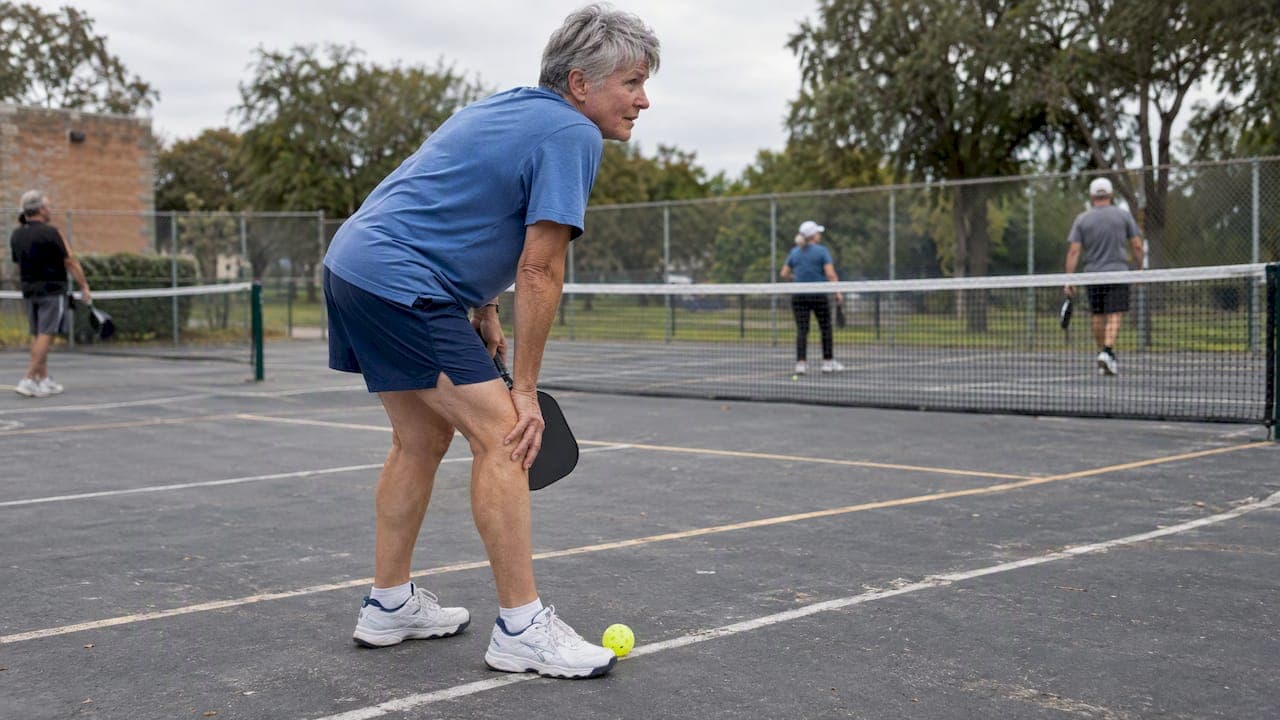
For most people, pickleball is not bad for the knees. It is easier on them than tennis or running. But it is not harmless either. The knee is the most frequently injured body region in pickleball, and the risk depends on your age, your joints, how fast you ramped up and how you move on the court. Here is what the research shows, why knees hurt, and what to change before pain becomes an injury.
TL;DR
- Pickleball is a relatively safe activity for most people, including older adults and first-time athletes, according to a sports medicine specialist at Hospital for Special Surgery (HSS).
- Knees still take a lot of the load. In a 2025 survey of 1,758 players, the knee accounted for 29.1% of reported injuries.
- The usual culprits are stop-and-start movement, lateral pivots, long stretches stooped at the kitchen line, and ramping up play too fast.
- Warm up, strengthen your legs off the court, shorten sessions and watch for swelling or a knee that gives way. Those signs mean it's time to see a clinician.
Table of Contents
- What the injury data says about pickleball and knees
- Why pickleball can be hard on knees
- Who is most at risk
- Normal soreness or a warning sign?
- How to protect your knees and keep playing
- What about pickleball toe?
- Our perspective: knees are a movement problem, not a verdict on the sport
- See how your knees actually move
- Coming back after a knee injury or surgery
- FAQ
- Sources
What the injury data says about pickleball and knees
Start with the number that worries people. A 2025 nationwide study of 1,758 participants (mean age 62.7) found that 68.5% had some kind of injury complaint over 12 months. Most of those were not dramatic. Non-time-loss injuries, the nagging overuse pain you play through, affected 51.2% of players. Time-loss injuries, the kind that keep you off court, affected 40.8%. The knee led the list at 29.1% of reported injuries.
That is a survey of players who chose to respond, so read it as a pattern rather than a precise risk for every player. The emergency room data tells a different story, about the serious end. A review of US emergency department data through 2023 found that pickleball injuries rose about 22-fold between 2013 and 2022. Fractures and sprains or strains were the most common diagnoses. Among players 60 and older, impact with the floor accounted for 56.1% of injury mechanisms. In that dataset the knee made up about 10.9% of injuries, behind the upper trunk and head, which fits a sport where falls and wrist injuries show up in the ER.

The two datasets measure different things. The ER numbers capture falls and fractures. The survey captures the slow, grinding overuse that most players live with. For knees, the second picture matters more.
Why pickleball can be hard on knees
Pickleball is often sold as low impact. That is true compared with running or tennis, where you cover more ground at higher speed. It is less true of the movements the game demands. HSS notes that the sport's stop-and-start movement and lateral pivots are high-risk for the knee, especially with existing arthritis. Several things stack up.
Sudden stops, pivots and lunges
A small court means short, explosive efforts: a quick step to the side, a lunge for a dink, a hard stop. Each one loads the knee through a twisting or decelerating motion. Cedars-Sinai lists repetitive-use injuries, including acute flares of underlying hip and knee osteoarthritis, among the most common pickleball problems. They build over time rather than arriving in one bad step.
The kitchen crouch
The no-volley zone can hurt too. Waiting for the next shot in a stooped, bent-knee stance puts sustained pressure on the kneecap. HSS says a lot of the game is spent stooped over, which can cause challenges for knees. That can lead to tendinitis and quadriceps pain, and it can aggravate a kneecap problem you did not know you had, such as chondromalacia or patellar tendinitis.

Skipped warm-ups
Many recreational players figure a small court means small demands. They walk on cold and play. Joints that have not been prepared for explosive direction changes take the hit. An arthritis-focused review of pickleball injuries makes the same point: participants often omit warm-ups and keep playing through an injury.
Too much, too soon
Sports and internal medicine physician Dr. Christopher Wu says overuse injuries often come from ramping up intensity or volume too quickly. He also advises staying active outside pickleball with resistance and aerobic training, rather than relying on the sport alone for fitness. That matters because pickleball can be addictive: three days a week turns into six, and the knee has had no time to adapt.
Who is most at risk
Not every knee faces the same odds. These groups should be a little more careful.
| Group | Why the risk is higher | What to do first |
|---|---|---|
| Players with knee osteoarthritis | Twisting and trauma can flare existing arthritis | Keep playing if your clinician agrees, but modify volume and warm up thoroughly |
| Players 60 and older | Falls cause a large share of serious injuries in this group | Add balance and leg strength work |
| New or returning players | Joints and tendons have not adapted | Build up sessions gradually |
| Weekend marathoners | Long sessions with little recovery | Cap session length and add rest days |
| Players with past ligament or meniscus injuries | Structural weakness may not be obvious | Get cleared before returning to pivot-heavy play |
One point deserves emphasis. HSS's Dr. James Robinson says people with knee osteoarthritis should not avoid pickleball, because inactivity is worse for joint health than the sport itself. The test is how the knee feels. Minor soreness that settles quickly after play is acceptable. Persistent, intense or swelling-inducing pain deserves a medical evaluation.
Normal soreness or a warning sign?
This is the question most players actually need answered. Pain after your first week of play, which fades within a day or so, usually just means your body is adapting. The pain that needs attention looks different. Pickleball USA's knee guide lists swelling in or around the joint, a sense of instability or that the knee might give out, sharp pain during or right after a specific movement, and pain that does not improve.
If any of those show up, stop playing and see a primary care doctor or sports medicine physician. A knee that locks, buckles or swells after a twist could be a meniscus or ligament injury. Those do not get better by playing through them. If you want a structured way to read your own symptoms, our guide to six knee pain warning signs and a rehab plan walks through them.
How to protect your knees and keep playing
The good news is that the fixes are mostly simple. None of them require quitting.
1. Warm up for five to ten minutes
HSS recommends warming up muscles before play, and the point is practical: raise your heart rate, move the hips and knees through their range, then add a few gentle lunges and side steps before the first rally. Coaches can use the five to ten minute warm-up and session templates we have published.
2. Strengthen your legs off the court
Strong quads, glutes and hips take load off the knee joint. Strong single-leg control helps you decelerate and change direction without the knee collapsing inward. Our three-move prehab routine is built for recreational and senior players, and a six-week single-leg plan targets the control that helps on hard courts.
Balance matters as much as strength, because falls are behind many of the serious injuries. Here is a useful overview of balance training for seniors that fits alongside leg strengthening.
3. Manage how much you play
Sports medicine physicians note that lower-extremity injuries track closely with playing for long stretches without enough rest. Dr. Stevenson at HonorHealth suggests small changes, such as playing doubles instead of singles, shortening sessions and prioritizing technique over power. They can lower injury risk without making you stop. Our three load management rules turn this into a weekly plan.
Recovery is part of the load. A practical primer on active recovery techniques can help you use rest days well, with light movement rather than complete stillness.
4. Fix your stance, not just your strength
Stay out of the deep, locked-knee stoop at the kitchen. Hinge from the hips, keep your weight on the balls of your feet, and take smaller steps instead of lunging when you can. Take breaks between games to stand and straighten the legs.
5. Choose braces carefully
Knee gear is widely misunderstood. According to Pickleball USA, a compression sleeve mainly helps proprioception and mild swelling, while a hinged brace is for structural instability. A generic sleeve will not protect a torn ligament, and it can give a false sense of security. If you suspect a structural problem, get it examined before you buy anything.
What about pickleball toe?
People often search for this alongside knee pain. Pickleball toe is a bruise under the nail (subungual hematoma) caused by repetitive micro-trauma and friction as the foot jams against the front of the shoe during stops and lunges. It is not a knee problem, but it comes from the same movements, and well-fitting court shoes help with both. See a clinician if the pain is intense, the nail is badly lifted or there are signs of infection.
Our perspective: knees are a movement problem, not a verdict on the sport
We built Play On Pickle because the question "is pickleball bad for knees?" has the wrong shape. The sport is not the problem. Movement is. Two players can play the same three hours a week and have completely different knee outcomes, because one drops into the kitchen with the knee drifting inward and the other keeps it stacked over the foot.
Most recreational players never see their own movement. They feel the pain weeks later and guess at the cause. That is the gap we focus on. Our AI movement analysis works from video you upload. It uses patent-pending computer vision to identify stress points in your body and turns them into an injury risk assessment, with exercise and equipment recommendations matched to your biomechanics. We aim for simple routines that fit into a normal week, because the plan that gets done beats the perfect one that does not.
We are not a replacement for a doctor. If you have swelling, instability or pain that does not settle, see a clinician first. What we can do is help healthy players, coaches and facilities spot patterns early and act on them before knee pain becomes time off. You can read more on our injury prevention guide for recreational and older players.
— Drona
See how your knees actually move
If you want to know whether your own stance and footwork are loading your knees, you can upload a short video and get a personalized assessment. Plans are $9.99 per month or $99 per year, with a free initial trial. There is also a free tripod offer with the monthly plan to help you film. If you are curious how the analysis works, read about our technology.
Coming back after a knee injury or surgery
If you are already hurt, the path back should be staged. Our four-stage return to pickleball covers a gradual return for recreational players. After surgery the rules are stricter, because strength percentages and timelines are not clearance. See our guide to pickleball after knee replacement, and always follow your surgeon's release.
FAQ
Is pickleball bad for arthritic knees?
Not necessarily. HSS's Dr. Robinson says people with knee osteoarthritis should not avoid pickleball, since inactivity is more harmful to joints than the sport. Twisting and falls can aggravate arthritis, so warm up, limit session length and see your clinician if you have swelling or lasting pain.
Should I wear a knee brace for pickleball?
It depends on the problem. A compression sleeve can help with proprioception and mild swelling, while a hinged brace is meant for structural instability. A sleeve will not protect a torn ligament, so get a diagnosis from a sports medicine physician or orthopedist before relying on one.
Is pickleball easier on the knees than tennis?
Generally yes. HSS notes that pickleball is less demanding than tennis or racquetball and does not require as much running. It still involves pivots, lunges and sudden stops, so knee injuries remain common, as the 29.1% share in the 2025 survey shows.
Should I stop playing pickleball if my knees hurt?
Not always. Soreness that fades quickly after play is usually acceptable. Stop and get evaluated if you have swelling, a knee that feels like it might give out, sharp pain during a specific movement, or pain that does not improve.
Sources
- Understanding Injury Patterns and Predictors in Pickleball Players: A Nationwide Study of 1,758 Participants
- Pickleball-Related Geriatric Fractures and Pediatric Equipment-Related Injuries Are Increasing in Emergency Departments
- Is Pickleball Good for the Knees? (HSS)
- Pickleball Injuries: Causes and Prevention (Cedars-Sinai)
- What doctors want patients to know about preventing pickleball injuries (AMA)
- Five ways to stay on the pickleball court (HonorHealth)
- Pickleball Tips for Knee Pain (Pickleball USA)
- Why Your Toenail Keeps Turning Black From Pickleball