
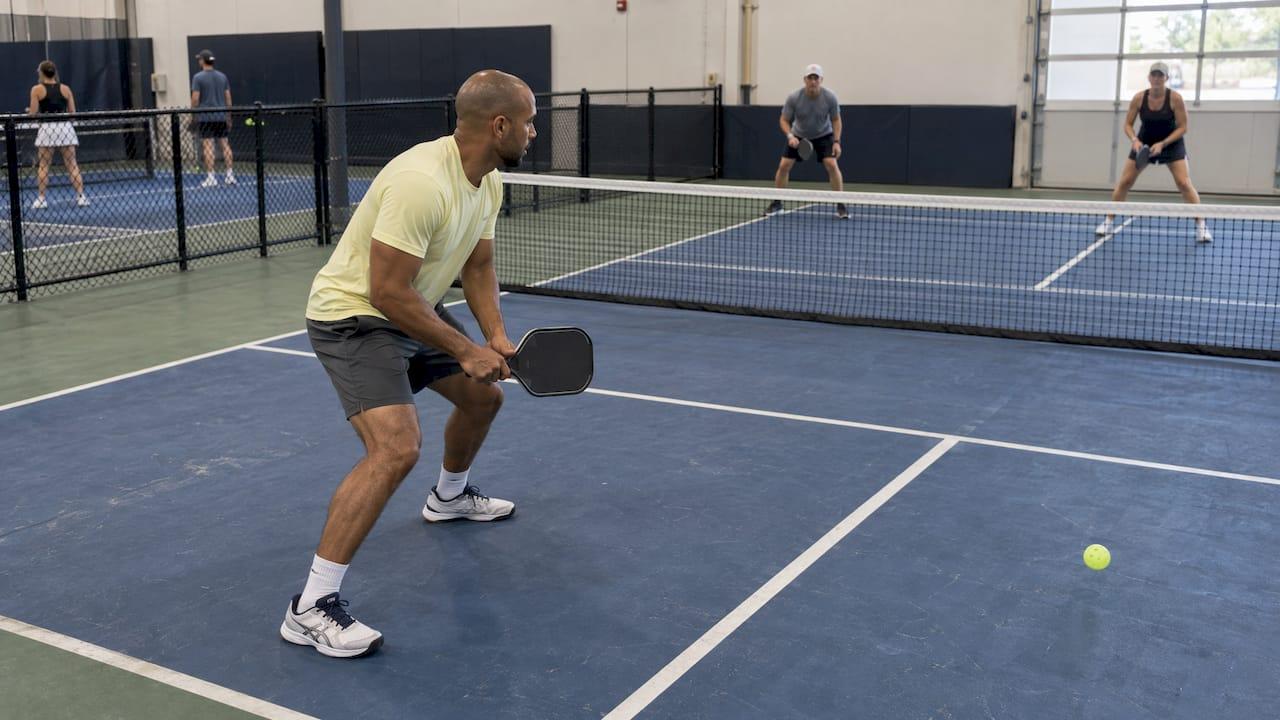
Pickleball's stress points are the wrist, lower leg and ankle, knee, shoulder, elbow and lower back. The movements that load them are sudden stops at the kitchen line, backpedaling for lobs, reaching behind your body and repeated overhead swings. Your own weak links depend on how you move, and that is exactly what a video-based movement analysis is built to show. Play On Pickle's AI reviews your uploaded video of your play to find them and turns them into a personal plan.
TL;DR
- The wrist is the most injured body part in a 10-year U.S. emergency-room analysis (12.7%), followed by the lower trunk, lower leg, head and knee.
- Overuse problems such as tendinopathy, meniscal irritation and plantar fasciitis come from repeated loading. Fractures and sprains come from falls and hard stops.
- Risk rises with weekly play frequency and with fewer than five years of experience, so conditioning matters most for newer, frequent players.
- A dynamic warm-up, strength work and a few movement fixes cover most of what you can control.
- Play On Pickle analyzes your own video to find your personal stress points and suggest targeted exercises.
Table of Contents
- What "stress points" means in pickleball
- The body parts that take the load
- The movements that create the stress
- Who is most exposed
- How to find your own stress points
- What to do about them
- Perspective
- Get your own stress-point analysis
- FAQ
- Sources
What "stress points" means in pickleball
A stress point is a place where the demands of the sport meet something your body can't yet handle well. Sports scientists call the first step a needs analysis: list what the sport asks of you, then compare it with what you can currently do. For pickleball, that list includes lateral movement and deceleration, foot and ankle stability, lower-body strength, rotational power, balance, shoulder durability and recovery capacity.
Two things make the sport demanding on joints. The ready position, semi-flexed and leaning forward, loads the lumbar spine and hip abductors for the whole rally. And the small hard court turns every cut and sudden stop into high force through the ankle, knee and hip.

The body parts that take the load
The numbers differ by study, but they point the same way.
| Area | What the evidence shows |
|---|---|
| Wrist and hand | Most injured body part (12.7%) and most common fracture site (29.2% of fractures) in a 10-year emergency-department analysis |
| Lower leg, ankle, knee | Lower leg 43.9%, ankle 21.3%, knee 19.3% of lower-extremity emergency visits |
| Shoulder | Rotator cuff tendinopathy is among the common overuse conditions |
| Elbow | Lateral epicondylitis was the most frequent diagnosis (75%) in a 2026 academic-center study |
| Achilles and foot | Achilles tendonitis and plantar fasciitis appear among the overuse injuries in the same ACSM review |
Note what these sources count. Emergency-room data captures acute events such as fractures and sprains. Clinic data captures slower overuse problems. Together they give you two kinds of stress: sudden and cumulative.
Wrist and hand
Falls drive wrist injuries. Reaching out to break a fall puts force straight through the distal radius. In the 2026 academic-center study, distal radius fractures after falls were among the leading diagnoses, and hand and wrist injuries were disproportionately on the non-paddle side. For a deeper look, see our guide to pickleball wrist pain.
Lower leg, ankle and knee
This is where stopping happens. In a study of senior players, slips, trips and falls were the mechanism in 63.3% of weighted pickleball cases, and for senior men the calf and Achilles accounted for 39.8% of strains and sprains. A common pattern is the player who backs up quickly for a lob, plants and feels a pop in the calf.
Shoulder and elbow
Smashes and overhead lobs load a rotator cuff that most recreational players have never strength-trained. Meanwhile, the elbow takes repeated vibration and grip load. Beginners tend to use heavier paddles (about 8.5 oz versus 7.2 oz), which raises tennis elbow risk, and a neutral continental grip with a loose hold is recommended for novices. Our elbow prevention plan covers the equipment side.

The movements that create the stress
The 2020 ACSM review names the specific patterns to watch:
- Forceful stops at the nonvolley zone. Hard eccentric braking is a risk for lower-extremity tendon tears and ankle sprains.
- Backpedaling on the heels for lobs. Common in older adults and a fall risk.
- Contacting the ball behind the body. Keeping contact in front reduces biomechanical stress.
- No balanced ready position. Learning the split step helps.
All four are described in the review. Notice that none is about effort. They are about technique and position, which you can change.
Who is most exposed
Age, experience and frequency stack up.
- Age 60 and over. Adults 60 to 79 had the highest injury incidence in a 2025 injury study, with falls 2.10 times and fractures 1.75 times more likely than in other groups. Age-related collagen changes make tendons and ligaments less compliant, so planting and stopping cost more.
- Frequent players. In a nationwide study of 1,758 players, playing more often each week (OR 1.45) and having fewer than five years of experience (OR 1.50) were linked with injury. Total play duration and body mass were not significant predictors.
- Long sessions and consecutive days. In a survey of 253 recreational players, playing more than two hours at a time had an acute-injury relative risk of 2.38 and consecutive days 4.97. A tight baseline grip scored 2.67.
- Gender patterns. Women had higher odds of hand and wrist injuries and falls, while men had more lower-extremity strains and sprains, according to the same 2025 study.
For older players, balance is the lever. Among 92 recreational players, those who fell were significantly slower on a pickleball T-test, and hip abduction strength correlated with faster times. Practical balance training for seniors is worth building into your week, and our 8-week balance plan is written for pickleball specifically.
How to find your own stress points
Population data tells you where players get hurt. It cannot tell you where you will. Individual factors decide that: old injuries, asymmetries between sides, how you land and decelerate, how much you play.
A clinical movement screen is the traditional route. A typical 30-minute version covers injury history, mobility, strength and control, movement patterns, landing and deceleration, and side-to-side differences, and ends with a risk profile and two to four priority fixes. That is the right model: few, specific priorities.
Research is moving toward doing this from video. One study used markerless pose tracking on 715 forehand drives and sorted novice swings into three pathological upper-limb patterns, a preprint but a sign of where assessment is heading.
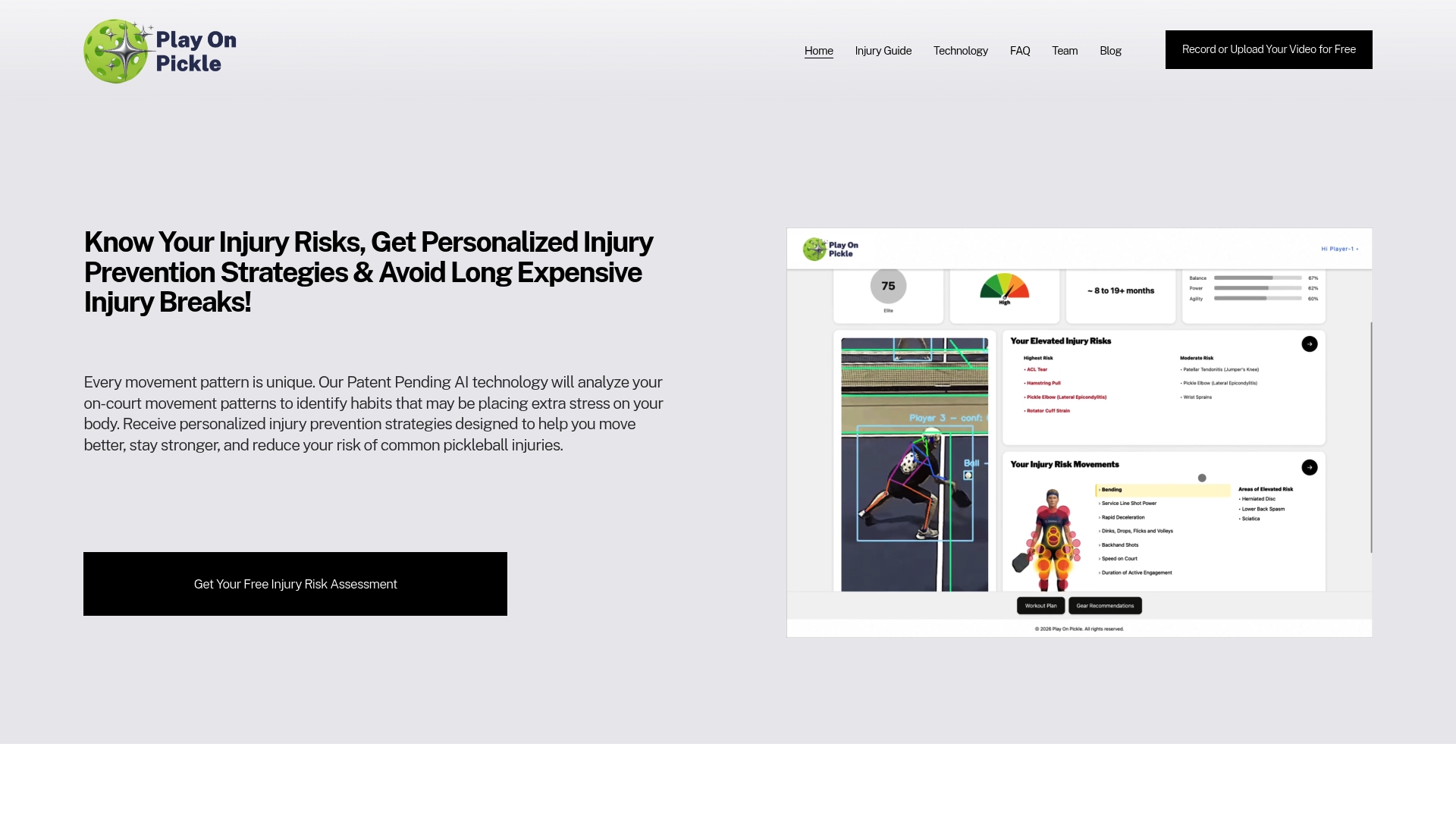
Play On Pickle works from that idea. You upload video of your play, and our patented computer vision identifies biomechanical stress points and generates a personalized injury risk assessment, with tailored exercise and equipment recommendations. It needs minimal equipment, and the technology page explains the approach.
What to do about them
The AMA recommends a dynamic warm-up (walking lunges, high knees, arm circles), static stretching during the cool-down, resistance and aerobic training, hydration, and tennis shoes with firm sides and grip rather than running shoes.
Match the fix to the stress point:
| Stress point | Practical response |
|---|---|
| Shoulder | Rotator cuff activation and shoulder range-of-motion warm-up, per the ACSM review |
| Knee, Achilles, ankle | Lateral bound-and-stick drills to train deceleration, the split step, and no heel backpedaling |
| Elbow | Lighter paddle, loose neutral grip |
| Wrist | Fall prevention through balance and footwear |
| Whole body | Gradual progression rather than 10 games straight or tournaments every other day |
Strength is the common thread. Building force through structured strength training carries into the sport, and our three-move prehab routine is a simple start. Older players can also use our agility drills and the senior safety checklist.
Pain that persists is not a stress point to play through. The AMA recommends medical evaluation for persistent problems, and medical clearance first for anyone with heart or lung issues or new to physical activity. See a physician or physical therapist for sharp pain, swelling after a fall or a joint that gives way.
Perspective
We built Play On Pickle around a simple observation: most recreational players never train for the sport they play. They show up, play three or four days a week, and carry the same movement habits for years. The research says the risk sits in those habits: frequency, hard stops, reaching behind the body.
Generic advice tells everyone to warm up and stretch. That is sound, but your left ankle, your shoulder and your grip are not the average player's. Our approach is to look at your actual movement on video, find the stress points that apply to you, and give you a short list of simple exercises that fit your routine instead of a long program you will drop.
That is how we think injury prevention should work for pickleball: personal, specific and light enough to keep doing.
Drona
Get your own stress-point analysis
Play On Pickle is a monthly subscription at $9.99 per month, or $99 per year, with a free initial trial. Upload your video, and get your personalized assessment and exercise plan. See the pricing page to start, or the free tripod offer for filming your play.
FAQ
What is the most common pickleball injury?
It depends on the data. Emergency departments see mostly fractures (32.7%) and strains or sprains (30.8%) in a 10-year analysis. Clinics see more overuse problems such as tennis elbow and rotator cuff tendinopathy.
Why are older players injured more often?
Tendons and ligaments become less compliant with age, and muscle mass and flexibility decline. Stopping and planting then cost more, and falls become more likely. About 90% of emergency visits involve players 50 and over, according to one report.
Does a warm-up really help?
Physicians recommend a dynamic warm-up, a few minutes of movement until you are lightly sweating, before the first game. A five-minute dynamic routine works, and static stretching fits better after play.
How can I check my own stress points?
A movement screen looks at mobility, strength, landing and side-to-side differences. Play On Pickle does this from your own video and returns a personalized assessment with exercises.
Sources
- The Ultimate Pickleball Workout Plan
- Pickleball Injury Prevention: What Twenty Years in Practice Show
- Increasing Incidence of Pickleball Injuries Presenting to Emergency Departments
- Lower-extremity pickleball injuries in emergency departments
- Pickleball: Review and Clinical Recommendations
- Pickleball-related injuries at a tertiary academic center
- Non-fatal senior pickleball and tennis injuries
- Pickleball Injuries in the Aging Athlete
- Epidemiology of Pickleball Injuries Presenting to US Emergency Departments
- Understanding Injury Patterns and Predictors in Pickleball
- Risk of Upper Extremity Injury in Recreational Pickleball
- Hip Strength, Change of Direction, and Falls
- Preseason Movement Assessments
- Automated Diagnosis of Upper-Limb Kinetic Chain
- AMA: preventing pickleball injuries
- Top pickleball warmups for better movement
- A step-by-step warmup routine
- How to Prevent Pickleball Injuries, Keck Medicine of USC
- Pickleball Injuries: Common Risks and Safe Play
- Balance Training for Seniors
- Strength Training for Athletes