
A stiff mid-back makes your lower back and shoulder do work they were not built for, and pickleball asks for a lot of that work: crouching at the kitchen, rotating into groundstrokes, reaching overhead for a lob. Improving thoracic (upper and mid-back) mobility, then training the new range so you can control it, is one of the simplest ways to move better and spread the load. Below you will find why it matters, which drills to use and how to fit them into your week. You will also see how to tell whether your own movement needs attention.
TL;DR
- The thoracic spine is the part of your back between your neck and your lower back. It supplies most of your trunk rotation, and when it is stiff, your lower back and shoulders compensate.
- Back complaints are common in pickleball: one 2025 national survey put 12-month back injury prevalence at 19.9%.
- Start with pain-free thoracic rotation and extension drills, add breathing work, then build strength in the new range. Do not skip that last step.
- Ten minutes, most days, for a few weeks is a realistic dose. Stop if you feel sharp pain, numbness or tingling, and see a physician first if you have a back history.
- Video-based movement analysis can show where your own body stiffens, so you pick drills for you rather than for everyone.
Table of Contents
- What the thoracic spine does on a pickleball court
- Why a stiff mid-back shows up as lower-back and shoulder trouble
- How to check your own thoracic mobility
- Thoracic mobility drills for pickleball players
- Lower-back mobility for pickleball without aggravating it
- Mobility is not enough: train the new range
- Fitting thoracic work into your pickleball week
- Older adults and players with limited mobility
- Safety rules that apply to every drill
- Try it on your own swing
- FAQ
- Sources
What the thoracic spine does on a pickleball court
Your thoracic spine is the 12 vertebrae of the mid-back, attached to your ribs. It sits between the neck and the lower back, and a 2020 review of the thoracic spine in overhead athletes states that about 80% of axial rotation (twisting) comes from this region. The same review explains that when thoracic control is impaired, neighboring segments take the brunt of the movement.
That matters because pickleball is a rotational, overhead and crouched game at once:
- Groundstrokes and serves need hip, trunk and shoulder rotation in sequence. If the mid-back will not turn, the lower back twists instead.
- Overheads and lobs need thoracic extension (opening the upper back) so the arm can reach up. Without it, the shoulder makes up the difference.
- Kitchen stance keeps you folded forward for long stretches, which trains the mid-back into flexion and shortens the hip flexors.
A training guide from NASM puts the same idea in coaching terms: confirm that thoracic rotation is adequate before loading rotational power, so the lower back is not asked to compensate.
Why a stiff mid-back shows up as lower-back and shoulder trouble

The body does not lose a movement; it borrows it from somewhere else. A tight thoracic spine means the lumbar spine (lower back) rotates and extends more than it should, and the shoulder lifts and pinches more than it should on overhead shots.
The numbers show why this deserves attention:
- In a 2025 nationwide study of 1,758 players, 68.5% reported at least one injury complaint over 12 months. The back came in fourth at 19.9%, after the knee (29.1%), thigh, leg and foot (26.9%) and the shoulder (22.2%).
- The same study found that playing more often each week and placing little importance on injury prevention both predicted injury. The odds were 1.45 times higher with more frequent play and 2.02 times higher with a low perception of prevention.
- A review of 618 pickleball injuries at a single institution from 2017 to 2022 found back pain or sciatica was the third most common diagnosis, with 48 cases, behind rotator cuff injuries and arthritis-related pain. Total injuries rose 6.8-fold over that period.
- In a 2025 survey of 253 recreational players, 41% reported an upper-extremity injury, and the risk was about 1.5 times higher with longer or more frequent sessions, or play on consecutive days.
None of this says thoracic stiffness alone causes these injuries. Volume, technique, footwear and recovery all play a part. But mid-back motion is one of the few contributors you can change in minutes a day.
How to check your own thoracic mobility
You do not need equipment for a first look. Try these on a day you feel fine, and write down what you notice.
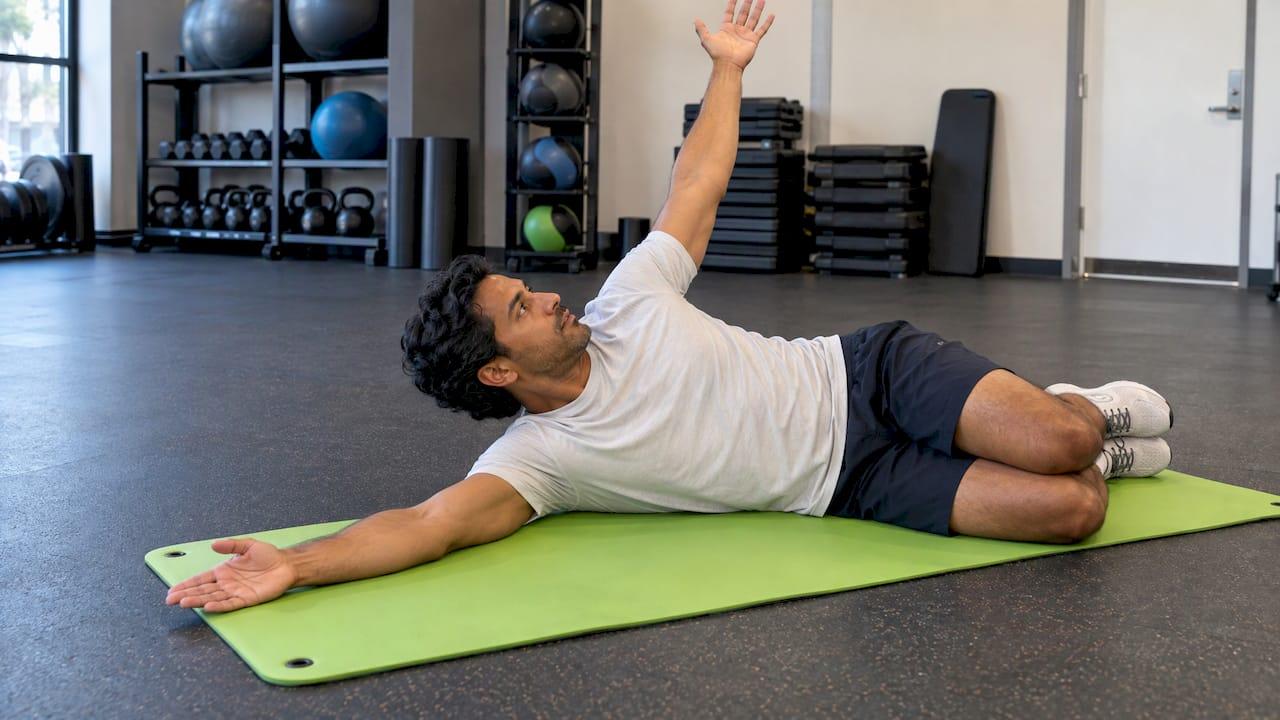
- Open-book rotation. Lie on your side with knees bent and stacked, arms straight in front. Lift the top arm and open it toward the other side, following your hand with your eyes. Notice how far your shoulder blade gets toward the floor, and whether your lower back arches or your knees pop apart to help.
- Seated rotation. Sit tall on a chair with arms crossed over your chest and turn as far as you can with your hips square. Compare left and right.
- Overhead reach. Stand with your back against a wall and raise both arms overhead. If your ribs flare, your lower back arches or your arms stop short of the wall, your upper back may not be extending the way an overhead shot needs.
A clear difference side to side, or a lower back that does most of the turning, tells you where to start. If a test brings pain, numbness or tingling, stop and see a physician or physical therapist rather than stretching through it.
Video can show the same thing in live play, which is where it counts. Our movement screen guide walks through four checks that point to the right drills.
Thoracic mobility drills for pickleball players
The order below follows the sequence the ACSM overhead-athlete review recommends: restore range first, then rotation, then sport-specific movement. Choose two or three drills, not all of them.
Quadruped thoracic rotation
The OTRF Fund's pickleball warm-up program prescribes this one. Kneel on your hands and knees, put one hand behind your head, and rotate your shoulders and torso until the elbow opens as far as it can without turning the hips. Do 2 sets of 10 reps. Keep your hips still: the point is to move the mid-back, not the pelvis.
Thread the needle
From hands and knees, slide one arm under your chest toward the opposite side and let your shoulder and head lower toward the floor. Healthline's thoracic mobility guide suggests 6 to 8 reps per side, holding 5 to 10 seconds, while breathing deeply and limiting lower-back and pelvic movement.
Cat-cow
Alternate rounding and arching your back on hands and knees. The same guide suggests 8 to 12 reps with 5 to 10 second holds. Slow it down and think about moving between the shoulder blades.
Foam roller or firm ball extension
The ACSM review mentions self-mobilization with a foam roller or firm ball as part of thoracic work. Lie with the roller across your upper back, hands supporting your head, and gently let your upper back extend over it. Stay in the mid-back and avoid rolling onto your lower back or neck.
Breathing-based rib cage positioning
The NSCA's thoracic mobility guide frames breathing as a driver of thoracic motion. Its pattern is a 2-second inhale followed by a 4 to 6 second exhale and a 4 to 6 second pause, to draw the rib cage down and position the spine. It suggests doing breathing-based exercises twice a day, with progress expected within 2 to 4 weeks.
If you also like lifting, these mobility drills that transfer to strength work are a handy complement for the days you train off court.
Lower-back mobility for pickleball without aggravating it
The lower back is built to be stable, not to twist a lot. For most players the goal is not to stretch it harder but to free the segments above and below it, so it stops absorbing their share.
- Free the mid-back first. Every thoracic drill above takes demand off the lumbar spine.
- Free the hips. Hip movement in rotation and extension also protects the lower back. Hip flexors that stay shortened from repeated crouching can pull the pelvis forward and arch the lower back, as a strength training blog explains. The 90-90 hip switch and a half-kneeling hip flexor stretch are gentle places to start.
- Stay pain-free. A 2025 Springer review of common pickleball injuries recommends beginning with pain-free range-of-motion work, then gentle mobilization, then stability and gradual strengthening.
- Add trunk control. The same review points to planks and bridges for the rotary forces of forehand and backhand strokes, and squats and lunges to mimic the stop-and-start demands of the sport.
Tight hamstrings and a stiff lower back limit how well you bend, reach and lunge. Gentle hamstring work with a neutral spine is better than forced forward folds, which push the movement into the very region you are trying to relieve.
If you have had back pain, sciatica, a disc problem or surgery, ask your physician or physical therapist which of these suit you before you begin. The OTRF program advises consulting a physician before starting, and stopping immediately if you feel discomfort or overexertion.
Mobility is not enough: train the new range
The NSCA guide makes a point that most mobility articles skip: gaining range is not the end. Once you can rotate and extend, you must train that range with strength and power so your body can control it in play.
In practice, that means:
- Own the position. Hold a half-kneeling or standing rotation with a tall spine, and move only your mid-back.
- Load it lightly. Add a light band or cable rotation, or a slow medicine-ball turn, keeping your hips quiet.
- Make it sport-specific. Shadow your forehand, backhand and overhead slowly, then at pace, feeling the turn happen in the mid-back.
- Support it with the shoulder. The ACSM overhead-athlete authors advise engaging the upper back muscles around the shoulder blades before the arm goes overhead. Our rotator cuff routine covers this.
Fitting thoracic work into your pickleball week
The 2020 ACSM review of pickleball notes there are no published pickleball-specific warm-up studies. It points to a dynamic full-body warm-up with good range of motion and shoulder work, drawn from racquet-sport research. The 2025 Springer review says prevention centers on structured warm-ups with dynamic mobility and light aerobic activity, technique for deceleration, pivoting and overhead strokes, and prehabilitation including balance and core stabilization.
A workable week looks like this:
| When | What | Time |
|---|---|---|
| Before play | Cat-cow, quadruped rotation, standing rotation, arm circles, light movement | 5 to 10 minutes |
| Two or three off-court days | Thread the needle, foam roller extension, hip flexor and hamstring work, breathing drills | 10 to 15 minutes |
| Once or twice weekly | Planks, bridges, rotational band work | 10 minutes |
| After play | Easy breathing and gentle holds | 3 to 5 minutes |
Save long static stretches for after play, and use dynamic moves before. Our pickleball warm-up routines lay out five and ten minute versions, and the prehab routine gives three simple moves for recreational and senior players. Also give yourself rest: the 2025 recreational player survey tied risk to long sessions and consecutive days of play.
Give it two to four weeks of consistent practice before judging results, in line with the NSCA's expectation, and retest your open-book rotation to see whether your mid-back is doing more of the turn.
Older adults and players with limited mobility
You do not need a deep range to benefit. Smaller, controlled movement, done regularly, builds confidence. Use a chair for seated rotation, a wall for support during extension work, and shorter holds.

The ACSM pickleball review adds court habits that help older players: avoid backpedaling on the heels for lobs, learn the split step for a stable ready position, keep the contact point in front of the body, and learn to fall and roll rather than catching yourself with a stiff outstretched hand. For more, see our guides to pickleball injury prevention for recreational and older players and senior pickleball safety.
Coaches and facilities can build the same drills into group warm-ups. The coaching templates give two session formats and a 5 to 10 minute warm-up, and the principle behind any warm-up for athletes carries across sports: prepare the body for the specific demands it will face.
Safety rules that apply to every drill
- Stop at sharp pain, pinching, numbness or tingling. The OTRF program says to discontinue immediately if discomfort or overexertion occurs.
- Anyone with a history of spinal, shoulder, hip, knee, ankle, elbow or wrist problems should consult a physician before starting.
- Move within a range you can control and breathe through each rep. Do not bounce or force end range.
- Keep your hips and pelvis still on rotation drills, so the movement happens where you intend.
Our view: your movement, not a generic list
We build Play On Pickle on a simple idea: two players with the same sore back rarely have the same cause. One has a stiff mid-back, another has tight hips, another has a shoulder that never learned to share the overhead load. A generic mobility list treats them all alike.
That is why we designed our approach around video of you actually playing. Our patent-pending computer vision identifies stress points in your movement and turns them into personalized injury-prevention recommendations, including simple exercises that fit your routine. For a recreational player, that means you spend your ten minutes on the drills your own body needs.
Thoracic mobility is a good example. Stiffness here can show up as a lower-back or shoulder issue, and seeing the pattern in your own strokes is the most direct way to connect the two.
Drona
Try it on your own swing
Play On Pickle analyzes the video you upload to find biomechanical stress points and gives you a personalized injury risk assessment with tailored exercise and equipment recommendations. There is a free initial trial, and plans are $9.99 per month or $99 per year. Our free tripod offer comes with the $9.99 monthly plan, which makes filming yourself easier.

You can read how our computer vision technology works or start from the Play On Pickle home page.
FAQ
How often should I do thoracic mobility exercises for pickleball?
A short session most days is a good target, ideally 10 minutes. The NSCA guide suggests doing breathing-based exercises twice a day, with progress expected within 2 to 4 weeks. Add a brief dynamic version before each session of play.
Can thoracic mobility help with lower-back pain from pickleball?
It can take pressure off the lower back, because a stiff mid-back makes the lumbar spine rotate and extend more to make up the difference. Pair it with hip mobility and core strength. If you have ongoing or radiating pain, see your physician or physical therapist before starting new drills.
Should I stretch before or after playing?
Use dynamic movements such as cat-cow, quadruped rotation and arm circles before play, and save longer static holds for afterward. Healthline's guide also recommends dynamic work as a warm-up ahead of static stretching.
Is thoracic mobility safe for older players?
Yes, when it is gentle and pain-free. Use a chair or wall for support, keep the range small at first and progress slowly. Anyone with a history of back or joint problems should check with a physician before beginning.
Sources
- Understanding Injury Patterns and Predictors in Pickleball (Sports Medicine – Open, 2025)
- Evaluation of Pickleball-Related Injuries at a Single Institution (PMC, 2025)
- Risk of Upper Extremity Injury in Recreational Pickleball (MDPI, 2025)
- The Thoracic Spine in the Overhead Athlete (ACSM Clinical Sports Medicine Reviews, 2020)
- Pickleball Fitness: Training the World's Fastest-Growing Sport (NASM)
- OTRF Pickleball warm-up and stretching exercise program (2023)
- 8 Thoracic Mobility Exercises to Improve Function and Form (Healthline)
- NSCA's Coach, Issue 3.3: thoracic mobility
- Diagnosis and Management of Common Musculoskeletal Injuries in Pickleball (Springer, 2025)
- Pickleball: Review and Clinical Recommendations (ACSM Clinical Sports Medicine Reviews, 2020)
- Best Pickleball Strength Training Program
- 5 Mobility Drills for Lifters
- The Real Role of Warm Up Exercises for Youth Pitchers