
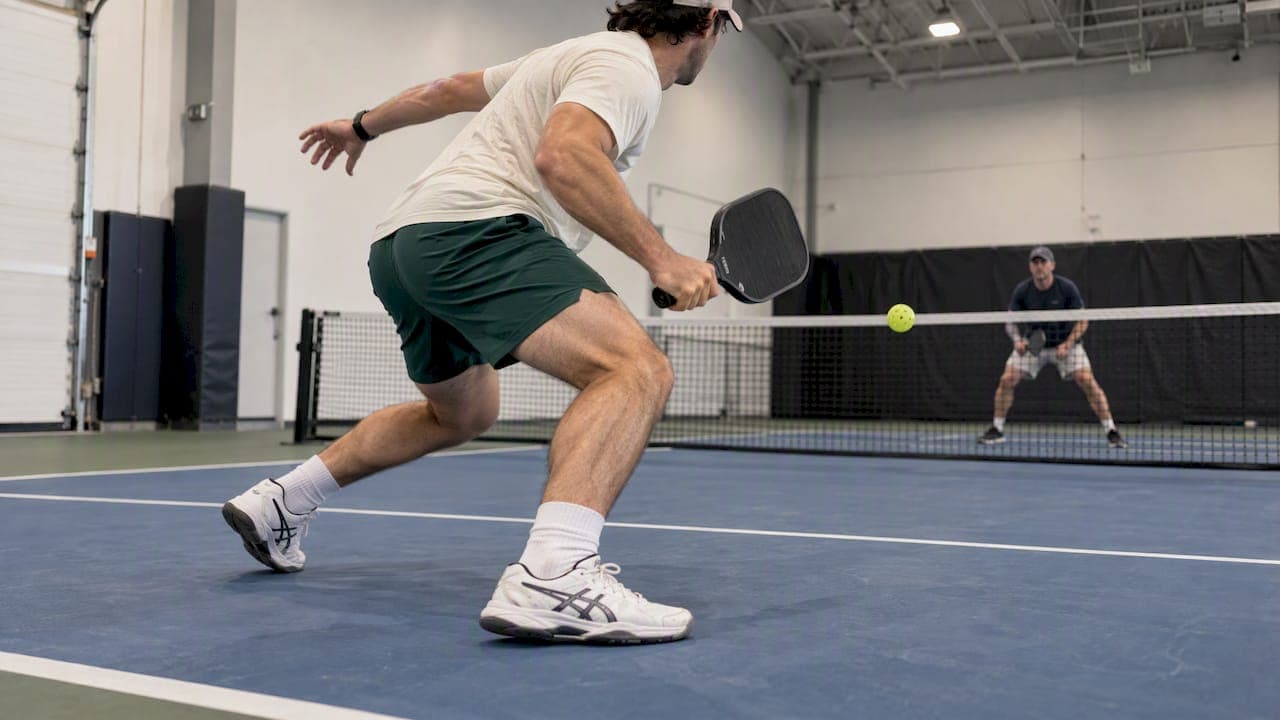
Turf toe is a sprain of the joint at the base of your big toe, and pickleball can cause it. The usual trigger is a hard push-off or a sudden change of direction while the toe is planted and the heel is lifting. Most cases are mild if you catch them early. This guide covers how the injury happens on the court, what it feels like, when to see a clinician, how recovery and return to play usually work, and what you can change to avoid it.
TL;DR
- Turf toe is a sprain of the ligaments and soft tissue at the base of the big toe, caused by forcing the toe upward past its normal range (Cleveland Clinic).
- Lunges, split steps, and quick pushes off the front of the foot put that joint under load, especially in a shoe that bends too easily.
- Pain, swelling, bruising (sometimes on top of the foot), and trouble pushing off are the main signs. Get care right away if you can't bear weight or the joint looks out of place.
- Treatment depends on severity. It runs from rest and activity changes to bracing, physical therapy, and, rarely, surgery.
- Supportive footwear, a real warm-up, and lower-body strength and balance work are the best-supported ways to lower your risk.
Table of Contents
- What turf toe actually is
- Why pickleball can do this to your toe
- Symptoms: what turf toe feels like
- The three grades of turf toe
- When to see a clinician
- Treatment: what recovery involves
- Returning to pickleball safely
- How to lower your turf toe risk
- Our perspective on turf toe
- See your own movement before the toe complains
- FAQ
- Sources
What turf toe actually is
Turf toe is also called a metatarsophalangeal (MTP) joint sprain. It is an injury to the ligaments, tendons, and soft tissues at the base of the big toe, and it happens when the toe is forcefully hyperextended beyond its natural range of motion (Cleveland Clinic). Picture the toe being bent hard toward the top of your foot while your body weight drives down through the ball of the foot.
The name comes from football players on artificial turf. You don't need turf to get it. Any sport where you push off the front of the foot can do it, and a hard, grippy court surface is a good candidate.
The big toe matters more than its size suggests. It is your last point of contact with the ground when you push off, so a sprained joint there affects every step, lunge, and recovery move.
Why pickleball can do this to your toe
Turf toe can come from repeated forceful pushes or from sudden movements and direction changes when the toe is planted and the heel lifts (UT Southwestern). Pickleball is full of those moments, even though the court is small.
The dink-to-drive transition. You creep forward at the kitchen line on the balls of your feet, then a speed-up forces you to explode backward or sideways. The push comes from the forefoot with the heel off the ground.
The lunge for a wide ball. Reaching for a ball at full stretch loads the trailing foot. If that heel is up and the toe is jammed against the court, the joint bends further than it should.
The stop-start rhythm. Doubles points are short bursts, with a reset every few seconds. A recreational player can make hundreds of small push-offs in a session, and a joint that is a little stiff or tired takes the hit.
Shoes that don't suit the sport. Running shoes are built for straight-ahead motion. They often have soft, tall midsoles and little lateral support. Guidance on pickleball injury prevention points to footwear with lateral support and proper sole traction (Springer Nature, 2025). A shoe that is too soft or too flexible at the forefoot leaves the big toe joint to handle the stress alone.
Grip and traction problems. If your outsole grips too hard, your foot stops while your body keeps moving. If you slip, you catch yourself on the toes. Neither is good for that joint. Our guide on court surface injuries and a six-week single-leg fix goes deeper on this.

Symptoms: what turf toe feels like
Symptoms range from mild to severe. They include pain at the base of the big toe, swelling, bruising, limited range of motion, and difficulty bearing weight or pushing off (Cleveland Clinic).
In practice, players describe it like this:
- A sharp or achy pain at the ball of the foot, right under the big toe joint, that gets worse when you rise onto your toes.
- Puffiness around that joint that wasn't there before the match.
- A toe that won't bend upward as far as the other foot's toe.
- A feeling of weakness when you push off to move laterally.
- Pain that begins after a single hard push or lunge, or one that creeps up over several sessions.
Can turf toe hurt on top of the toe?
Yes, in a way. The injury sits at the joint under the toe's base, but swelling and bruising can extend to the top of the foot (Cleveland Clinic). Pain on the top of the big toe joint itself can also come from other problems, so don't assume. The Yale Medicine fact sheet covers the broader picture of the condition (Yale Medicine).
Not every big toe ache is turf toe
Other causes of big toe or forefoot pain after pickleball include arthritis in the joint, sesamoid irritation, bunions, general joint inflammation, and shoes that flex in the wrong place. Plantar fasciitis is a heel and arch problem, a different structure from the big toe joint. A clinician can tell them apart. If you're not sure what you're feeling, our article on pickleball foot pain and when to get it checked walks through the common patterns.
The three grades of turf toe
Clinicians grade the injury by how much soft tissue is damaged (Cleveland Clinic).
| Grade | What's happening in the joint | What it can mean for you |
|---|---|---|
| Grade 1 | Soft tissue is stretched | Soreness and mild swelling. Many players keep wanting to play, which is how it gets worse. |
| Grade 2 | Soft tissue is partially torn | More pain, swelling, and bruising. Pushing off hurts, and activity needs to change. |
| Grade 3 | Soft tissue is completely torn, and the MTP joint may dislocate | Severe pain, trouble bearing weight, and a joint that can look out of place. Needs prompt medical care. |
You can't reliably grade your own toe. Two players with similar pain can have different degrees of damage, so the grade is a clinician's call.
When to see a clinician
See a provider for toe or foot pain, swelling, or bruising that doesn't settle. Seek care right away for severe pain, an inability to bear weight, or a joint that looks dislocated (Cleveland Clinic). A podiatrist, sports medicine physician, or orthopedic foot and ankle specialist are the usual choices.
Don't wait it out. Yale Medicine notes that turf toe that isn't diagnosed or treated promptly can lead to long-term problems, including persistent pain, joint stiffness, loss of push-off strength, bunions, and hallux rigidus, which is stiffness and arthritis in the big toe joint (Yale Medicine).
How turf toe is diagnosed
A provider will check tenderness and range of motion. X-rays and, if needed, an MRI can look for damage to bones and soft tissues (Cleveland Clinic). Clinicians also use hands-on stability tests, such as the varus/valgus stress test and the dorsoplantar drawer test, to see how stable the MTP joint is (PMC review). Expect them to move the joint in different directions and compare it with the other foot.

Treatment: what recovery involves
Your treatment depends on severity, and your clinician sets the plan. For acute pickleball injuries, initial management can include RICE (rest, ice, compression, elevation). Longer-term soft-tissue recovery may involve activity modification, physical therapy, pain relief, and bracing or immobilization (Springer Nature, 2025).
In plain terms, for a mild case that often means:
- Stop playing through the pain, and cut back on the movements that provoke it.
- Reduce swelling with the basics your clinician approves.
- Protect the joint with a stiffer-soled shoe, taping, or a brace if advised.
- Begin guided strengthening and mobility work as pain allows.
More serious injuries need more. Surgery for turf toe is rare and may be needed to repair severe tears, fractures, or joint damage (Cleveland Clinic).
We aren't giving you a number of weeks, because the honest answer is that it depends on the grade, your age, your health, and how the joint responds. Ask your clinician for a timeline based on your exam and imaging.
Returning to pickleball safely
Return-to-play guidance emphasizes rest and gradual rehabilitation. Taping or bracing can support the area as you transition back to sport (Springer Nature, 2025). Sport demands matter too: higher-impact activities such as cutting and jumping come after lower-impact ones (PMC review).
For pickleball, that suggests an order like this, to be agreed with your clinician:
- Walking and daily life without pain comes first.
- Low-impact movement and strength work, such as stationary cycling or controlled calf and foot exercises if cleared.
- Straight-line drilling: soft dinks and controlled rallies at the kitchen, with little pushing off.
- Lateral movement and lunges: side-to-side steps at low intensity, then more reach.
- Full games, starting with short sessions and a stiff, supportive shoe.
If pain returns at any stage, drop back a step and tell your clinician. Our four-stage return to pickleball plan lays out a progression for recreational players that you can adapt with professional guidance.
How to lower your turf toe risk
Nothing removes the risk completely, but a few habits stack the odds in your favor.
Pick shoes built for the court
Choose court shoes with lateral support and appropriate sole traction (Springer Nature, 2025). Check three things in the store:
- The shoe shouldn't fold easily in half at the ball of the foot. A little flex at the toe break is normal, but the forefoot should feel supportive.
- Your big toe should have room and not hit the end of the shoe.
- The outsole should grip without sticking so hard that your foot stops dead mid-move.
Replace shoes once the tread is worn or the midsole feels flat. Court shoes wear out faster than people expect when you play several times a week.
Warm up properly
Structured warm-ups with dynamic mobility and aerobic activity are central to injury prevention in pickleball (Springer Nature, 2025). Walking onto the court and hitting a few dinks isn't it. A few minutes of ankle circles, calf raises, light jogging, and side shuffles gets blood into your feet and calves first. We have 5- and 10-minute warm-up routines you can copy.
Build the strength under the toe
Prehabilitation, including eccentric strengthening of the lower body, core stabilization, and balance training, is recommended to build tissue resilience and improve movement quality in pickleball players (Springer Nature, 2025). Single-leg balance, slow heel lowers off a step, and controlled lunges all train the foot and calf to absorb the load that otherwise lands on the big toe joint. For a simple starting point, see our three-move prehab routine. If you've already had foot pain, check any exercise with your clinician first.
Watch how you move
Two players in the same shoes can load their toes very differently. Some lift the heel early and push hard off the forefoot. Some lunge with the back foot twisted. Others get stuck on the toes when they split step. Those habits are hard to see from inside your own body, which is why filming yourself helps. For a broader view, our guide to pickleball injury prevention for recreational and older players covers the whole body, and the data on pickleball injury risk shows why it's worth the effort.
Coaches and facility staff can fold this into sessions too. Our coaching injury prevention templates include a 5 to 10 minute warm-up for groups.
Our perspective on turf toe
Most turf toe stories we hear start the same way: a recreational player feels a twinge at the ball of the foot, plays through it for a few sessions, and then can't push off at all. The injury isn't dramatic at the start. It's the repetition, a joint asked to do a job that the calf, the ankle, and the hip should be sharing.
That is why we think about turf toe as a movement question as much as a footwear question. Every player has a pattern: how early the heel rises, how the weight shifts when reaching wide, how much the knee and hip help on a lunge. When those patterns send too much load to one spot, the big toe pays. A shoe change helps. So does strength. But the most useful first step is knowing where your own stress points are.
We built Play On Pickle around that idea. You upload video of yourself playing, and our patent-pending computer vision looks at your movement to flag stress points and suggest simple exercises and equipment changes suited to your biomechanics. It isn't a medical exam and it doesn't diagnose turf toe. If you have pain, swelling, or bruising at the big toe, see a clinician. We're for prevention, and for helping you keep the habits that keep you playing.
— Drona
See your own movement before the toe complains
If you want to find out how you load your feet on the court, Play On Pickle gives you a free initial trial. After that, the plan is $9.99 per month or $99 per year, and you can see both on our pricing page. Our technology page explains how the video analysis works, and there is also a free tripod offer with the $9.99 monthly plan, which makes filming easier.

Film a few points from behind and from the side, upload them, and you get a personalized assessment with exercises you can fit into your routine.
FAQ
Can I keep playing pickleball with turf toe?
Not through pain. Playing on a sprained big toe joint can make a mild injury worse, and untreated cases can lead to long-term stiffness and loss of push-off strength (Yale Medicine). Get it examined, and let your clinician decide when and how you return, usually through gradual steps and sometimes with taping or a brace.
How do I know if it's turf toe or something else?
Turf toe typically causes pain and swelling at the base of the big toe and trouble pushing off. Arthritis, sesamoid problems, and bunions can feel similar. A provider can examine the joint, test its stability, and order X-rays or an MRI if needed (Cleveland Clinic).
Does turf toe need surgery?
Rarely. Surgery may be needed for severe tears, fractures, or joint damage (Cleveland Clinic). Most cases are managed with rest, activity changes, and rehabilitation, with bracing or immobilization where a clinician advises it.
What shoes help prevent turf toe in pickleball?
Look for court shoes with lateral support and proper sole traction, as pickleball injury guidance recommends (Springer Nature, 2025). Avoid shoes that bend too easily through the forefoot, and replace them when they wear out.
Can plantar fasciitis cause turf toe?
They are different problems in different spots: plantar fasciitis is heel and arch pain, while turf toe is a sprain at the big toe joint. Both can show up in the same foot, though, and both are worth having checked if pain lingers. Our foot pain guide explains how to tell where your pain is coming from.
Sources
- Turf Toe: What It Is, Causes, Symptoms & Treatment, Cleveland Clinic
- Turf toe: What athletes need to know, UT Southwestern Medical Center
- Turf Toe fact sheet, Yale Medicine
- Turf Toe: Anatomy, Diagnosis, and Treatment, PMC
- Diagnosis and Management of Common Musculoskeletal Injuries, Springer Nature