
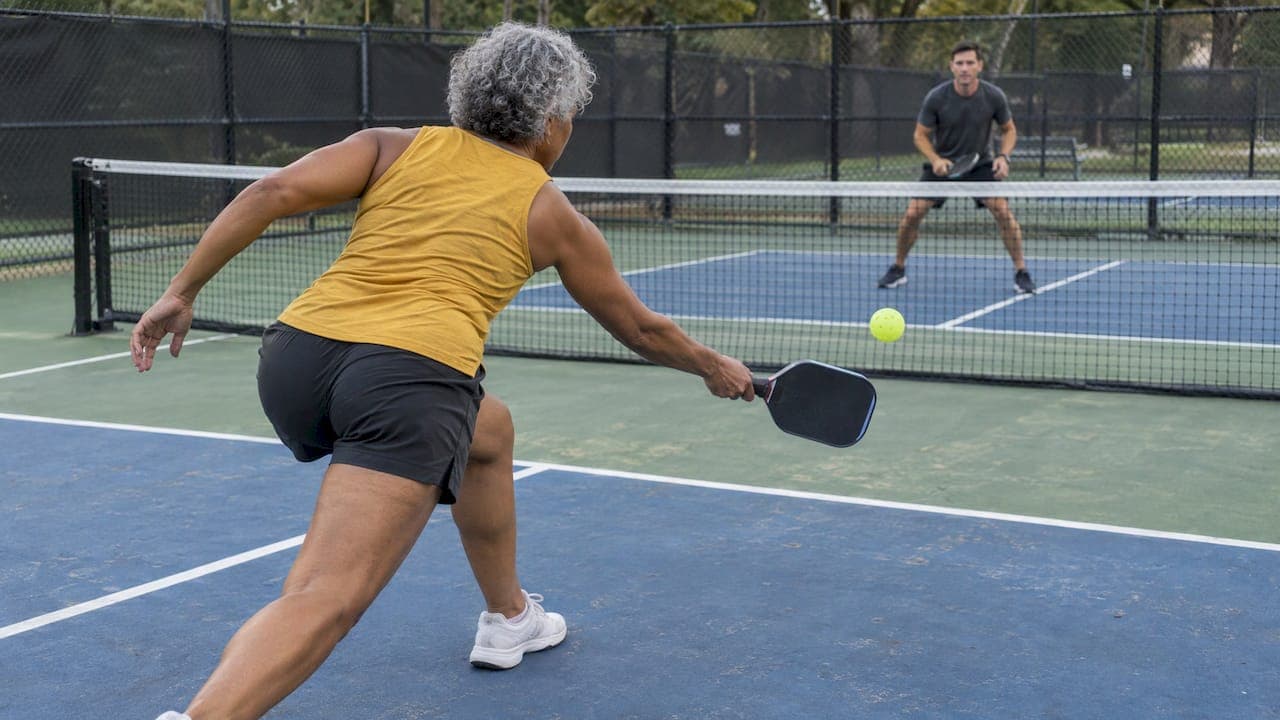
A pickleball meniscus tear usually happens when your foot is planted and your knee twists: a quick pivot at the kitchen line, a lunge for a dink, a late step back for a lob. The meniscus is a C-shaped piece of cartilage that cushions the knee, and twisting and pivoting movements common in pickleball can tear it. Hip labral tears follow a different pattern but show up on the same courts. Below you will find the symptoms, when to get examined, what recovery generally looks like and how to lower your risk.
TL;DR
- A meniscus tear typically comes from twisting the knee on a planted foot. Pain, swelling, stiffness, catching, locking or giving way are the classic signs.
- Older players can tear a meniscus with little or no injury, because the cartilage weakens with age.
- Knee pain when you put weight on the leg, reduced motion or significant swelling means a prompt medical evaluation, not another match.
- Hip labral tears tend to cause groin pain and a sharp catch when the hip rotates. Many recreational players with small tears are first treated without surgery.
- Strength, a dynamic warm-up, good deceleration technique and court shoes with grip lower your risk.
Table of Contents
- How pickleball tears a meniscus
- Symptoms of a torn meniscus
- When to see a doctor
- Recovery and return to pickleball
- What about a hip labral tear?
- How to lower your risk
- Our perspective
- See your own movement before it becomes a knee problem
- FAQ
- Sources
How pickleball tears a meniscus
Pickleball looks gentle, but the court asks a lot of the knee. You split-step, stop hard, change direction in a small space and reach wide on a fixed foot. The danger moment is the combination: your body weight is on the knee, the foot is stuck to the surface, and the upper body rotates.
The meniscus acts as a shock absorber between the thigh bone and the shin bone. When the knee bends and twists under load, that cartilage can be pinched and torn. A sports medicine review of pickleball injuries notes that acute meniscus tears can present like a ligament sprain, which is one reason you cannot tell the difference by feel alone.
Two profiles show up most often:
- The sudden tear. A pivot, a pop, and a knee that will not feel right afterward. More common in younger and middle-aged players.
- The degenerative tear. In older adults, tears can happen without significant trauma because the cartilage weakens over time. You may only remember a awkward step, or nothing at all.
The court surface and your shoes matter too. If your sole grips the surface hard while your body keeps turning, the knee absorbs the difference. Our guide to single-leg work for court surface injuries goes into that in more detail.
Symptoms of a torn meniscus
The signs can be subtle at first. Mayo Clinic lists these:
- Knee pain
- Swelling and stiffness
- A popping sensation when it happens
- Difficulty fully straightening the leg
- A feeling that the knee is locking or giving way
The American Academy of Orthopaedic Surgeons adds a detail that explains why people keep playing: most people can still walk on the injured knee, and many athletes keep playing with a tear. Over the next two to three days, though, the knee typically gets stiffer and more swollen. Do not let a good walk across the parking lot reassure you.
A quick self-check, not a diagnosis:
| What you notice | What it can mean | What to do |
|---|---|---|
| Pop at the moment of a twist, then swelling the next day | Possible meniscus tear | Stop playing, get evaluated |
| Catching or locking when you bend or straighten | A torn piece may be interfering with the joint | Get evaluated soon |
| Knee feels like it will give way | Meniscus or ligament problem | Get evaluated before returning |
| Mild ache after long sessions, no swelling | Overload or irritation | Rest, reduce volume, watch closely |
When to see a doctor
Do not wait for a tear to "declare itself." The sports medicine literature says that knee pain with weight-bearing, decreased range of motion or significant swelling warrants immediate physician evaluation. Locking, where the knee will not straighten, and repeated giving way belong on that list too.
What to expect at the appointment: the doctor checks for tenderness along the joint line and may perform the McMurray test, bending, straightening and rotating the knee to see whether it produces pain or clicking. An X-ray will not show a meniscus tear, though it may be ordered to look for other causes such as osteoarthritis. MRI is the usual next step when the picture is unclear. Your physician decides what imaging you need.

Recovery and return to pickleball
Whether a meniscus tear needs surgery depends on the tear, your age, your symptoms and your knee's overall condition. That is a decision for an orthopedic or sports medicine physician. What can be said generally:
Conservative care is often the first step. Conservative management typically includes the RICE protocol (rest, ice, compression, elevation), physical therapy and anti-inflammatory medication. Ask your doctor whether the medication is right for you.
Rehab is more than waiting. Physical therapy typically restores motion, then strength, then control. For players working through the conservative phase, recovery routines and tools are a common topic; red light therapy for sports injuries is one of the options some players explore alongside the plan their clinician sets.

Many players go back, not all. In a 2024 study of pickleball- and paddleball-related lower-extremity injuries, 68 of 166 patients (40.9%) returned to play, and five (3%) were told to refrain from pickleball or other high-impact activities. Your own outcome depends on your injury and your clinician's guidance, so treat these numbers as context, not a forecast.
A sensible way back
Exact timing belongs to your care team, but the structure is consistent:
- Calm the knee. Swelling down, walking normal.
- Restore full motion. Straighten and bend without pain or catching.
- Rebuild strength. Squats, step-ups, single-leg work and hip strengthening.
- Add court movement gradually. Controlled side steps, then short rallies, then full points with pivots.
We laid this out in more detail in our 4-stage return to pickleball guide for recreational players.
What about a hip labral tear?
Players also search for labrum tears, and the hip deserves a section. The labrum is a ring of cartilage around the hip socket. Research from a clinical consensus statement says that labral tears are associated with sports involving repetitive or sustained flexion, adduction and internal rotation of the hip. Deep lunges, low reaches and rotating while the foot is planted put the hip in similar positions.
Signs to watch
The same consensus lists anterior groin pain, pain during hyperflexion or sustained flexion, and sharp, catching pain when the hip rotates as common indicators. If your groin hurts when you sit deep in a chair, get into a low car or drop into a wide lunge, mention it to a physician. Many other problems cause groin pain, so an exam matters.
Treatment and return to play
The consensus notes that nonoperative management is often appropriate for recreational athletes with small or chronic tears and no significant mechanical symptoms. Nonoperative care may include core strengthening and gluteal stabilization, and conservative care should involve a multidisciplinary team. Return to play looks at pain-free full range of motion, strength, sport-specific endurance, balance and proprioception.
That last list is useful for any lower-body injury: do not ask only "does it hurt?" Ask whether the joint moves fully, whether it is strong, whether you can last through a long session and whether you can balance on that leg.
If hip surgery is already in your history, see our piece on pickleball after hip replacement, which explains why a calendar alone is not clearance.
How to lower your risk
No plan eliminates injury risk, but the evidence points in a clear direction. A 2025 academic review says players can reduce risk through lower-body strength training, dynamic warm-ups, proper technique during quick deceleration and pivoting, and court footwear with traction and lateral support.
Turned into habits:
- Warm up with movement, not just stretching. Leg swings, bodyweight squats, lateral shuffles and easy rallies before your first competitive point. Our pickleball prehab routine has three moves that take a few minutes.
- Build the legs. The same review names squats and lunges. Two short sessions a week beat one heroic one.
- Train the stop. Most knee trouble starts when you decelerate or pivot. Slow down your split step, land softly, keep the knee tracking over the toes instead of collapsing inward.
- Wear court shoes. Running shoes are built for forward motion. Court shoes provide lateral support, and the traction should match the surface without sticking so hard that your foot cannot rotate.
- Do some cardio away from the court. General cardiovascular conditioning helps reduce fatigue, and tired players move worse.
- Keep lifting as you age. Researchers note that aging athletes show better bone health and fracture resistance with regular resistance training. Our senior pickleball exercises map strength work to specific court moves.
- Add balance work. An 8-week balance plan helps with the quick corrections that keep knees from twisting.
For a fuller overview, start with our guide to pickleball injury prevention for recreational and older players.
Our perspective
Most players we hear from do not lack motivation. They lack a way to see what their body does at game speed. You feel the knee only after it has already absorbed the stress, and a mirror or a friend rarely catches a knee drifting inward on a hard stop.
That is why we built our approach around video. When you upload footage of your play, our computer vision technology is designed to identify stress points in your movement and turn them into a personalized injury risk assessment and a short list of simple exercises that fit into your week. The idea is to catch the pattern before it turns into a tear.
We do not replace your physician or physical therapist. If you have pain, swelling or locking, get examined. But for the many recreational players who skip conditioning because they do not know what to work on, we believe specific, individualized guidance is the missing piece.
Drona
See your own movement before it becomes a knee problem
If your knees or hips feel fine and you want to keep it that way, Play On Pickle analyzes video of your play and delivers personalized exercise and equipment recommendations built around your biomechanics. A monthly subscription costs $9.99 per month, or $99 per year, and a free trial is available to start. You can also read about the patent-pending technology behind it.

If you are ready to try it, start on the Play On Pickle site. Coaches running group sessions may also like our warm-up and session templates.
FAQ
Can I keep playing pickleball with a torn meniscus?
Some people can walk and even play with a tear, and AAOS notes that many athletes keep playing. That does not make it safe. Locking, giving way or swelling means you should stop and get examined, since continued twisting can make a tear worse.
How do I know if it is a meniscus tear or just a sore knee?
You cannot know without an exam. A pop, swelling that builds over a couple of days, catching, locking or a feeling of giving way point toward a tear, while a mild ache without swelling often reflects overuse. A physician can examine the joint line and order imaging if needed.
Can pickleball cause a hip labral tear?
It can contribute. Labral tears are linked to repeated or sustained hip flexion, adduction and internal rotation, which deep lunges and low reaches can reproduce. Groin pain with a sharp catch when you rotate the hip is worth a medical visit.
Is it safe to play pickleball after a meniscus tear?
Many players return, but not everyone does, and it depends on your injury and treatment. Your clinician should clear you based on full motion, strength, endurance and balance, not only on how many weeks have passed.
Sources
- Pickleball-Related Knee Pain, Baptist Health
- Torn meniscus: Symptoms and causes, Mayo Clinic
- Meniscus Tears, OrthoInfo, AAOS
- Pickleball: Injury Considerations in an Increasingly Popular Sport
- Pickleball- and Paddleball-Related Injuries in the Lower Extremity
- Meniscus tears are on the rise with pickleball, Hoag
- Management of Labral Tears in the Hip: A Consensus Statement
- Diagnosis and Management of Common Musculoskeletal Injuries
- Pickleball Injuries in the Aging Athlete: A Critical Review