
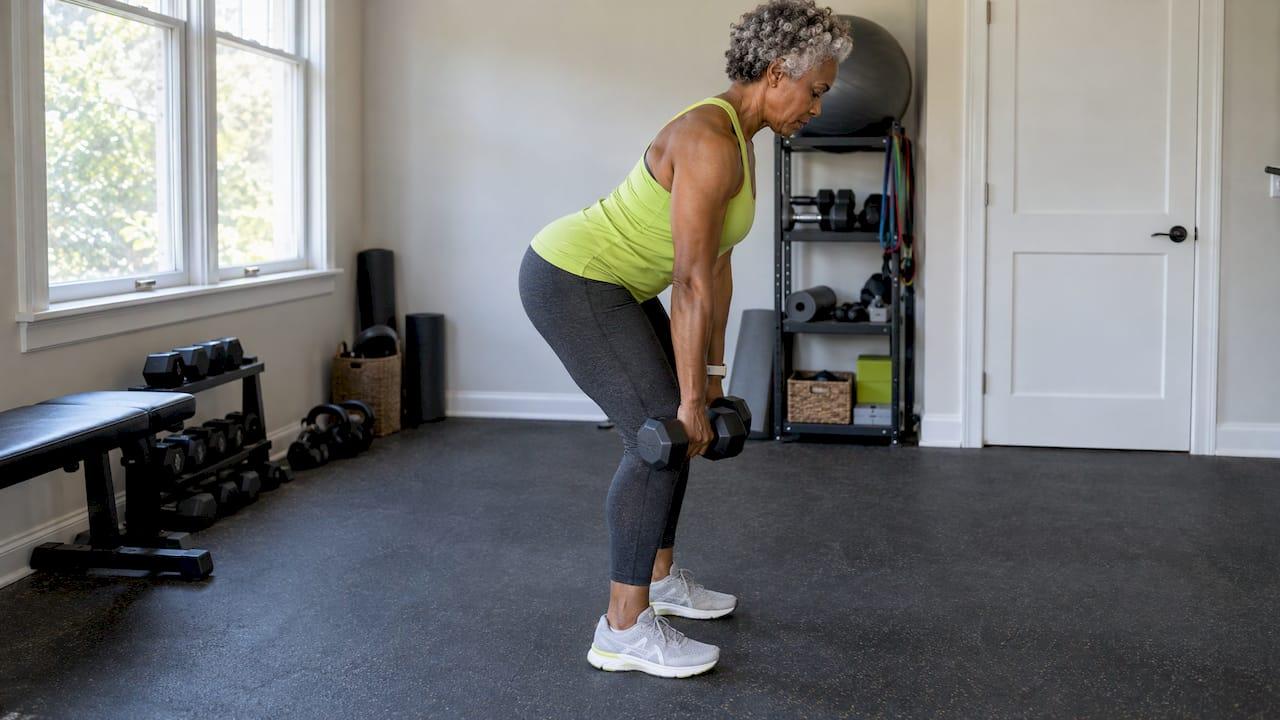
The posterior chain is the set of muscles along the back of your body: glutes, hamstrings, calves and the muscles that stabilize your lower spine. In pickleball you hinge at the hips, split-step, lunge and stop all match long, so these muscles carry much of the load. Train them one or two days a week with hinges, bridges and single-leg work, warm up before you play, and progress slowly. Below you'll find the muscles, the best exercises, sets and reps, and how to adapt the plan if you're older, new to lifting or coming back from an injury.
TL;DR
- The posterior chain (glutes, hamstrings, calves, lower-back stabilizers) powers your split-step, lateral moves, lunges and stops.
- Start with Romanian deadlifts, glute bridges and single-leg Romanian deadlifts, plus a core exercise such as a bird dog.
- A sensible starting point is 1 to 2 sessions a week, 3 to 6 sets of 5 to 10 reps per muscle group per week, on non-consecutive days.
- Warm up for about five minutes before play, and add weight only after your form is clean.
- Older players and anyone with back pain should regress exercises and keep effort low, then see a physical therapist if pain persists.
Table of Contents
- What the posterior chain is
- Why it matters in pickleball
- The best posterior chain exercises for pickleball
- How to structure your week
- Warm up before you play
- Older players, beginners and returning players
- Our perspective
- Get a plan built for your movement
- FAQ
- Sources
What the posterior chain is
Think of everything you can't see in a mirror from the front. HSS Sports Medicine Institute describes the posterior chain as the muscles along the back of the lower body, with emphasis on the gluteus maximus, the smaller glute muscles, the hamstrings, the calves and the stabilizers of the lumbar spine. Healthline adds the erector spinae along the spine and the calf muscles (gastrocnemius and soleus), with the trapezius, latissimus dorsi and rhomboids contributing from the upper body.
The Journal of Strength & Conditioning Research describes these dorsal muscles as supporting the thoracic and lumbar spine and the joints of the hip, knee and ankle. That's the useful way to see it: it's a connected system from your heel to your mid-back, and when one link is weak the others work harder.
| Muscle group | Where it sits | What it does on court |
|---|---|---|
| Gluteus maximus | Back of the hip | Drives you out of a lunge and into the next step |
| Gluteus medius and minimus | Side of the hip | Steadies the pelvis on one leg during lateral moves |
| Hamstrings | Back of the thigh | Controls knee and hip when you reach and stop |
| Calves | Lower leg | Push-off and ankle control |
| Erector spinae and core | Along the spine | Transfers force between legs and swing |
Why it matters in pickleball
Pickleball looks gentle, but the movement is demanding. NASM lists forward and backward acceleration and deceleration, overhead reaching and striking, rapid lateral direction changes and trunk rotation, often over 60- to 90-minute recreational sessions. It names the glutes, hip abductors and adductors, core rotators and rotator cuff as key muscle groups, and says groundstroke power comes from well-sequenced hip, trunk and shoulder rotation.
JOOLA USA makes the point that you are constantly hinging at the hips in a ready position, so your posterior chain is loaded the whole time, and it argues that targeted hamstring work matters for quick, powerful movement. An orthopedic physical therapist quoted by Peloton identifies the quads, glutes, hamstrings and calves as the muscles with the greatest workload in pickleball because they move you around the court.
Injury risk
NASM notes that the typical injury sites, the shoulder, knee, Achilles and lower back, reflect inadequate preparation for the sport's demands, not a sport that is inherently dangerous. That's good news: preparation is something you control. A review in Springer Nature lists prehabilitation for pickleball as eccentric strengthening of the rotator cuff and lower extremities, balance and proprioceptive training to prevent falls, and core stabilization to support the kinetic chain and help prevent low-back injury.
HSS exercise physiologist Mathew Welch states that a strong posterior chain supports performance, injury prevention and longevity, and that strengthening these muscles helps counter the age-related loss of muscle and bone known as sarcopenia.
The best posterior chain exercises for pickleball
You don't need a gym full of equipment. Pick one hinge, one bridge, one single-leg movement and one trunk stabilizer.
Romanian deadlift (RDL)
In the 2014 study in the Journal of Strength & Conditioning Research, hamstring activity was highest in the Romanian deadlift and the glute-ham raise, so the authors suggested athletes who want maximal hamstring involvement focus on those two. The RDL is also the easier one to do at home with dumbbells.
How to do it: stand tall with a dumbbell in each hand, soften your knees, push your hips back as if closing a car door with them, keep your back flat, lower until you feel a stretch in the hamstrings, then drive the hips forward to stand. According to the physical therapist in the Peloton piece, RDLs strengthen the hamstrings to help you keep balance when reaching for a ball without stepping over the line.
Single-leg Romanian deadlift
The same hinge on one leg. Peloton's trainer Olivia Amato says it builds glute and hamstring strength and helps balance, core stability and ankle stability. That fits the way you actually play: most shots land on one leg. If you want to build the balance side further, balance training for seniors covers safe exercises that cut fall risk, and many of the ideas carry over to players of any age.
Begin by lightly touching a wall or a chair with one hand, with no weight. Add dumbbells only when you can hinge without wobbling.
Glute bridge
Lie on your back, knees bent, feet flat. Press through your heels, lift your hips until your body forms a line from shoulders to knees, pause, lower. It's the lowest-stress way to load the glutes, and a safe starting point for anyone who is deconditioned or has a sensitive back.
Bird dog and dead bug
These train the trunk to stay still while limbs move, which is what your spine does when you swing. For a deeper look, see our guide to anti-rotation core training for pickleball.
Glute medius work
Side-to-side court movement relies on the hip muscles that keep your pelvis level. Our five-minute pre-court flow for the glute medius and minimus is a quick add-on to a warm-up.
Backward and deceleration work
Pickleball players back up for lobs, and that stresses calves and Achilles tendons. Backward work and tendon care fits well alongside posterior chain training. The ACE-sponsored work cited in its pickleball workout also notes that proper technique means turning and running for the ball rather than backpedaling.
How to structure your week
Here is what the professional sources suggest as starting points. They're ranges, not prescriptions, and your own situation decides where you sit within them.
| Source | Frequency | Volume and intensity |
|---|---|---|
| HSS | 1 to 2 times per week | 3 to 6 sets of 5 to 10 reps per muscle group per week; start with bodyweight or lighter loads and more reps, then add weight |
| ACE | 2 to 3 non-consecutive days per week | 1 to 4 sets of 8 to 15 reps at 20 to 70% of one-rep max, multijoint moves across all three planes of motion |
A simple week for a recreational player who plays three times:
- Strength day A (after play or on an off day): RDL 3 sets of 8, glute bridge 3 sets of 10, bird dog 2 sets of 6 per side.
- Strength day B, two to three days later: single-leg RDL 2 to 3 sets of 6 per leg, lateral step-downs or side-lying hip work, calf raises 2 sets of 10.
- Play days: five-minute warm-up, then play.
In practice, keep strength sessions away from the day before a long match when you can, and skip heavy lifting when you're already sore.
Progress in the right order
NASM recommends progressing lower-body work from two-legged strength to single-leg control, then emphasizing eccentric (lowering) loading, then deceleration drills, and finally adding change-of-direction and reactive movement. It notes that knee injuries in pickleball are frequently failures of deceleration. So the order matters: build the base before you chase speed.

Move forward only when form is clean. For tracking progress, change one variable at a time, such as weight, reps or depth, not all three.
Warm up before you play
The Springer Nature review says injury prevention centers on structured warm-ups with dynamic mobility and light aerobic activity, good technique for quick deceleration, pivoting and overhead strokes, and footwear with sole traction and lateral support.
Pickleball.com suggests a five-minute pre-match sequence:
- 60 to 90 seconds to raise your heart rate: jumping jacks, base shuffles or a light jog.
- Two minutes of joint mobilization: shoulder, ankle, knee and trunk circles.
- 60 to 90 seconds of sport-specific patterns: lateral shuffles and controlled stops.
The same page says warm-ups that include balance, strength and movement control tend to lower injury rates across multiple sports, and that a proper warm-up beats doing nothing or static stretching alone for speed, power and coordination.
Older players, beginners and returning players
If you're 60 or older, or just new to strength training, the goal is the same, only the entry point differs.
- Form before load. NSCA guidance for older adults says not to increase loads or progressions until proper form is evident. If the lower back feels stressed during a floor kettlebell row, it recommends regressing to dumbbells on a box or bench.
- Warm up and stay flexible. A 2024 review of pickleball injuries in the aging athlete advises careful warm-ups before competitive play, flexibility work to preserve range of motion, and a routine that includes strengthening plus balance, coordination and reaction-time work.
- Plan for falls. The ACE-sponsored study noted that nearly every participant had fallen once or twice, and the Springer Nature review calls for fall-risk reduction, activity modification and a gradual return to sport, with special attention to older adults at higher fracture risk. Our 8-week balance plan and proprioception drills are built for this.
A gentle starting plan
For people who are deconditioned or pain-sensitive, Advanced Pain Management VA outlines three days a week: front plank (2 sets of 15 to 20 seconds), dead bug and bird dog (2 sets of 6 to 8 reps per side), glute bridge (2 sets of 10 to 12), cat-camel (10 reps) and 10 to 20 minutes of walking on most days. It suggests reassessing tolerance every two weeks and increasing one variable at a time.
If your back already hurts
The same source advises keeping discomfort at or below 3 out of 10 during exercise, making sure no flare-up lasts beyond 24 hours after a session, reducing deadlift depth by 20% and temporarily avoiding loaded spinal flexion. If pain is sharp, travels down a leg or lingers past those limits, stop and see a physical therapist or physician before continuing. For tendon-related knee pain, read our guide to patellar tendinopathy in pickleball. A short, low-barrier routine is also in our pickleball prehab moves.
Our perspective
Most recreational players we talk to skip strength work because it feels like a second job. We think the posterior chain is the best place to start, because a few well-chosen moves protect the hips, knees and lower back that your game leans on.
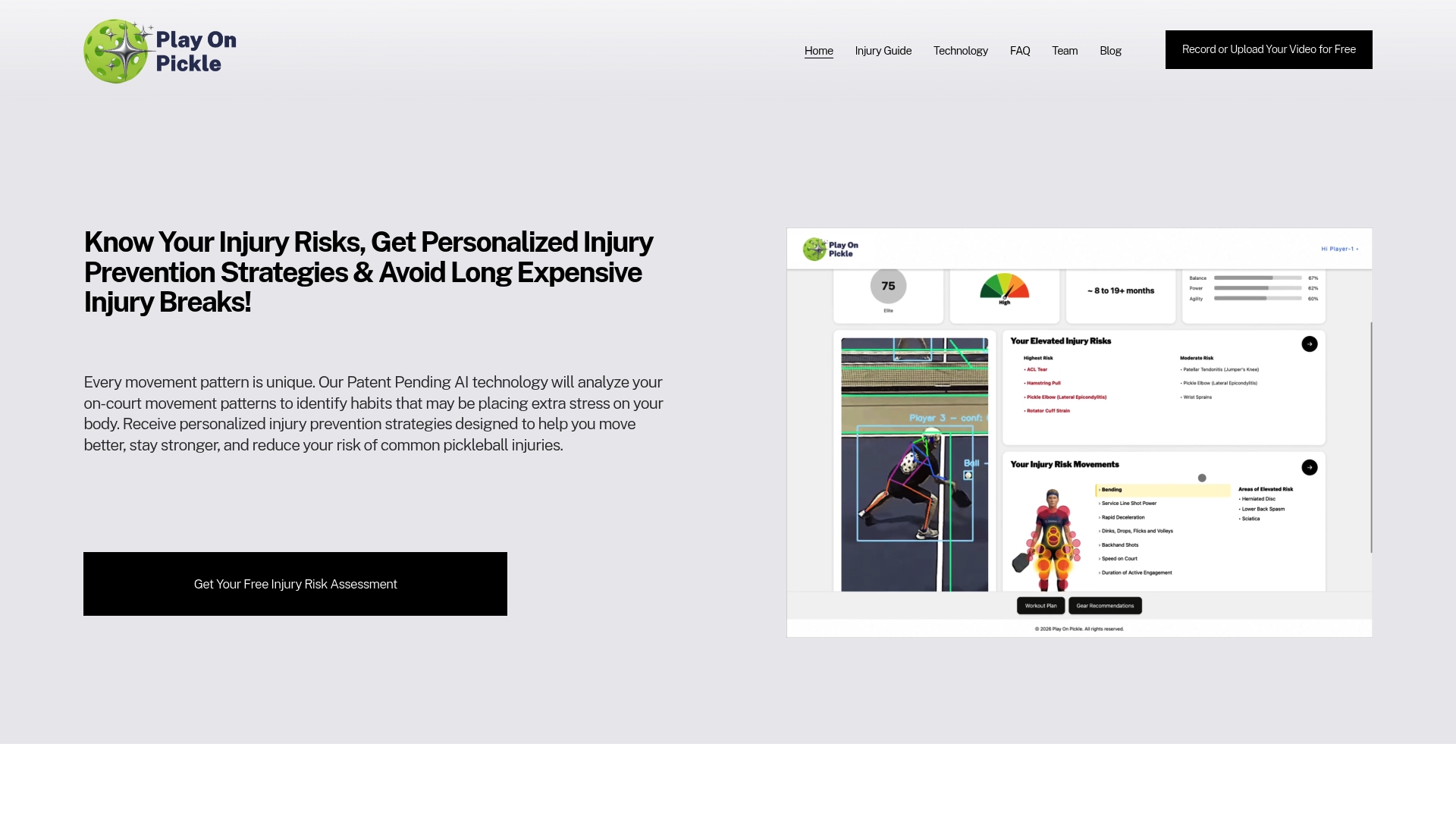
The catch is that two players doing the same RDL can have very different weak links. One drops a hip on single-leg stance, another loses the knee line when stopping. That's why we built Play On Pickle around movement analysis: you upload video of your play, our patent-pending computer vision looks for stress points in your biomechanics, and you get a plan matched to your body instead of a generic list.
Our approach is designed to make the exercises simple and quick enough to fit your routine, and our assessments are designed to be scientifically validated. Use the guidance in this article as your foundation, then let your own movement tell you which exercise deserves the most attention.
Drona
Get a plan built for your movement
If you'd rather not guess which posterior-chain exercise your body needs, Play On Pickle analyzes video of you playing and returns personalized injury-risk insights with tailored exercise and equipment recommendations. It's a subscription at $9.99 per month or $99 per year, with a free initial trial. You can also see how the technology works or claim the free tripod offer with the monthly plan so filming is easy.
For a broader overview, start with our guide to pickleball injury prevention for recreational and older players, or see how exercises can be mapped to court moves.
FAQ
What is a posterior chain exercise?
It's any movement that works the muscles on the back of your body, mainly the glutes, hamstrings, calves and spinal stabilizers. Romanian deadlifts, glute bridges and single-leg RDLs are common examples. For pickleball, hinge and single-leg versions suit the sport best.
What muscles do you use in pickleball?
The legs do much of the work: quads, glutes, hamstrings and calves, according to a physical therapist quoted by Peloton. NASM also names the hip abductors and adductors, core rotators and rotator cuff. Your posterior chain stays loaded because you hold a hinged ready position.
How often should I train my posterior chain for pickleball?
HSS suggests one to two sessions per week, starting with 3 to 6 sets of 5 to 10 reps per muscle group per week. ACE's pickleball workout is designed for two to three non-consecutive days. Begin at the low end and add volume gradually.
Is it safe to do deadlifts if I'm over 60?
Often yes, with regressions. NSCA guidance says to hold off on adding load until form is clear, and the PMC review recommends strengthening plus balance work for aging players. If you have back pain, osteoporosis or a prior fracture, ask your physician or physical therapist which version suits you.
Sources
- Journal of Strength & Conditioning Research: muscle activation during hamstring exercises
- HSS: 8 Exercises to Strengthen Your Posterior Chain
- Healthline: Posterior Chain
- NASM: Pickleball Fitness
- JOOLA USA: The Crucial Role of a Strong Posterior Chain in Pickleball
- Peloton: 10 Essential Strength Exercises for Pickleball Players
- Springer Nature: Diagnosis and Management of Common Musculoskeletal Injuries in Pickleball
- ACE: Pickleball Workout to Improve Your Game
- Pickleball.com: Top pickleball warmups
- PMC: Pickleball Injuries in the Aging Athlete
- Advanced Pain Management VA: Lower Back Training Exercises
- Balance Training for Seniors