

A good pickleball return comes down to five things done in order: set up behind the baseline, split-step as the server hits, turn and meet the ball in front of your body, send it deep with a compact swing, then stop, balance and move to the kitchen line. Do those in sequence and the serving team loses its easy third shot. Skip one, and you get a short ball, a rushed lunge or a sore shoulder. This guide walks through each piece, how to adjust to different serves, which drills build the habit, and how to protect your body while you do it.
TL;DR
- Stand about 1 to 2 feet behind the baseline against a strong serve, closer against a short or soft one, and split-step as the server makes contact.
- Let the serve bounce (the rules require it), meet the ball in front of your body, and use a smooth, compact swing rather than a big one.
- Aim deep, roughly 3 to 4 feet inside the baseline, with enough height to buy time to reach the kitchen.
- Stop to hit, then move forward. Arriving a little short of the line and balanced beats reaching it while still running.
- Warm up, wear court shoes, and avoid backpedaling on lobs. Most return injuries come from sudden stops and awkward reaching.
Table of Contents
- Why the return of serve matters more than it looks
- Step 1: Set up behind the baseline
- Step 2: Read the serve and split-step
- Step 3: Make contact in front of your body
- Step 4: Send it deep, with height
- Step 5: Stop, balance, then move forward
- Adjusting to different serves
- Drills that build a reliable return
- Protecting your body while you sharpen your return
- Common return mistakes and quick fixes
- Our perspective: your return is a movement pattern, not just a stroke
- Get your return analyzed
- FAQ
- Sources
Why the return of serve matters more than it looks
The return is the one shot in pickleball where you know exactly when the point starts and roughly where the ball is coming from. That makes it the most controllable shot you have. It is also the shot that decides who gets to the kitchen line first, and the kitchen line is where most points are won.
The structure of the game explains why. Under the two-bounce rule, the serve and the return must each bounce before either team can volley. USA Pickleball's skills guidance describes the consequence: the returning team advances to the kitchen line while the serving team stays back so the third shot can bounce. In other words, your return is your ticket forward. A weak or short return keeps you stuck at the baseline, and a deep one gives you the time to move up.
The rulebook also states the receiver's part plainly: the receiver must let the served ball bounce before returning it, per the USA Pickleball Basic Rules Summary. So you cannot volley the serve out of the air, however tempting a slow serve looks.
Step 1: Set up behind the baseline
The first mechanic happens before the serve is hit. You want enough space to let the ball come to you and a body position that lets you move in any direction.
Distance. Coaching advice published by PickleballTV's lesson with Catherine Parenteau suggests standing about 1 to 2 feet behind the baseline against a strong serve and stepping closer against a shorter or weaker one. Another guide makes the same point from the other direction: there is no magic number of feet to stand behind the baseline, and you should adjust to the depth and pace you expect. Watch the first two or three serves, then place yourself accordingly.
Side of the court. Favor your strong side. If the server tends to hit toward your backhand, shade slightly toward it so you can still take the ball with a forehand when the serve comes there.
Stance. A beginner sequence from Better Pickleball describes a ready position with feet shoulder-width apart, knees slightly bent and the paddle held in front at waist height. That paddle position matters: a paddle that starts low or behind you adds a second movement before every swing.
Step 2: Read the serve and split-step
The split step is a small, low hop that lands as the server strikes the ball. It puts your weight on both feet, loads your legs and lets you push off in whichever direction the serve goes. The 2020 ACSM clinical review of pickleball recommends learning the split step to establish a balanced ready position and to avoid wrong-footing and sudden, forceful stops, particularly near the non-volley zone.
Two timing notes from experience on the court:
- The hop is small. A bigger hop only makes you land later. We cover this in detail in our piece on split step timing in the pickleball ready position.
- Land when the server hits, not when the ball bounces. Landing late means you start moving from a standstill.
After the split step, pivot and turn sideways toward the ball. A turned body gives you a longer, smoother path to the ball and keeps your swing coming from the hips rather than the arm.
Step 3: Make contact in front of your body
This is the heart of return mechanics. Three principles do most of the work.
Wait for the bounce to rise. The Better Pickleball technique recommends letting the serve bounce and rise into a comfortable strike zone rather than lunging down at it. If you are reaching low and far in front, you were either too deep or too early.
Contact in front. Keeping the contact point in front of your body is both a performance and a safety habit. The same ACSM review advises keeping contact in front to reduce musculoskeletal stress. A ball taken beside or behind your hip forces the shoulder and elbow to compensate.
Compact swing. Use a smooth forehand or backhand with a short backswing and a lift through the ball so it clears the net comfortably. The goal is not winning the point on the return. It is giving the opponent a ball they cannot attack.
For a closer look at what comes next, once you are at the line, see our guide to volley mechanics at the kitchen line.
Step 4: Send it deep, with height
Depth is the priority. The Better Pickleball sequence suggests targeting approximately 3 to 4 feet inside the opponent's baseline. Friday Pickleball's guide to serves, returns and the fourth shot makes the same priorities explicit: minimize spin, avoid excessive pace, and use a controlled return that gives you time to advance. Their coaching view is that a deep, controlled return limits the opponent's immediate options and buys the receiver time to take the net.
Think of the return as a two-part job:
- Depth pushes the server back so the third shot is harder to attack.
- Height gives you the seconds you need to travel from the baseline to the kitchen.
A flat, hard, low return can look aggressive, but if it lands mid-court it comes back at you while you are still in no-man's land. A softer, higher, deeper ball is usually the better percentage play, especially for recreational players.
Step 5: Stop, balance, then move forward
The single most common error after a decent return is running through the shot. Coach Catherine Parenteau's guidance is to stop to hit the ball, then move forward. The PickleTip guide adds a useful standard: being a few feet short of the kitchen and balanced is better than reaching the line while your body is still running.
Here is how the sequence looks in practice:
- Hit the return from a stable, turned position.
- Take small, quick steps forward as the ball travels.
- Split-step again just before the serving team hits its third shot.
- Continue to the line only when the third shot has been struck and you are balanced.
The serving team must let the return bounce, so the third shot is almost always played from behind or near the baseline. That gives you the time, provided your return was deep enough.
Adjusting to different serves
The mechanics stay the same, but your position and target shift with what the server gives you.
| Serve you face | Setup adjustment | Return goal |
|---|---|---|
| Deep, hard serve | Stand 1 to 2 feet behind the baseline or a bit more; shorten the swing | Block or lift it back deep and high; do not try to add pace |
| Short or soft serve | Step closer to the baseline | Move in, hit in front, still aim deep |
| Spinning serve | Give yourself room; let the ball bounce and settle | Prioritize control and depth, minimize your own spin |
| Serve to your backhand | Shade toward the backhand side | Use a compact backhand with a firm wrist and the same deep target |
One practical tip for spin: do not try to out-spin the server. The coaching guidance referenced above is to keep your own return low on spin and moderate on pace. Spin from the server is absorbed by a solid, in-front contact and a controlled paddle face.
For deep serves that push you back, the instinct is to backpedal. Resist it. The National Council on Aging's injury-prevention guidance advises turning and running rather than backpedaling when the ball goes over your head, and the ACSM review also advises against backpedaling to return a lob.

Drills that build a reliable return
Return mechanics are simple to understand and surprisingly hard to repeat under pressure. These drills make them automatic.

Deep-margin return. Mark the back third of the opponent's court with cones or a towel. Your partner serves, you return, and you count only balls that land in the back third with visible height. The PickleTip guide lists this as its deep-margin drill. Aim for a fixed number of successes, such as 8 out of 10, before you move on.
Return and advance. Return the serve, then walk forward in small steps so you are balanced at the moment your partner hits the third shot. This teaches the timing between the return and the split step at the line.
Ten-ball pressure test. Play ten returns in a row and add a point for each ball that is both deep and followed by a balanced stop. It rewards the stop-then-move habit, not just the shot.
Return, volley, block. The P.E.M. Pickleball 3.5 skills and drills manual describes a sequence of five deep baseline returns, then five punch volleys while moving to the kitchen, then five block-volley returns into the opponent's non-volley zone. It is a good template for linking the return to what follows.
Serve, return, repeat. Coach Shea Underwood's practice guidance describes partners alternating serving and returning, with occasional short serves thrown in. Stay low with bent knees through contact, and the short serves keep you honest about stepping in.
Keep sessions short. Twenty focused minutes of returns, with a rest between sets, beats an hour of tired repetitions where form slips and the shoulder takes the load.
Protecting your body while you sharpen your return
The return asks for a quick start, a turn, a stretch and then a stop. That combination is where knees, hips, ankles and shoulders get stressed, particularly for players who show up and play cold.
Warm up with game-like movement. The NCOA guidance recommends 5 to 10 minutes of movements similar to the game. Our 5- and 10-minute pickleball warm-up routines give you a ready-made version.
Wear the right shoes. Court or cross-training shoes are preferred over running shoes because they provide lateral stability for rapid side-to-side movement, according to a review of pickleball injury considerations in the medical literature.
Build the legs that make the split step possible. Strong hips and quads, balanced single-leg control and a bit of lower-body power make every return easier. A guide to exercises for pickleball lays out gym movements that support court play, and our own prehab routine with three moves is designed for recreational and senior players with little time.
Train balance, especially if you are an older player. Sudden stops and quick direction changes are where falls and strains happen. A seniors' balance training guide covers safe exercises to prevent falls, and our agility drills for older players build to a 6 to 8 week progression. If you have a knee, hip or back condition, or you have fallen recently, check with a physician or physical therapist before adding new drills.
Progress gradually. The American College of Sports Medicine's youth fitness text makes a point that applies to any new movement: allow time to develop basic movement patterns before progressing to complex skills, because an impatient approach increases injury risk. Learn the stance and the stop before you add pace.
For a broader plan, see our injury prevention guide for recreational and older players. Coaches running group sessions can use our warm-up and session templates.
Common return mistakes and quick fixes
- Standing on the baseline or inside it against a hard serve. You get jammed and hit late. Step back a foot.
- Swinging big. A long backswing causes mishits and wears the shoulder. Shorten it and let the lift do the work.
- Hitting the ball beside your hip. Turn earlier and meet the ball in front.
- Running while hitting. Stop, hit, then go.
- Racing to the line. Arrive balanced and a little short instead.
- Aiming for winners. The return is a setup shot. A deep ball every time beats an occasional corner shot and three errors.
If you hit a serve as often as you return one, our article on serve sequencing shows how the same body mechanics apply from the other side.
Our perspective: your return is a movement pattern, not just a stroke
We look at pickleball through movement. When we study a return, we are less interested in whether the ball landed deep and more interested in what the body did to put it there: how the knees tracked on the split step, whether the trunk rotated or the arm did all the work, how the player decelerated after the stop. Those details show where stress piles up over hundreds of returns in a season.
Most recreational players never see this. They feel a sore shoulder or a cranky knee weeks later and blame age or bad luck. In our view, a lot of that comes from small, repeated habits: contact point too far from the body, a sudden stop on a locked leg, a hop that lands late. They are fixable once you can see them.
Our advice is simple. Pick one thing to change at a time, usually the stop-then-move habit or the in-front contact point. Film a few returns from the side, check your own mechanics against the steps above, and add two or three easy strength and balance moves to your week. Small changes, repeated, protect your game for years.
— Drona
Get your return analyzed
If you would rather not guess at your mechanics, Play On Pickle analyzes video of your movement with AI, identifies stress points in your body and gives you a personalized injury risk assessment with simple exercises and equipment recommendations. You upload a clip, and our system does the review.
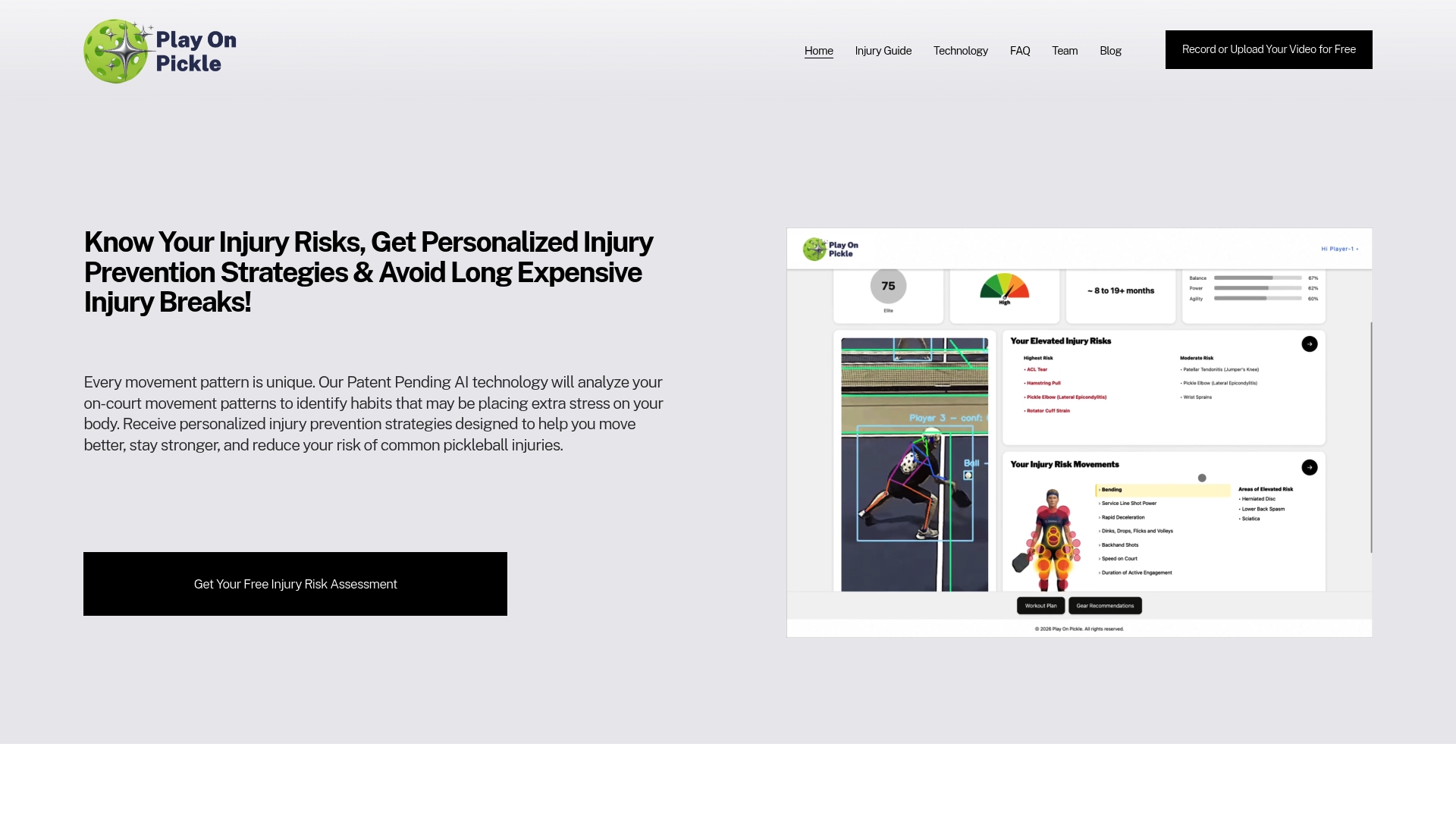
Plans are $9.99 per month or $99 per year, and you can start with a free trial on our pricing page. There is also a free tripod offer with the monthly plan, which helps you film returns from the side or behind the baseline without asking a friend to hold your phone.
FAQ
How do I return a serve in pickleball?
Stand 1 to 2 feet behind the baseline, split-step as the server hits, and let the ball bounce. Meet it in front of your body with a smooth, compact swing and send it deep. Then stop, get balanced and move toward the kitchen line.
Can you volley a serve in pickleball?
No. The receiver must let the served ball bounce before returning it, according to the USA Pickleball rules summary. The return must also bounce before the serving team can volley, which is the two-bounce rule.
Where should I aim my return of serve?
Deep is the safest target. One beginner sequence suggests landing the ball roughly 3 to 4 feet inside the opponent's baseline, with enough height to clear the net comfortably. A deep return pushes the server back and gives you time to reach the kitchen.
Should I hit the return hard or soft?
For most recreational players, controlled pace beats power. Coaching guidance favors minimizing spin, avoiding excessive pace and using a return that gives you time to move forward. Save pace for when the serve is short and you are already set.
How can I return serves without hurting myself?
Warm up for 5 to 10 minutes with game-like movement, wear court shoes and keep the contact point in front of your body. Avoid backpedaling on deep balls and sudden, forceful stops. If you have joint pain or a history of falls, talk to a physician or physical therapist first.
Sources
- Mastering the return of serve with Catherine Parenteau, PickleballTV
- The Return of Serve, Better Pickleball
- How to Return a Serve in Pickleball, PickleTip
- Pickleball Return and Run and Keeping the Ball Low, USA Pickleball
- Basic Rules Summary, USA Pickleball
- Pickleball 101: Serves, Returns, and the 4th Shot, Friday Pickleball
- Pickleball: Review and Clinical Recommendations, ACSM
- How to Prevent Injuries When Playing Pickleball, NCOA
- Pickleball: Injury Considerations in an Increasingly Popular Sport, PMC
- 3.5 Skills and Drills, P.E.M. Pickleball
- Never Miss A Return Again, Shea Underwood
- Essentials of Youth Fitness, American College of Sports Medicine
- Exercises for Pickleball: 13 Best Picks
- Balance Training for Seniors: Safe Exercises to Prevent Falls