
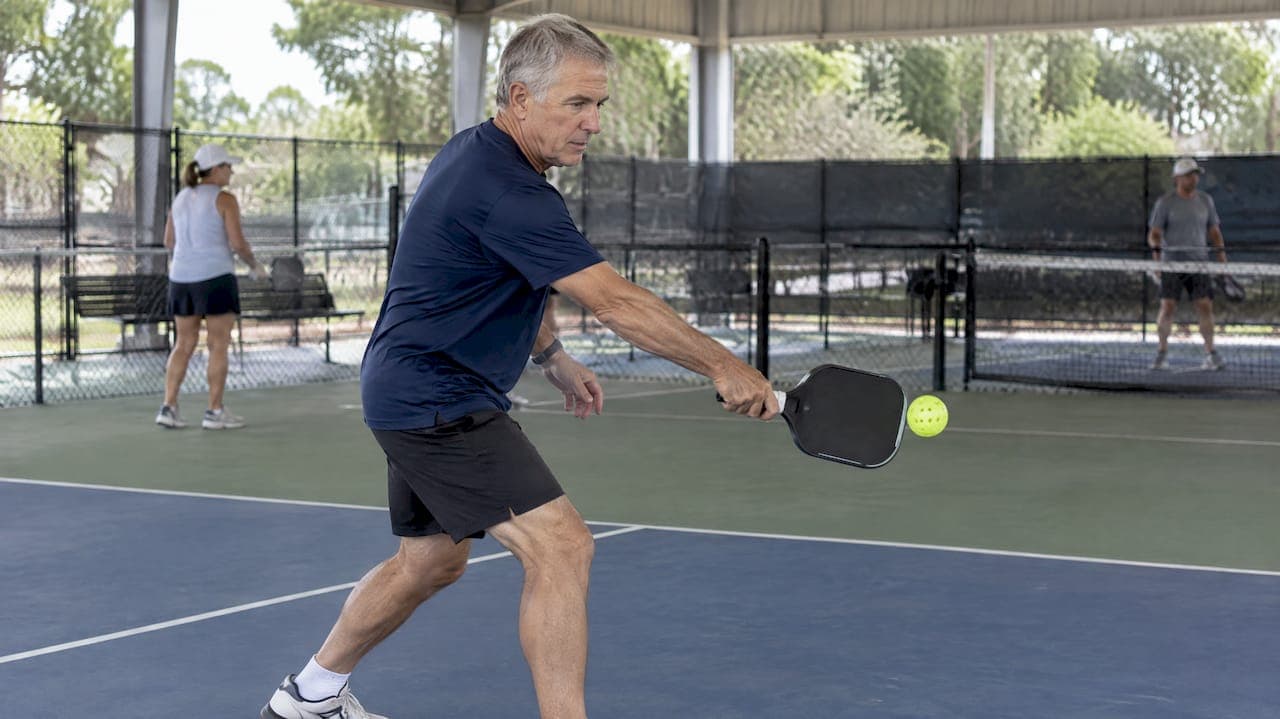
A good pickleball forehand drive comes from the ground up: a balanced stance, early hip and shoulder rotation, a compact backswing, contact slightly in front of your body at about waist height, and a low-to-high swing that keeps accelerating through the ball. The arm finishes the stroke. It should not start it. Get that order right and you gain pace, depth and topspin while taking load off your elbow, wrist and shoulder.
This guide walks through the stroke phase by phase, explains why the common errors hurt both your game and your joints, and gives you drills you can run on your own court this week.
TL;DR
- Power travels through the kinetic chain: legs, then hips, then trunk, then shoulder, then paddle. Arm-only swings cap your pace and raise overuse risk.
- Contact the ball slightly in front of your body at waist height, with a compact backswing and a low-to-high path.
- Keep the wrist stable through impact. Excessive wrist extension is a known stressor linked to chronic wrist pain.
- Forehands load the body more than most players assume, so strength work for the rotator cuff and forearm belongs in your routine.
- Filming your swing from the side and from behind shows you what feel cannot.
Table of Contents
- Why forehand mechanics matter more than you think
- The kinetic chain: where forehand power really comes from
- Forehand drive mechanics, phase by phase
- Wrist, elbow and shoulder: where bad mechanics show up
- Common forehand faults and the quick fix for each
- Drills that build better mechanics
- Why your eyes are not enough
- Our perspective: fix the pattern, not the symptom
- Older players: protect your base
- Check your forehand with Play On Pickle
- FAQ
- Sources
Why forehand mechanics matter more than you think
Many people treat pickleball as a gentle sport. The numbers say the forehand is not that gentle. A 2025 study of pickleball strokes found a mean impact acceleration of 8.4 ± 3.1 m/s² on forehands, well above the serve at 5.0 ± 2.6 m/s². Only the smash, at 11.4 ± 6.3 m/s², was higher. Your forehand is a stroke you repeat dozens or hundreds of times a session, so small mechanical flaws add up.
Injury data points the same way. A 2025 review of pickleball cases reported that 37% of upper extremity injuries involved the wrist, shoulder or elbow, with wrist problems making up half of those. It is a small case series, so treat it as a signal and not a precise rate. Still, the pattern fits what coaches and physical therapists see: the arm absorbs what the body failed to deliver.
That is the idea behind this whole guide. Better mechanics are not only about winning more points. They decide where the forces of your swing end up.

The kinetic chain: where forehand power really comes from
The kinetic chain is the sequence of movement from the ground through the legs, hips, trunk and shoulder to the paddle. Sports biomechanics research on racket strokes describes paddle or racket speed as generated mainly by rotation of the pelvis and trunk, followed by shoulder horizontal adduction and internal rotation. That review studied the tennis forehand, and the principle carries over to pickleball, though the pickleball swing is shorter and the paddle lighter.
Two practical lessons follow:
- Rotation beats reach. If your hips and trunk do not turn, your arm has to make up the speed. That is slower and harder on the joints.
- Sequence matters. The big segments go first and the small ones follow. When the arm fires before the body, you lose the energy transfer.
A 2026 preprint on amateur players used automated pose tracking to look at upper-limb mechanics. It described novices who show a rigid arm swing, constricted elbow flexion or kinematic lag, and linked those patterns to a higher risk of lateral epicondylalgia, better known as pickleball elbow. It is a preprint, so it has not completed peer review, but the patterns will look familiar to anyone who has watched a weekend rec session.
Forehand drive mechanics, phase by phase

1. Grip and paddle position
Start with a relaxed grip and the paddle up in front of you, with your knees slightly bent. Most players use a continental or eastern-style grip on the forehand. Eastern grips tend to make topspin easier because the palm sits slightly more behind the handle, while a continental grip is a comfortable all-purpose starting point that suits quick exchanges at the kitchen line. Try both and keep the one that lets you brush up the back of the ball without forcing your wrist.
Whatever you choose, hold the handle loosely until contact. A death grip tightens the forearm muscles that attach at the outside of the elbow, which is exactly where pickleball elbow shows up.
2. Stance and unit turn
As soon as you read a forehand, turn your shoulders and hips together, as one unit. Your stance affects where the ball goes. A slightly closed stance sends the ball more down the line and an open stance more cross-court, which is a common coaching point among teaching pros. Your weight loads onto the back leg, your knees stay bent, and your paddle hand stays in front of your chest.
A frequent mistake is turning only the arm back. If your chest still faces the net when the paddle is back, you have taken the body out of the stroke before it started.
3. A compact backswing
The backswing in pickleball should be short. Compact backswing, early shoulder and hip rotation, and a contact point slightly in front of the body at waist height are the hallmarks of an efficient drive. Think of taking the paddle back only as far as your back hip. A big, looping swing eats up time, and time is what you do not have at drive speed.
4. The forward swing and contact point
Uncoil from the ground. Push through your back foot, rotate the hips, then the trunk, and let the paddle arrive last. Meet the ball slightly in front of your lead hip at roughly waist height. A late contact, with the ball beside or behind your body, forces the arm to rush and the wrist to flick.
If the ball is below the net, you need to bend your knees to lower your body instead of dropping the paddle head with your wrist.
5. Swing path and topspin
A steady low-to-high path is what gives a drive its topspin and keeps it inside the court. Start the paddle below the ball and finish above your opposite shoulder or in front of your face. You are lifting the paddle face up the back of the ball as it travels forward, not chopping across it.
6. Follow-through
Keep accelerating through contact instead of stopping short. Decelerating at impact costs you pace and tends to produce a jabbing motion that jars the elbow. Let the paddle finish naturally across your body, then recover to a ready position with the paddle up.
Wrist, elbow and shoulder: where bad mechanics show up
The forehand is a chain, and the weakest link takes the stress. Here is where flawed swings tend to land.
The wrist
Motion-capture work on recreational players, presented at a 2025 research symposium, examined forehand, backhand and dink swings and looked at impact-phase wrist positions to find high-risk patterns. Its summary highlights excessive wrist extension at impact as a biomechanical stressor tied to chronic wrist pain. The fix in practice is a stable, neutral wrist through contact, with the paddle moved by body rotation and not a snap of the hand. If you already have pain, our guide to pickleball wrist pain and a safe return to play covers what to do next.
The elbow
A forehand that is all arm loads the tendons on the outside of the elbow. Physical therapists at Natural Motion Physio note that many players treat lateral epicondylitis with cortisone injections, even though injections give short-term relief and no better long-term outcomes than placebo. They point to slow, controlled eccentric strengthening, such as dumbbell wrist extensions, as first-line care. If your elbow already hurts, see a physical therapist or sports medicine physician before starting a loading program. If you are healthy and want to stay that way, see our low-equipment plan to prevent pickleball elbow.
The shoulder
The same clinic says shoulder trouble often comes from an imbalance in rotator cuff strength, and that external rotation exercises help stabilize the joint for the fast reaching motions of the sport. A shoulder that cannot hold position pushes you toward compensations like lifting the elbow or leaning back. For overhead shots, which stress the shoulder even more, read our overhead mechanics plan.
Common forehand faults and the quick fix for each
| What you see | What is usually going on | Fix to try |
|---|---|---|
| Ball sprays long or into the net | Paddle face open or closed at contact, or no consistent swing path | Shorten the backswing and feel a low-to-high brush up the back of the ball |
| Arm pain after play | Arm-dominant swing, tight grip, wrist extended at impact | Turn the hips first, relax the grip, keep the wrist stable |
| Hitting late, behind the body | Slow unit turn, or standing flat-footed | Turn as soon as you read the ball and step into it |
| Weak, floaty drives | No weight transfer, stopping at contact | Push off the back foot and keep accelerating through |
| Frames and mishits | Contact too close to the body | Make contact slightly in front of the lead hip |
Drills that build better mechanics
Keep drills simple. You are changing a pattern your nervous system already knows.
- Shadow swings in front of a mirror or window. Ten slow swings, checking that the hips turn before the paddle moves. Slow is the point.
- Catch and release. Have a partner feed you balls. Instead of hitting, catch the ball in your paddle hand at your contact point. This teaches you where in space contact should happen.
- Drop and drive. Drop the ball yourself to the forehand side, let it bounce, and hit a drive with only 70 percent effort. Focus on the sequence, not the pace.
- Wall rallies at easy speed. Short backswing, stable wrist, continuous rhythm for two minutes. If your elbow feels it, stop and check your grip pressure.
- Cross-court and down-the-line pairs. Hit five from a slightly open stance and five from a slightly closed stance, and notice how the direction changes without changing your swing.
Before sessions, spend five minutes on an easy warm-up. Our prehab routine with three moves is designed for recreational and senior players, and the broader injury prevention guide explains how to build it into your week.
Why your eyes are not enough
You cannot see your own swing while you hit, and a friend watching from the next court is guessing at speeds that happen in a fraction of a second. The researchers behind the 2026 pose-tracking preprint argue that subjective visual observation is often insufficient for spotting injury risk, and that automated analysis gives objective insight into the kinetic chain, including why amateurs fall back on arm-dominant, high-stress swing patterns.
A phone video helps. Film from two angles: from behind your hitting side to check swing path, and from the side facing your chest to check rotation and contact point. Watch at quarter speed and look at three things: do the hips turn before the paddle, is the contact in front, and does the wrist stay stable?
For a hands-on check, an in-person assessment with a clinician who uses objective movement tracking can add another layer, especially if you already feel pain.
For more on filming and reviewing swings, see our pickleball video analysis guide and the four-check movement screen.
Our perspective: fix the pattern, not the symptom
We built Play On Pickle around a simple observation: most recreational players never see their own movement, and most injury advice arrives after the pain starts. A forehand that overloads the arm usually looks fine to the player until it hurts.
Our approach is to look at the whole chain. We use computer vision on your video to find stress points in the body and turn them into a short list of exercises and equipment suggestions matched to how you move. We would rather you do three simple things consistently than follow a long generic program you abandon after a week.
Our advice on the forehand specifically: start with the sequence (legs, hips, trunk, arm), then the wrist, then strength. Do not try to change everything at once. Pick one fault from the table above, film it, fix it, and film it again.
And if you have pain that lingers, see a licensed clinician. Software can point to risk. It does not diagnose.
— Drona
Older players: protect your base
If you are an older adult, the forehand still works the same way, but the legs deserve extra attention, since that is where power and stability start. A steady base lets you rotate without lunging, and good balance helps you avoid falls, which the research on injuries identifies as a common cause of wrist fractures. In the 2025 case review, fractures, mostly distal radius fractures from falls, made up 40% of upper extremity cases. Regular balance training for seniors is one practical way to improve your footing on court. Pair it with shorter, controlled swings and you give yourself room to keep playing for years.
Check your forehand with Play On Pickle
If you would like an objective look at your own swing, you can upload a video to Play On Pickle and get an analysis of your movement, a personalized injury risk assessment and tailored exercise and equipment recommendations. Plans are $9.99 per month or $99 per year, and there is a free initial trial. You can read about the patent-pending technology behind it, and if you need a way to film yourself, there is a free tripod offer with the $9.99 monthly plan.
Coaches and facilities can also use it to screen groups. Our guides on markerless movement analysis for coaches and session templates with a short warm-up show how.
FAQ
How do you hit a forehand drive in pickleball?
Turn your hips and shoulders together as soon as you read the ball, take a short backswing, and meet the ball slightly in front of your body at about waist height. Swing low to high, rotate through the shot and keep accelerating to the finish. Keep your grip relaxed and your wrist stable.
Where does the power in a forehand drive come from?
Mostly from your legs, hips and trunk, not your arm. Research on racket strokes describes rotation of the pelvis and trunk as the main source of speed, with the shoulder adding to it. Arm-only swings limit pace and put more stress on the elbow and wrist.
Why does my elbow hurt after hitting forehands?
A tight grip, a late contact point and an arm-dominant swing are common contributors to lateral elbow pain, often called pickleball elbow. Relax your grip, start the swing with your hips and check your contact point on video. If the pain lasts more than a few days, see a physical therapist or sports medicine physician.
Should I use a continental or eastern grip on my forehand?
Both are used. A continental grip is a good all-purpose starting point, while an eastern grip often makes topspin easier on drives. Try each in a rally and keep the one that lets you brush up the ball with a stable wrist.
Sources
- Impact Accelerations Associated With Pickleball Strokes
- Analysis of Common Injury Patterns Observed in Pickleball Play
- Mechanics and Learning Practices Associated with the Tennis Forehand: A Review
- Automated Diagnosis of Upper-Limb Kinetic Chain Deficiencies in Amateur Pickleball Players
- Pickleball Injury & Swing Analysis using Motion Capture and Simulation
- How to build a reliable forehand drive in pickleball
- Natural Motion Physio