
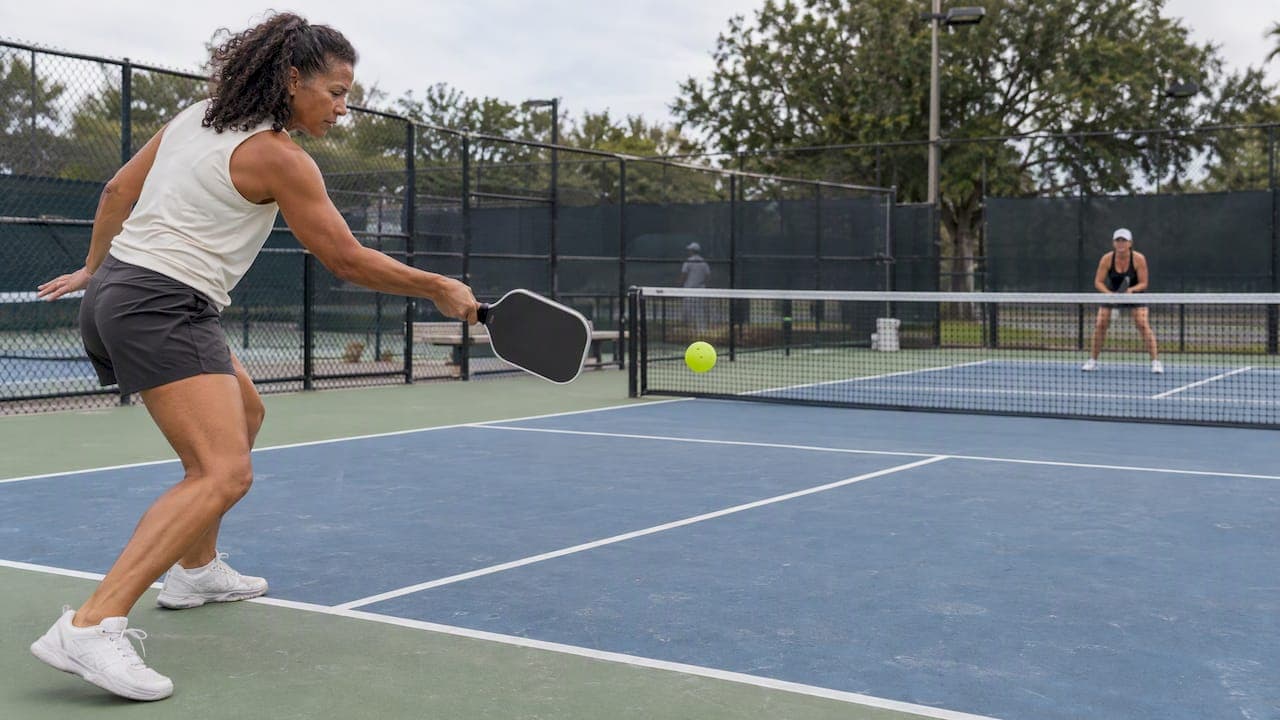
A good third shot drop comes down to five things: a semi-open stance, a soft grip, a compact paddle path that stays in front of you, contact low and out in front, and a smooth swing that finishes forward and up. Get those right and the ball arcs just over the net and lands softly in the kitchen, so your team can walk up to the line instead of getting stuck at the baseline.
This guide walks through each piece in the order it happens on the court, then covers the mistakes that make a drop attackable, drills to build it, and how to protect your shoulder, elbow, knees and Achilles while you practice thousands of repetitions.
TL;DR
- Stand semi-open, keep the paddle in front of your body, and hold the grip softly. USA Pickleball's third shot drop basics describe a grip pressure of about three on a ten-point scale.
- Let the ball bounce, contact it low as it starts to descend, and finish with a forward, slightly upward follow-through.
- Aim for a low arc over the net and a landing spot in the front part of the kitchen, not the middle or back.
- Drop low balls, drive high balls, and follow your shot in.
- Warm up, build play volume gradually, and use footwear and grip size that fit, because the drop is a high-repetition shot.
Table of Contents
- What the third shot drop is supposed to do
- Step 1: Stance and footwork
- Step 2: Grip and paddle readiness
- Step 3: Paddle path and the "brick wall" rule
- Step 4: Contact point
- Step 5: Follow-through
- Controlling height, depth and placement
- Technique variations
- Common mistakes and how to fix them
- Drills to build a consistent drop
- Protecting your body while you practice
- Our perspective on drop mechanics
- See your own drop on video
- FAQ
- Sources
What the third shot drop is supposed to do
In doubles, the serving team hits the third shot from the baseline, after the return of serve. The opponents are usually close to the kitchen line, and you are not. USA Pickleball describes the drop as a soft, controlled shot that lands in the opponent's kitchen, neutralizes their advantage and gives your team time to advance.
That purpose explains every mechanical choice below. The drop is not about hitting the ball softly for its own sake. It is about making the ball arrive at the opponent's feet, below net height, so they have to hit up. Everything you do with your feet, grip and paddle serves that.
When to drop and when to drive
The drop is not mandatory on every third shot. A simple rule from USA Pickleball's level three guidance is to drop low balls, drive high balls, and follow the shot in. If the return gives you a ball you can hit down on, driving is reasonable. If the return is deep and you are pinned behind the baseline, a drive gives opponents extra time to react, which is why the drop is the safer default from back there.
The pro game has shifted too. Coverage of a recent pro event noted that third-shot drives, mid-court power shots and speed-ups happen more often than they used to, and that the drop was once regarded as the most important shot. For most recreational players, though, the drop is still the shot that turns a defensive position into a neutral one.
Step 1: Stance and footwork
Set up early. Most bad drops start with a player still moving when the ball arrives.
Use a semi-open stance. USA Pickleball recommends it because it keeps movement compact and helps prevent an oversized backswing. Picture your feet pointing roughly between the net and the sideline, with your hips and shoulders turned only slightly toward the contact side. A fully closed stance invites a big wind-up. A fully square stance can make you arm the ball.
Split-step on the opponent's contact. A small hop as the returner hits the ball lets you push off in any direction. Then move your feet to the ball rather than reaching with your arm.
Bend at the knees, not the waist. Getting low with your legs lets the paddle meet the ball low without rounding your back. This matters for control and for your body: your legs should do the lowering work, not your lower back.
Stay balanced through contact. Weight shifts gently from back foot to front foot as you swing. If you fall backward or stand up as you hit, the ball tends to sail.

Step 2: Grip and paddle readiness
A soft grip is the quiet secret of a good drop. The same USA Pickleball page suggests a pressure of around three out of ten, which helps absorb the pace of the incoming ball and place the drop precisely. Squeeze harder and the ball springs off the paddle faster than you intended.
A practical test: hold the paddle so a friend could pull it out of your hand with a firm tug, but it would not wobble during your swing. If your forearm is tight and your knuckles are white, the drop will come out flat or long.
Grip size matters here too. A handle that is too small makes you clench to control the paddle. If you are unsure about technique or discomfort, our guide to pickleball grip technique explains why loose comes first and power comes later.
Between shots, keep the paddle up and in front, with the face slightly open, so you are ready for the next ball without a long preparation.
Step 3: Paddle path and the "brick wall" rule
The drop swing is short. USA Pickleball gives a useful image: imagine a brick wall behind your legs and keep the paddle in front of the body, so it never swings past that wall. That limit prevents a big backswing, which is the main enemy of consistency.
Think of the path in three parts:
- Short preparation. Take the paddle back only as far as your back hip or slightly behind the ball.
- Low-to-forward acceleration. Swing forward and slightly upward. Many players who pop the ball up are swinging steeply upward. Swing more forward than up.
- Finish in front. The paddle should end out in front of you, roughly pointing to where you want the ball to go.
The pace should come from a smooth shift of your body weight and a gentle swing, not from a flick of the wrist. A wrist-heavy drop is inconsistent and puts avoidable stress on the joint. If your wrist already complains, see pickleball wrist pain: causes, fixes and safe return to play.
Step 4: Contact point
Where you meet the ball decides how much work the swing has to do.
Let it bounce. The third shot almost always comes after the return has bounced, since you are deep. Pro instructor Catherine Parenteau advises hitting the ball after it has bounced once, as it starts to descend toward its second bounce. That gives you a low contact point, which is what lets you lift the ball over the net gently instead of slapping it.
Contact in front of your body. If the ball gets beside or behind your hip, you will have to push with the arm and the ball will go high. Move your feet so the ball stays in front.
Keep your eyes on the ball. One of the tips that comes up repeatedly in player discussions is to line up your dominant eye with the ball and step into the shot. It is simple advice and it works because it forces a steady head and good positioning.
Step 5: Follow-through
Parenteau points out that a common beginner mistake is not following through, which can leave the ball short of the net. The fix is to practice a forward follow-through after contact, with the paddle continuing toward the target and finishing slightly upward.
The follow-through is also the place where many players unintentionally stop their body. Stopping the swing at contact makes the ball die off the paddle. Let the swing complete, then recover your balance and move forward.
Controlling height, depth and placement
Mechanics get the ball moving. Placement decides whether it can be attacked.
Height
A high arc produces a high bounce, and a high bounce is a gift to the opponent. One coaching article on drop placement suggests aiming for an arc roughly six inches above the net tape. Treat that as a practice target rather than a rule: the idea is that the ball crosses low, peaks before the net, and drops on the other side.
To lower your arc, swing more forward than upward, soften your grip, and check that you are not standing up as you hit.
Depth
The same article recommends landing the ball in the front third of the kitchen, closest to the net, so the opponent has to let it bounce and hit up. A ball that lands deep in the kitchen, or at the feet of a player standing on the line, is easier to attack with a volley or a drive.

A simple practice trick is to place a cone or a spot about two feet from the net inside the kitchen and count only the drops that land short of it. When you return to the full kitchen, the target feels huge.
Direction
Cross-court drops cross the net at its lowest point and use more court, so they are a safe starting choice. Straight-ahead drops are shorter in distance but give the opponent a quicker look. Choose cross-court until your drop is reliable, then add variety.
Quick reference
| Variable | What you want | Common fix |
|---|---|---|
| Stance | Semi-open, balanced | Move your feet earlier |
| Grip | Soft, about 3 out of 10 | Relax your forearm |
| Paddle path | In front of body, short backswing | Imagine the brick wall |
| Contact | After the bounce, low and in front | Let the ball descend |
| Arc | Low over the net | Swing forward, not up |
| Landing | Front part of the kitchen | Use a cone target |
| Finish | Forward, slightly upward | Do not stop the swing |
Technique variations
Once the basic drop works, players add variations such as a topspin drop for more margin, a slice drop that floats, or a shovel-style motion that stays compact. They can be useful, but they are refinements. A reliable lift-and-push drop with good stance and grip will carry most recreational players a long way, and trying a new spin before the foundation is stable usually makes the drop less consistent.
Common mistakes and how to fix them
The ball pops up and sits in the middle of the court. You are probably swinging upward or standing up at contact. Bend your knees, swing forward, and let the follow-through carry the ball.
The ball hits the net. The swing is stopping at contact or the paddle face is closed. Finish forward, and lift slightly through the ball.
The ball lands deep in the kitchen or beyond. Your swing is too big or your grip is too tight. Shorten the backswing and soften the hand.
You walk forward too early. If you hit a drop that you feel is high, do not advance yet. Stop, reset, and be ready to defend, then move up once the ball has crossed and the opponent's reply is clear.
Your drop works in practice and breaks in games. Pressure shortens the swing in the wrong places: the grip tightens and the feet stop. Rehearse with a rhythm, such as a deep breath before the serve return, and keep your preparation routine identical every time.
Drills to build a consistent drop
Start simple and add pressure gradually.
- Toss and place. Parenteau suggests tossing the ball from the baseline into the kitchen first, to get a feel for the arc and landing. Do 20 tosses on each side.
- Partner feed. Have a partner stand at the kitchen line and feed balls to you at the baseline, bouncing once. Hit drops forehand and backhand, 20 on each side.
- Target drill. Place a cone or marker near the net inside the kitchen. Score a point only when your drop lands short of it.
- Drop and walk. After each drop, take a split-step and move forward in two or three controlled steps. The drop is only half the shot; the transition is the other half.
- Live points. Play games where the serving team must hit a drop on the third shot. Keep score and track how many land in the target zone.
Ten minutes of focused drops two or three times a week generally beats an hour of unfocused hitting, and it is easier on the body.
Protecting your body while you practice
The drop is a low, repeated movement. That adds up. Deep knee bends, quick transitions, and thousands of swings can irritate the Achilles, knees, elbow and shoulder if you ramp up too fast.
A few practical habits, backed by general player guidance:
- Footwear and grip. A national player guide lists court-specific shoes, correctly sized paddle grips, dynamic stretching before play and gradual increases in play volume as ways to reduce injury risk.
- Dynamic warm-up. Pickleball Fire has reported advice from fitness expert Brad Walker to do dynamic stretching, such as arm and leg swings, before play, and static stretching afterward. See the September 2021 issue of Pickleball Fire. Our own 5 to 10 minute warm up is a good template.
- Limit volume after a layoff. In the same magazine, CJ Johnson suggests limiting play to two games, or three if you are in really good shape, when coming back from time off. Our four-stage return to pickleball lays out a longer progression.
- Work on balance. A drop depends on a stable base. Older players in particular may want to build balance training for seniors into their weekly routine so the split-step and forward transition feel secure.
- Pain is information. If elbow, wrist or Achilles pain keeps returning, stop pushing through it and see a physician or physical therapist. Our guides to preventing pickleball elbow and general injury prevention for recreational and older players cover the basics, and a three-move prehab routine is a low-effort place to start.
Our perspective on drop mechanics
We look at the third shot drop through a body-first lens. Most advice on the drop focuses on where the ball lands. That matters, but how you get into position often decides both the quality of the shot and what your body pays for it.
Players who fight the drop usually share the same patterns: they arrive late, so they reach; they stand up at contact, so the ball floats; and they compensate with the wrist or elbow, so the joint takes the load that the legs and hips should have taken. These are movement patterns, and they are visible on video long before they become pain.
That is why we built Play On Pickle around video. A short clip of your drops, filmed from the side or behind, can show whether your knees, hips and trunk are doing the work, and where stress is concentrating. Then the fix can be a simple exercise or an equipment change rather than a guess. We would rather a recreational player spend two minutes on a targeted single-leg or shoulder exercise than quit the game for six weeks.
The drop is a skill you will practice for years. Build it in a way your body can sustain.
— Drona
See your own drop on video
If you want an objective look at your stance, knee bend and swing, Play On Pickle uses computer vision to analyze video you upload, identifies biomechanical stress points, and returns personalized exercise and equipment recommendations. You can read how it works on our technology page. Plans are $9.99 per month or $99 per year, and there is a free initial trial; details are on the pricing page. There is also a free tripod offer tied to the monthly plan, so you can film from a stable angle.
FAQ
Why hit a third shot drop in pickleball?
Because you are usually at the baseline while the opponents are near the kitchen. A drop lands softly in their kitchen, slows the rally, and gives your team time to move forward. Driving from deep in the backcourt gives opponents more time to react and set up an attack.
How do you hit a third shot drop?
Use a semi-open stance, a soft grip and a short swing that stays in front of your body. Let the ball bounce, contact it low as it starts to descend, and follow through forward and slightly upward. Aim for a low arc and a landing spot near the net.
What is the hardest shot to hit in pickleball?
Many coaches would say the third shot drop, because it asks for soft touch, accurate placement and good footwork from far behind the baseline. A national player guide describes it as the skill that separates 3.0 players from 3.5 players, though that is one view among several.
Should I always drop on the third shot?
No. Drop low balls and drive high balls, then follow your shot in. If the return is high and you can attack it safely, driving is a legitimate choice. If you are deep and pinned back, the drop is usually safer.
How often should I practice the drop?
Short, frequent sessions work well, such as 10 to 15 minutes two or three times a week. Build volume gradually and warm up first so repeated low movements do not overload your knees, Achilles or elbow.
Sources
- Basics of the Third Shot Drop, USA Pickleball
- Pickleball Skill Level Three, USA Pickleball
- Master the Third Drop Shot With Catherine Parenteau
- Four takeaways from the Walgreens Open at the Las Vegas Strip
- Pickleball Player Guide: Every Level from Beginner to Pro
- Pickleball Fire, September 2021
- Third Shot Drop Placement: The Only Landing Spot That Works