
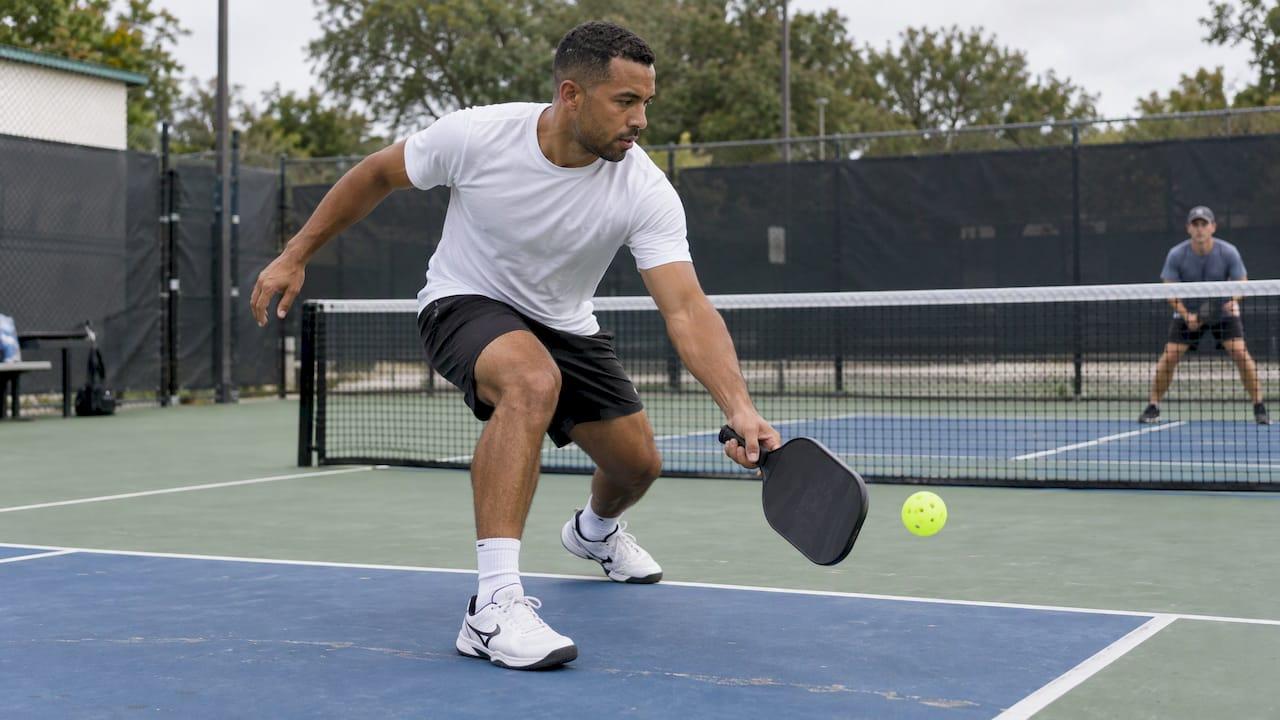
Most pickleball players train to get to the ball faster. The bigger job is stopping once you get there. Deceleration training teaches your legs, hips and trunk to absorb your body weight and halt your momentum under control, so the kitchen line, a sudden lunge or a lob that sends you backward does not land on a knee, ankle or Achilles tendon. At Play On Pickle we analyze how you actually move from video, so you can see where your own stops need work instead of guessing.
TL;DR
- Pickleball's deceleration demand is rated high in a 2026 biomechanics comparison, because players change direction constantly between the baseline and the kitchen.
- Good stopping means brake first, then push: a split step, small braking steps, bent knees and a balanced base.
- Build in order: bilateral strength, single-leg control, eccentric loading, braking drills, then reactive change of direction.
- Players over 50 should progress more slowly. A 10-week program combining strength, balance and agility reduced falls among older players.
- Video analysis of your own movement shows which stops stress which joints.
Table of Contents
- Why stopping matters more than sprinting in pickleball
- What good deceleration looks like on court
- Deceleration and change of direction are one skill
- A deceleration progression you can follow
- Adapting deceleration work for older and recreational players
- Seeing your own stops
- Try it on your own game
- FAQ
- Sources
Why stopping matters more than sprinting in pickleball
Pickleball is a short-distance game with constant starts and stops. A June 2026 comparative review rated its deceleration demand as high, above badminton (moderate to high) and table tennis (moderate), with frequent direction changes over short distances. Players often make a quick burst toward the non-volley zone (the kitchen) and then stop abruptly to avoid stepping in.
The same review, drawing on earlier work by Harper and colleagues, argues that deceleration is its own physical quality. High-intensity braking may load the musculoskeletal system more than accelerating does, so preparation should emphasize reactive movement control and repeated direction changes, not just sprint speed.
The injury picture fits. A 2026 systematic review of lower-extremity injuries found sprains, strains and fractures were the most common, with falls the leading mechanism, followed by running or lunging forward. It also noted that the seven-foot kitchen zone forces reaching, lunging and sudden halting, and recommends coaching recreational players on lunging mechanics and controlled footwork in and out of the zone.
A nationwide study of 1,758 players describes how the sport's running, jumping and sudden changes of direction subject the body to axial and torsional stress. A 2022 professional review adds that pickleball demands highly eccentric lower-body ability to stop short of the kitchen, and that sudden direction changes can cause inversion ankle sprains, while forceful pivoting or jumping can tear the Achilles tendon.
The most common injury sites, which are the shoulder, knee, Achilles and lower back, point to preparation gaps rather than a dangerous sport. That is good news: preparation is something you can change.
What good deceleration looks like on court
Deceleration is the ability to absorb your body weight and stop your momentum safely. When your shoe grips the court, energy travels up through the ankle, knee and hip, and your muscles act as shock absorbers to spread it out. When those muscles are underprepared, the joints take the impact instead, as this explanation of the stop puts it.
A few mechanics show up again and again in the sources:
- A split step before the opponent hits. USA Pickleball describes the split step as a small hop timed to the opponent's contact. It stops forward momentum during transitions with a wide, balanced base, and it acts as a quick reset for the body. The ACSM's clinical review says it keeps the feet stable and weight balanced, lowering the risk of wrong-footing, ankle sprains and falls. We cover the drills in our guide to split step drills for pickleball.
- More, smaller braking steps. Spreading your stop over several short steps reduces the force per step. One biomechanics chapter also describes forefoot-first contact with slightly bent knees so the calf and arch share the load.
- Weight on the inside of a turn. Keeping your center of gravity inside the turn lets friction with the court do the work of turning you.
- No heel backpedaling. The ACSM clinical review advises older players to avoid backpedaling on the heels to chase lobs, and to turn and move sideways or learn to fall and roll rather than catch themselves with an outstretched hand.
How hard are the forces?
Sports scientist Damian Harper reports that ground reaction forces in the first or second step of a maximal deceleration reach almost six times body mass, well above maximal sprinting or maximal acceleration, according to his analysis of multi-directional sports. Those figures come from athletes at full intensity, not casual doubles, but they show why braking deserves its own training time. A 2025 review on assessing deceleration links high-intensity decelerations to ACL rupture and calf and hamstring strains in multi-directional sports. Treat that as a reason for care in pickleball, not a pickleball statistic.
Deceleration and change of direction are one skill
You cannot push off well in a new direction until you have shed the old momentum. That is the logic behind the progression many coaches use: brake, push, read, play. The Pickleball Wise agility guide cites NSCA change-of-direction guidance that you must reduce force before you can produce it effectively, which is why drills begin with stopping rather than speed.
The research on pickleball players supports it. In a 2024 study of 92 recreational players, 42% reported a fall while playing and 30% had fallen more than once. Fallers were older and slower on a pickleball-specific T-test, in which every turn requires stopping momentum in one direction and quickly accelerating in the other.
So if your change of direction feels slow or clumsy, the fix is often at the front end, in the stop.
A deceleration progression you can follow
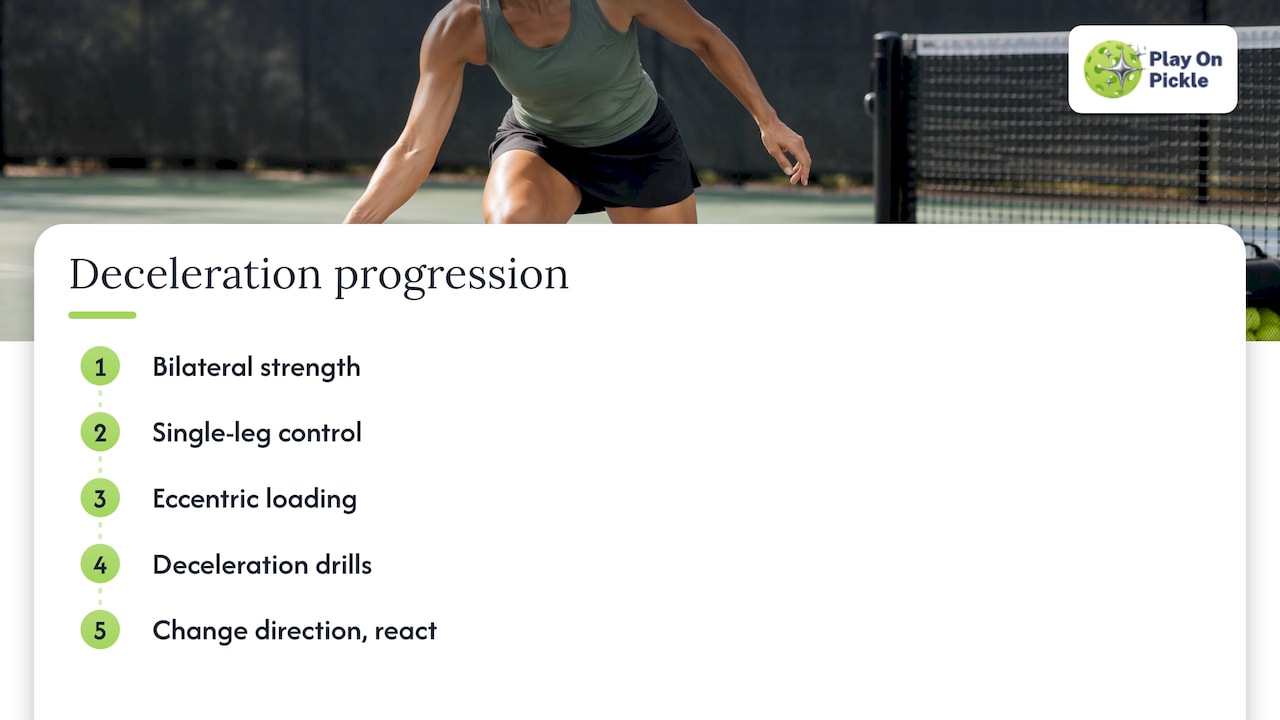
The order matters more than any single exercise. NASM's guidance for pickleball builds deceleration capacity before speed and agility work: bilateral strength, then single-leg control, then eccentric loading, then deceleration drills, and finally change-of-direction and reactive movement. An eccentric exercise is one where the muscle lengthens under load, like lowering slowly into a squat.
Stage 1: Two-legged strength and slow lowering
Squats and lunges mimic pickleball's stop-and-start nature, according to a 2025 Springer review of musculoskeletal injuries. A coach-written progression starts with bilateral squats lowered over three to eight seconds before anything faster, as this deceleration article describes. Use a controlled lowering phase, a pause, then stand.
Stage 2: Single-leg control
Pickleball stops usually happen on one leg, at the kitchen line or mid-lunge. Move to split squats, step-downs and single-leg work. If you are new to the hip hinge on one leg, this walkthrough of single-leg Romanian deadlift form covers the movement with a dumbbell. For the hamstrings in particular, see our eccentric hamstring progression for pickleball.
Stage 3: Eccentric loading and landing
Add slower, heavier lowering: eccentric step-downs, Bulgarian split squats and landing mechanics practice, all recommended by NASM for pickleball knees. The aim is to feel the ground, control your body and land with intent, developing the front-to-back and side-to-side planes first and rotation later through combination movements, as TeamBuildr's coaching article lays out. A general overview of strength training for athletes explains why force that you can absorb carries over to force you can use in sport.
Cue a "stick": land, hold still for a beat, and check that your knee tracks over your foot.
Stage 4: Braking drills, then reactive play
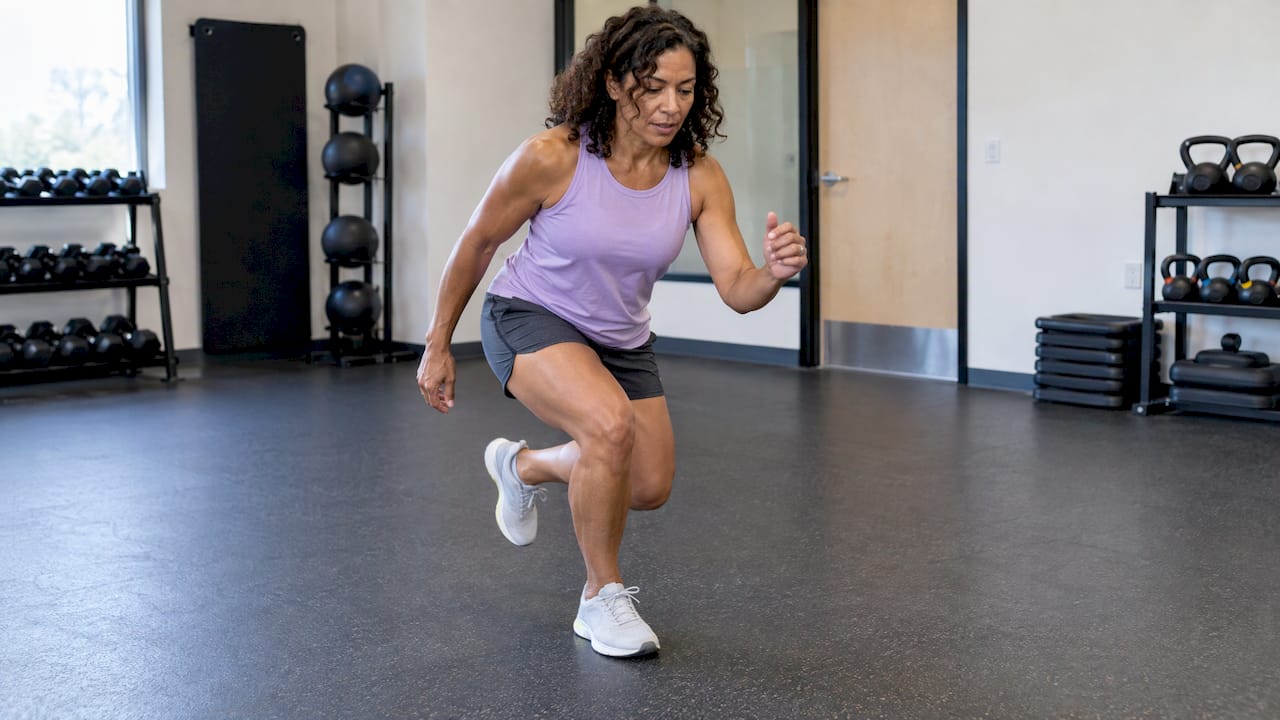
Once you can land and hold, move to lateral bounds, shuffles with a stop, side-step lunges and band walks. Then add a partner's signal so you have to decide which way to go, which trains decision speed. Finish by adding a ball and shot choice. Our guide to plyometrics for pickleball covers the jumping drills that belong at this stage.
| Stage | Focus | Example | Move on when |
|---|---|---|---|
| 1 | Two-leg strength | Slow-tempo squat | Smooth, pain-free, even weight on both feet |
| 2 | Single-leg control | Split squat, single-leg hinge | Hips and knee stay steady for the whole set |
| 3 | Eccentric and landing | Step-down, stick landing | You land quietly and hold the position |
| 4 | Braking and reaction | Lateral bound, partner-cued stop | You stop in balance on either side |
Ankle stiffness and joint awareness feed into every stage, so pair this with ankle mobility work and proprioception drills.
Adapting deceleration work for older and recreational players
Age changes the demands. A critical review of injuries in aging pickleball players links age-related declines in muscle mass and force production, and reduced flexibility as muscles tire during eccentric work, to greater injury susceptibility when planting and stopping. A 2025 cohort study found that over half of players aged 55 and older reported falling during play.
That same study tested a fix. A 10-week program of strength, balance, change-of-direction and agility work reduced fear of falling, improved change-of-direction time by 0.7 seconds, and left 25% of the training group falling at the five-month follow-up versus 44% of controls.
The session structure is a useful template:
- A 5 to 10 minute dynamic warm-up with pickleball-like squatting and lunging.
- About five minutes of fast-feet, power and balance drills.
- About 20 minutes of change-of-direction and agility work, building from 5 to 15 minutes over the 10 weeks.
- About 20 minutes of progressive strength in five stations, 20 seconds on and 20 seconds off.
Go slowly with jumping. The Springer review notes that older adults may find plyometrics and abrupt direction changes challenging, and potentially injurious if done improperly or too soon. If you have a joint, heart or balance condition, or have had a recent injury, check with your doctor or physical therapist before starting a new training block. For a gentler on-ramp, use our agility drills for older players, the 8-week balance plan, or the three-move prehab routine. Players over 50 with Achilles soreness can start with our guide to Achilles pain from pickleball.
Court surface matters too: the lower-extremity review recommends footwear guidance and inspecting the court surface as part of prevention. Our single-leg plan for court surface injuries goes further.
Seeing your own stops
Generic programs assume everyone brakes the same way. They do not. One player collapses the knee inward on the left side, another lands stiff on the heel, another never stops before the kitchen line. Which exercise you need first depends on what your stops look like.
That is where video helps. A short clip filmed from the baseline or the side shows how deep you sit, which foot takes the load, and whether you recover in balance. Coaches, facilities and physiotherapists can use the same approach to compare players against each other and track change over a season.
Our view at Play On Pickle
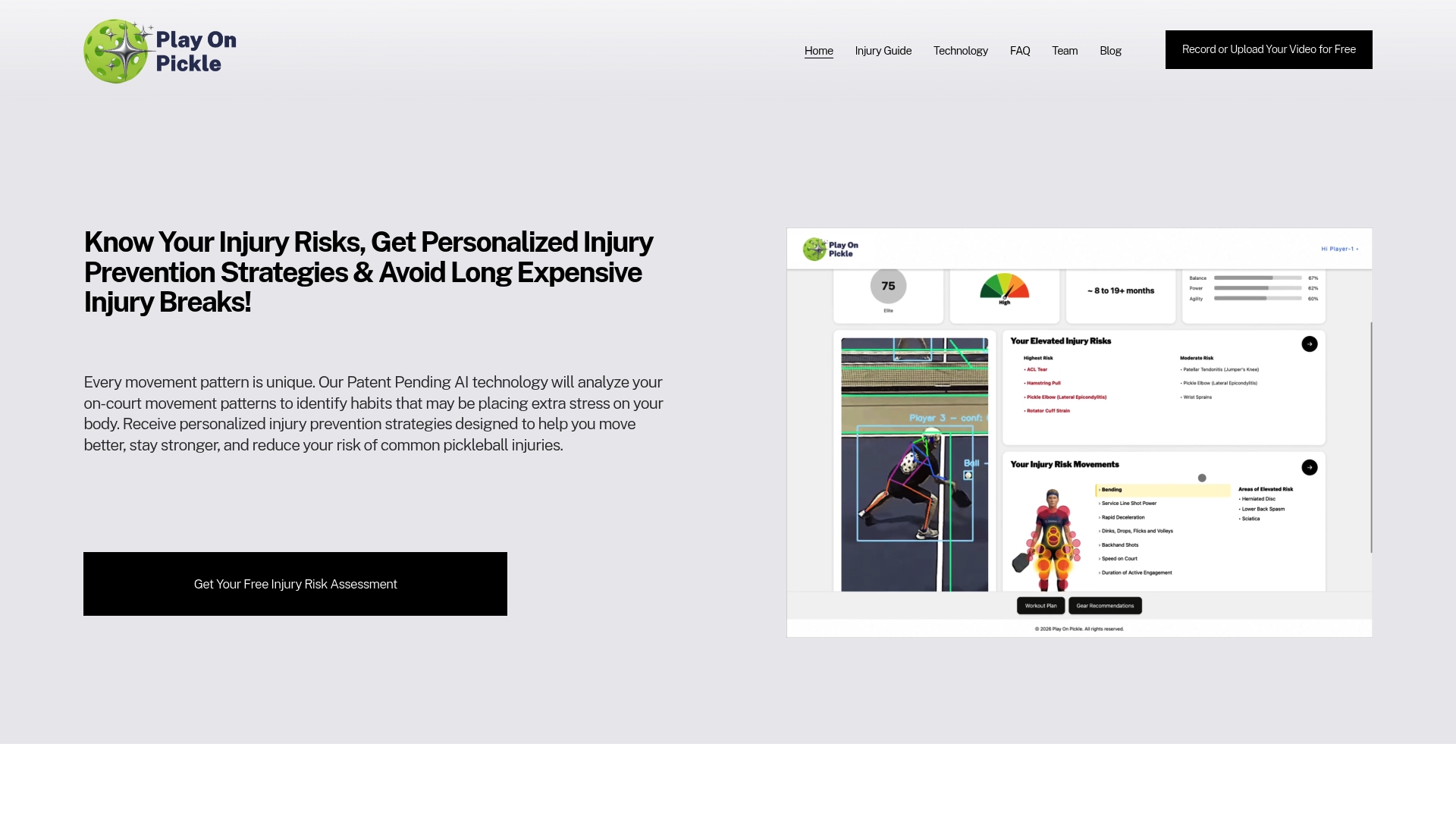
We built Play On Pickle around a simple idea: injuries in pickleball come from how your particular body handles pickleball's movements, so the plan should start with your movement, not a template. Our patent-pending computer vision looks at video you upload, identifies biomechanical stress points, and turns them into an injury risk assessment and a short list of exercises and equipment recommendations.
Deceleration is the clearest example. Everyone is told to "stop better", yet the stop that stresses your Achilles differs from the one that stresses your knee. We design our recommendations to be simple enough to fit into a normal week, because recreational players who skip conditioning are the ones who most need it, and a plan that takes minimal equipment and time is one that gets done.
Our goal is that you keep playing, whatever your age or level.
Drona
Try it on your own game
Play On Pickle gives you AI movement analysis from your own video, with personalized exercise and equipment recommendations, and it starts with a free trial. The monthly plan is $9.99 per month, and the annual plan is $99 per year. Right now there is also a free tripod offer with the monthly plan, which makes it easy to film your stops from a steady angle.
If you coach or run a facility, the same analysis can show where your players need the most work before it turns into an injury.
FAQ
How often should I do deceleration training for pickleball?
The older-adult study that cut falls used one supervised hour per week for 10 weeks, combining strength, balance and agility. Many recreational players fit shorter sessions two or three times a week around play. Start with the slow, controlled stages and add intensity only when your landings are quiet and balanced.
What is the best first drill?
A slow-tempo bodyweight squat, lowered over three to eight seconds, followed by a split step practiced without a ball. Both teach you to absorb force with bent knees and a balanced base before you add speed. Move to single-leg work once those feel easy.
Is deceleration the same as agility?
No. Agility includes reading the play, stopping and re-accelerating. Deceleration is the stopping part, and it comes first: you reduce force before producing it in a new direction. That is why agility progressions start with braking drills.
Can older players do plyometrics?
Sometimes, but later in the progression. Sports medicine reviewers caution that abrupt direction changes and jumping can be risky for older adults if done improperly or too soon. Build strength, balance and landing control first, and talk to your doctor or physical therapist if you have joint or balance concerns.
Sources
- Comparative analysis of movement patterns and lower-limb demands (GJSES, 2026)
- Lower Extremity Injuries in Adult Pickleball Players: A Systematic Review (2026)
- Understanding Injury Patterns and Predictors in Pickleball (2025)
- Exploring Training Strategies to Optimize Court Performance in Older Pickleball Athletes (2022)
- Pickleball Fitness: Training the World's Fastest-Growing Sport (NASM)
- Train the Stop: Deceleration Skills for Pickleball
- How to Master the Split Step for Faster Reactions (USA Pickleball)
- Pickleball: Review and Clinical Recommendations (ACSM, 2020)
- Chapter 21 The Science Behind Pickleball
- Deceleration: The Most Mechanically Demanding Task in Multi-Directional Sports
- Assessing Deceleration Performance: Methodological and Practical Considerations (2025)
- Pickleball Agility Training: Move Faster, Stay Balanced
- Hip Strength, Change of Direction, and Falls in Pickleball Players (2024)
- Diagnosis and Management of Common Musculoskeletal Injuries in Pickleball (Springer, 2025)
- The Role of Deceleration Training in Max Velocity
- Deceleration Training: Building Better Brakes (TeamBuildr)
- Pickleball Injuries in the Aging Athlete: A Critical Review (2024)
- Effect of a Multi-Faceted Training Program on Falls in Older Pickleball Players (2025)
- Strength Training for Athletes: Build Force That Carries Into Your Sport
- Single-Leg Romanian Deadlift With a Dumbbell: Form and Sets