
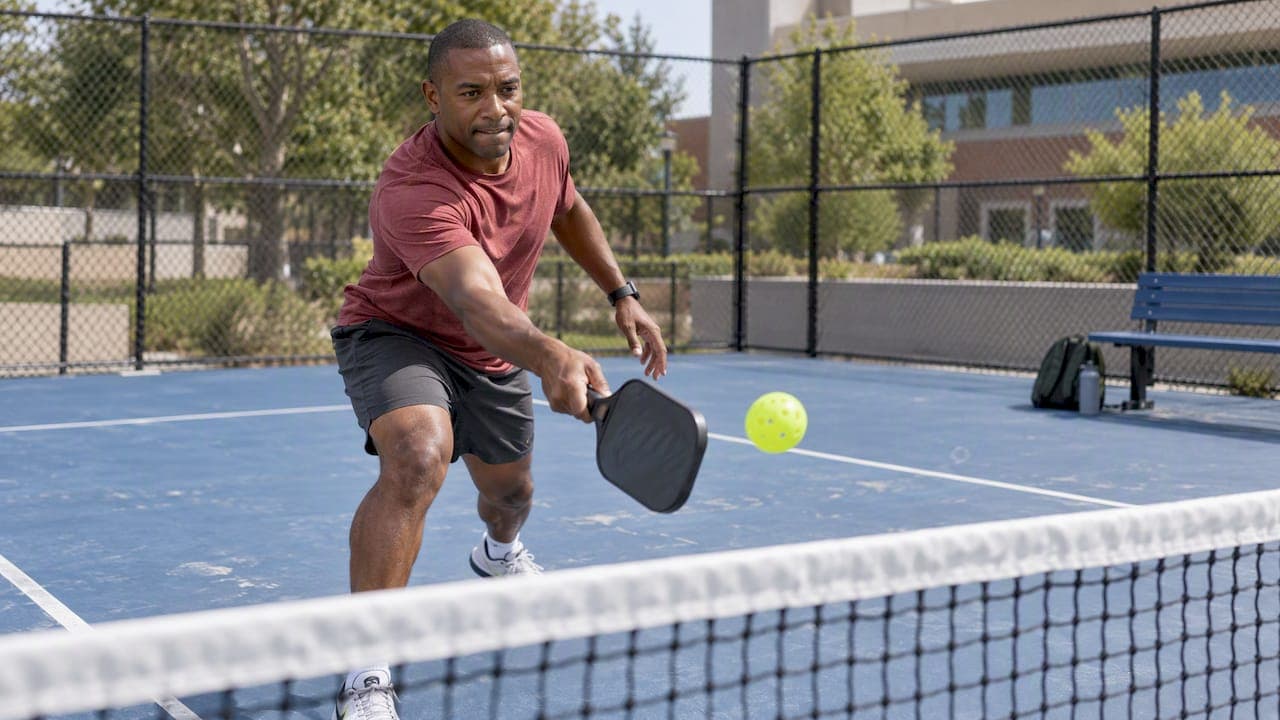
A forehand topspin comes from a low-to-high swing that brushes up the back of the ball while the paddle face stays slightly closed. The forward spin pulls the ball down after it clears the net, so you can aim higher and still keep it in. Getting there takes a relaxed grip, an early turn, a compact swing and a few weeks of the right drills. It also takes a body that can repeat the motion without breaking down, which is the part most guides skip.
TL;DR
- Topspin is a low-to-high brush up the back of the ball, with the paddle face slightly closed at contact. It is not a slap.
- Keep the grip loose and the backswing short. Gripping hard and swinging big are the two most common ways to lose spin and control.
- Learn it slowly with drop-feeds and cross-court targets, then add speed once the contact feels the same every time.
- Spin-heavy forehands load the shoulder, elbow and wrist. Build conditioning and rest into your practice from the start.
- Use topspin when you have time and an advantage, not on every ball.
Table of Contents
- What topspin does for your forehand
- The grip: loose first, then a little more spin
- Step-by-step: how to hit a forehand topspin
- Common forehand topspin mistakes and fixes
- Drills that build a consistent topspin forehand
- Practicing topspin without hurting yourself
- Our perspective: spin is a movement problem, not a wrist problem
- Get a second set of eyes on your swing
- FAQ
- Sources
What topspin does for your forehand
Topspin is forward rotation: the top of the ball rolls toward your opponent. That rotation creates a downward force, so the ball dips sooner than a flat shot would. In practice, you can clear the net by a comfortable margin and still land the ball inside the baseline. A TopspinPro guide describes the same effect and lists serves, drives, drops, dinks, lobs and passing shots as places to use it.
Three practical benefits matter for most players:
- A bigger margin for error. A flat drive has to skim the net. A topspin drive can pass a foot or more above it and still come down.
- A harder ball to read. NC State's pickleball course materials treat spin as a way to be more competitive, since it makes returns harder for opponents to judge.
- More ways to vary the game. With topspin you can change pace, depth and trajectory without changing your swing much, which makes you less predictable.
When to use it and when not to
Topspin is a tool for rallies where you hold the advantage. Good moments include a ball sitting up at waist height, an opponent pulled wide or caught at the baseline, and a fast exchange where you want to drive the ball at feet. It is also the shot that makes a passing ball dip below a volleyer's paddle.
It is a poor choice when you are stretched, jammed or hitting off your back foot. In those moments a simple, high-percentage block or a soft reset beats a spin attempt that sails long or hits the tape.

The grip: loose first, then a little more spin
Grip advice varies by source, and that is fine. Players commonly talk about three forehand grips: Continental, Eastern and Western. In general, a Continental grip favors power and a lower contact point, while grips rotated further toward Eastern and Western make it easier to brush up the ball and add spin. NC State's materials note that a Western grip produces a lot of forehand topspin. Another popular recommendation is a semi-Western grip.
For most recreational players, the practical answer is simple. Pick the grip that lets your paddle face meet the ball slightly closed without forcing your wrist into an awkward angle. Then hold it loosely. A grip that is too tight cuts paddle head speed, reduces feel and spin, and loads the forearm. Our guide to loose-first pickleball grip technique walks through grip pressure in detail.
Handle size matters too. A handle that is too small makes you squeeze to stay in control, and one that is too big limits wrist action. If your forearm is sore after spin-heavy sessions, check how to find the right paddle grip size.
Step-by-step: how to hit a forehand topspin

This sequence draws on the pickleball.com forehand drive guide, which stresses compact mechanics, early shoulder and hip rotation, and upward acceleration through contact, and on The Dink's forehand breakdown.
1. Ready position and early turn
Stand balanced with your knees slightly bent and the paddle out in front of your body. As soon as you see the ball is coming to your forehand side, turn your shoulders and hips together. Pickleball exchanges are fast, so a late turn is the main reason players end up arm-swinging.
2. Short backswing, paddle below the ball
Take the paddle back only as far as your hip turn takes it, and let the head drop below the height where you plan to hit the ball. This gap between paddle and ball is what creates the low-to-high path. A huge backswing adds no useful spin in a game this quick, and it makes recovery harder.
3. Stance and weight transfer
An open or semi-open stance, with your chest partly facing the net, works well and lets your hips rotate freely, as NC State's materials describe. If you have time, load your weight onto the back leg, then move it forward through the shot. Many players skip that transfer and end up hitting with the arm alone.
4. Contact in front, brush up the back of the ball
Meet the ball out in front of your body, in the middle of the paddle face. Brush upward and forward on the back of the ball with the face slightly closed. Think "brush, not slap": you are sculpting the ball, not smashing it.
5. Accelerate through, finish high
The Dink Media Team makes a useful point: paddle speed through the ball matters more than any single technical detail for spin rate, and the key is accelerating through the ball rather than at it. Keep the paddle speeding up after contact and finish high, often with the paddle up over the opposite shoulder. Stopping at contact kills both spin and depth.
Common forehand topspin mistakes and fixes
| Mistake | What happens | Fix |
|---|---|---|
| Gripping too tight | Slower paddle head, less feel, more forearm strain | Hold the handle lightly and tighten only at contact |
| Huge backswing | Late contact, poor timing, slow recovery | Shorten the backswing to match your hip turn |
| Hitting flat, paddle face square | Ball sails or hits the net with little dip | Start below the ball and brush up with a slightly closed face |
| Contact beside or behind your body | Pushed shots, arm-only swing, shoulder strain | Meet the ball out in front of your front hip |
| Arm-only swing | Weak ball, tired shoulder | Turn shoulders and hips early and let them lead |
| Decelerating at contact | Short, soft ball with little spin | Swing through the ball and finish high |
| Over-swinging on every ball | Errors, tired arm, tweaks | Save topspin for balls where you hold the advantage |
A thread on a pickleball discussion forum makes a point worth remembering: as long as your paddle is not flat or at 90 degrees at contact, you already get some topspin. You do not need a dramatic wrist flick. Most of the spin comes from path and speed, so work on those first.
Drills that build a consistent topspin forehand
Start slow. The pickleball.com guide recommends drop-feed drives to learn correct body position before adding speed. Practice wall drills, cross-court targets and consistency drills are other common ways to build forehand control.
Drill 1: Drop-feed brush (10 minutes)
Have a partner drop the ball (or drop it yourself) and hit at about 50% effort. Focus only on starting the paddle below the ball and brushing up. Do 20 reps, rest, then do 20 more. The target is a ball that clears the net by a few feet and lands deep without drama.
Drill 2: Cross-court target (10 to 15 minutes)
Place a towel or cone in the deep cross-court corner. Rally with a partner and try to land topspin forehands near the target. Count how many of 10 land in. When you reach 7, add pace.
Drill 3: Wall rhythm
Stand a few paces from a solid wall and hit forehands at a comfortable pace. This builds repetition and a feel for contact point. Keep the swing smooth, because a wall punishes rushed, arm-only hitting.
Drill 4: Topspin dink to topspin drive
Start with gentle topspin forehand dinks to feel the brushing motion at low speed, then extend the same path into a drive. If dinks are a weak spot, our dinking mechanics guide and the dinking posture drills cover the basics.
Putting it into a plan
Two or three short topspin sessions a week beat one long one. If you want a structure that sequences technique, conditioning and match play, see the 90-day pickleball training plan.
Practicing topspin without hurting yourself
Topspin asks a lot of the body: trunk and hip rotation, a fast upward arm path, and a stable shoulder. Repeated at volume, that adds up. UT Health Austin notes that upper-extremity injuries are the most common in pickleball, particularly in the shoulder, elbow and wrist, and that tennis elbow comes from repetitive wrist and elbow motions, often triggered by gripping the paddle or hitting the ball. The same source lists shoulder impingement, rotator cuff tendonitis and biceps tendonitis among common overuse problems.
That matters for topspin because the bad habits above, a tight grip, an arm-only swing and contact behind the body, are exactly the ones that put load on those joints. Practical steps:
- Warm up the way you play. Do a few minutes of easy movement and gentle torso and shoulder rotations before you start hitting full topspin.
- Ramp the volume. When you start a new swing, do short blocks of 15 to 20 balls with rest between them rather than 200 in a row.
- Let the legs and trunk do the work. If your arm feels like the engine, shorten the swing and rotate earlier.
- Condition between sessions. Rotational strength, shoulder stability and leg power make a repeatable swing easier. Our pickleball conditioning guide and exercises mapped to court moves are good starting points, and twice-weekly cross-training covers tendon care.
- Do not play through pain. Pain on the outside of the elbow, a pinching feeling in the shoulder or pain that lingers after play is a reason to see a sports medicine physician or physical therapist, not to switch to a new drill.
Our perspective: spin is a movement problem, not a wrist problem
Most topspin advice talks about the paddle. We think the more useful question is how the whole body moves around it. When we look at recreational players' swings, the same pattern shows up: a tight grip, a late turn, and an arm doing work that the hips and trunk should share. That pattern costs spin and control, and it is also the pattern that stresses the shoulder and elbow over time.
That is why we built Play On Pickle around movement analysis. You upload video, our patent-pending computer vision identifies stress points in your biomechanics, and you get a personalized injury risk assessment with simple exercises and equipment recommendations. You can read more about the approach on our technology page.
Our advice for any player learning topspin: film a few forehands from the side and from behind, check where the paddle starts relative to the ball, and watch whether your shoulders turn before the arm moves. Fix the sequence first, add spin second and add speed last. Spin you can repeat without pain is worth more than spin you can only produce once in a while.
— Drona
Get a second set of eyes on your swing
If you want feedback on your forehand mechanics and on where your body is under strain, Play On Pickle analyzes your uploaded video and returns personalized exercises. Plans are $9.99 per month or $99 per year, as published on our pricing page, and there is a free initial trial. We also run a free tripod offer with the monthly plan, which helps with steady filming from the side.
FAQ
Should you use topspin in pickleball?
Yes, in the right moments. Topspin gives you a larger margin over the net and makes the ball dip, so it suits drives, serves, lobs and some dinks. Skip it when you are stretched or off balance, since a simple controlled shot is safer then.
How do you hit topspin on a forehand?
Start the paddle below the ball, then brush up and forward on the back of it with the face slightly closed. Turn your shoulders and hips early, contact the ball in front of you and keep accelerating through to a high finish. Keep the grip light so the paddle can move freely.
Which grip is best for forehand topspin?
Grips rotated toward Eastern, semi-Western or Western make it easier to brush up the ball, while Continental favors power and a lower contact point. The best choice is the one that lets you meet the ball with a slightly closed face without straining your wrist. Whatever you choose, hold it loosely.
What is the hardest shot to hit in pickleball?
There is no official ranking, and players disagree. Fast, low-contact shots such as the topspin forehand drive from deep in the court are hard because they require timing, spin control and balance at once. That is a good reason to learn them slowly with drop-feeds before adding pace.
Can topspin cause tennis elbow or shoulder pain?
Repetitive paddle gripping and arm-heavy swings can contribute to overuse problems such as tennis elbow and rotator cuff tendonitis, according to UT Health Austin. Lighter grip pressure, body-driven swings and gradual volume help. If pain persists, see a sports medicine physician or physical therapist.
Sources
- Common Pickleball Injuries and How to Prevent Them (UT Health Austin)
- Pickleball Grips & Hitting Techniques (NC State)
- How to build a reliable forehand drive in pickleball (pickleball.com)
- How to Hit a Forehand in Pickleball: Grip & Swing (The Dink)
- The Pickleball Topspin Forehand: A Complete Guide (TopspinPro)